From Bucharest to Istanbul or Antalya with Pegasus Airlines
62 €



For most tourists, the best option is to combine city buses and Uber.
Buses are very cheap and run very well throughout the Hotel Zone, whilst Uber is handy in the evening, when travelling with luggage, or when heading off the main Boulevard Kukulcán.
Hiring a car doesn’t make much sense for everyday journeys around Cancún. You’ll mainly use it for trips outside the city, such as to Playa Blanca.
| Where or when you’re going | Best transport option | Approximate price |
|---|---|---|
| Around the Hotel Zone | Buses R1, R2 or R10 | 12 mxn |
| Zona Hotelera, city centre and ADO terminal | Bus R1 or Uber | 12 mxn / from 110 mxn |
| Short journeys around the city centre | Uber | 70 mxn up to 100 mxn |
| In the evening, with luggage or for 3 to 4 people | Uber | 100 mxn up to 250 mxn |
| You need to leave immediately | Taxi | from 200 mxn |
| Costa Mujeres | Uber, taxi or transfer | depending on distance or by arrangement |
| Isla Blanca | Car or pre-arranged taxi | as agreed |
| Cancún Airport | ADO or Uber/taxi | see transport from the airport |
If you’re staying in the Zona Hotelera, buses R1, R2 and R10 are usually sufficient during the day. In the evening, when travelling in a larger group or outside the hotel zone, Uber is more convenient.
Your choice of transport also depends on where you’re staying. You can easily get to the hotel on Boulevard Kukulcán by bus; from Cancún city centre, you’ll tend to use Uber more often; and from the resorts in Costa Mujeres, you’ll mainly use hotel transfers or Uber.
Compare hotels in Cancún on Booking.com
Uber in Cancún usually operates day and night. It’s no problem to book a car 24/7 in both the hotel zone and the city centre.
We used Uber in Cancún on several occasions and had a very good experience. The drivers arrived reliably, although we sometimes had to wait a little longer (but never more than 10 minutes).
Paying by card via the app worked without any issues; nobody asked us for cash, nor did anyone refuse a journey for no reason.
The price is displayed before you book and depends on current demand.
We travelled at the following prices:
Get a Mexican eSIM – Airalo.com
At some resorts, clubs and hotel locations, Uber drivers are not allowed to stop directly in front of the main entrance.
In such cases, the app may direct you to the hotel gate, a public road or a nearby shopping centre.
Keep your payment method set to your card in the app. If the driver asks you to cancel the booking and pay outside the app, I wouldn’t agree to that.
Sometimes, regular taxis also appear on the Uber app. In that case, however, the driver will often ask for cash and the final fare is likely to be higher.
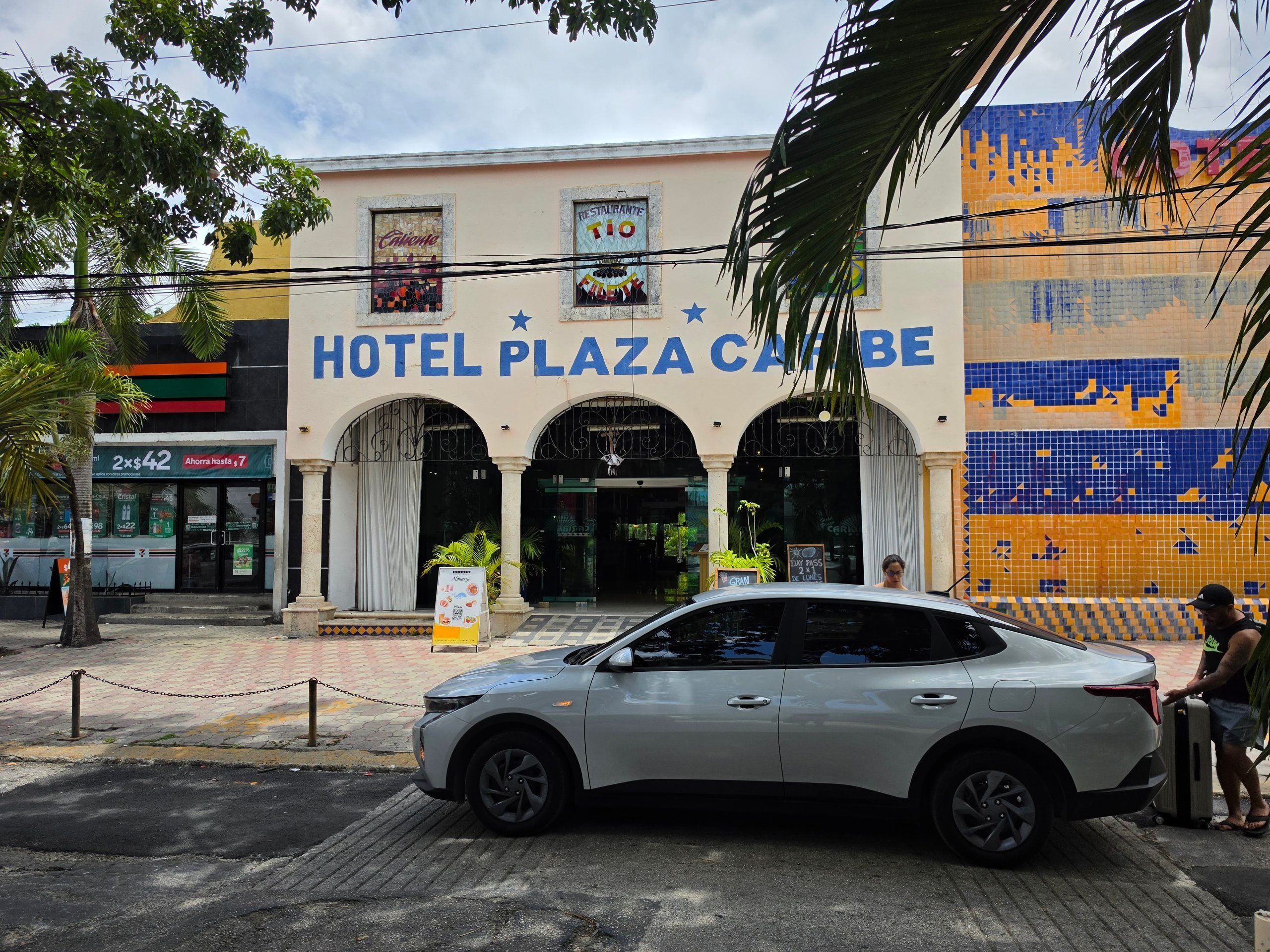
Personally, I would only book standard rides such as UberX, UberXL and similar via Uber.
You can also use the following as a backup:
For the average tourist, Uber is the simplest option. DiDi is useful as a backup app, whilst inDrive is mainly suited to travellers who already know how the bidding system works.
We therefore cover journeys from the airport separately in the section on transport from Cancún Airport.
In short:
Taxis are practically everywhere in Cancún. You’ll find them outside hotels, shopping centres, beaches, restaurants and nightclubs.
Ordinary taxis do not use a meter. Fares are determined by zone, but in practice, tourists are often simply quoted a price by the driver.
Since 2026, a limited roll-out of digital taximeters has been under trial, but it is certainly not yet the case that every taxi will have one (for the time being, only a very small number do).
Always agree on the fare before getting in and explicitly confirm that this is the total fare in Mexican pesos.
As a rough guide, expect to pay 150 mxn for a short journey within the Zona Hotelera and approximately 250 mxn between the city centre and the nearer part of the hotel zone.
The first quote you receive outside an expensive resort or nightclub may be significantly higher. If you don’t like the price, refuse it and approach another driver.
You should expect to pay in cash. Some taxis allow card payments, but the terminal may not be working and the exchange rate when paying in dollars is often unfavourable.
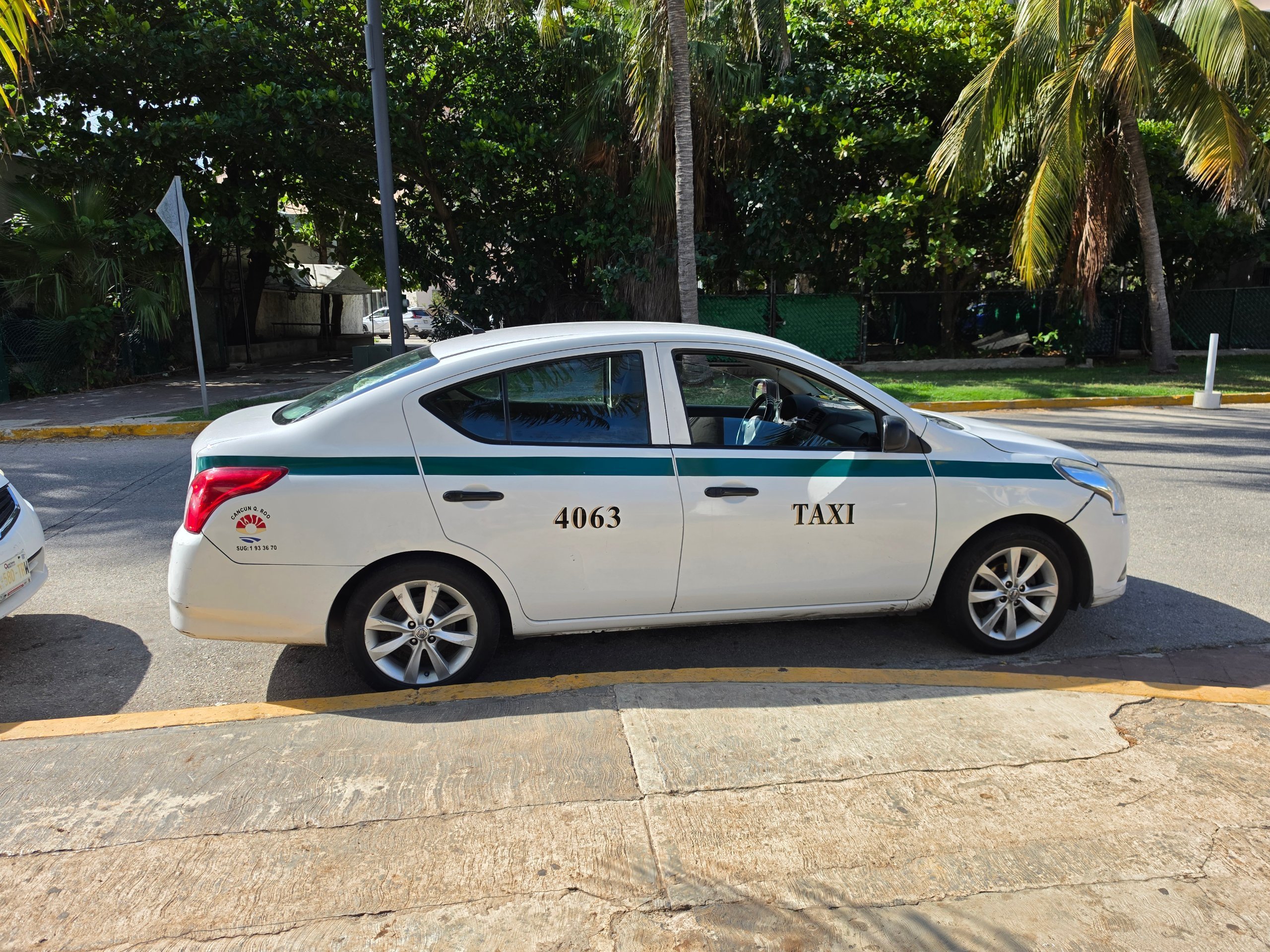
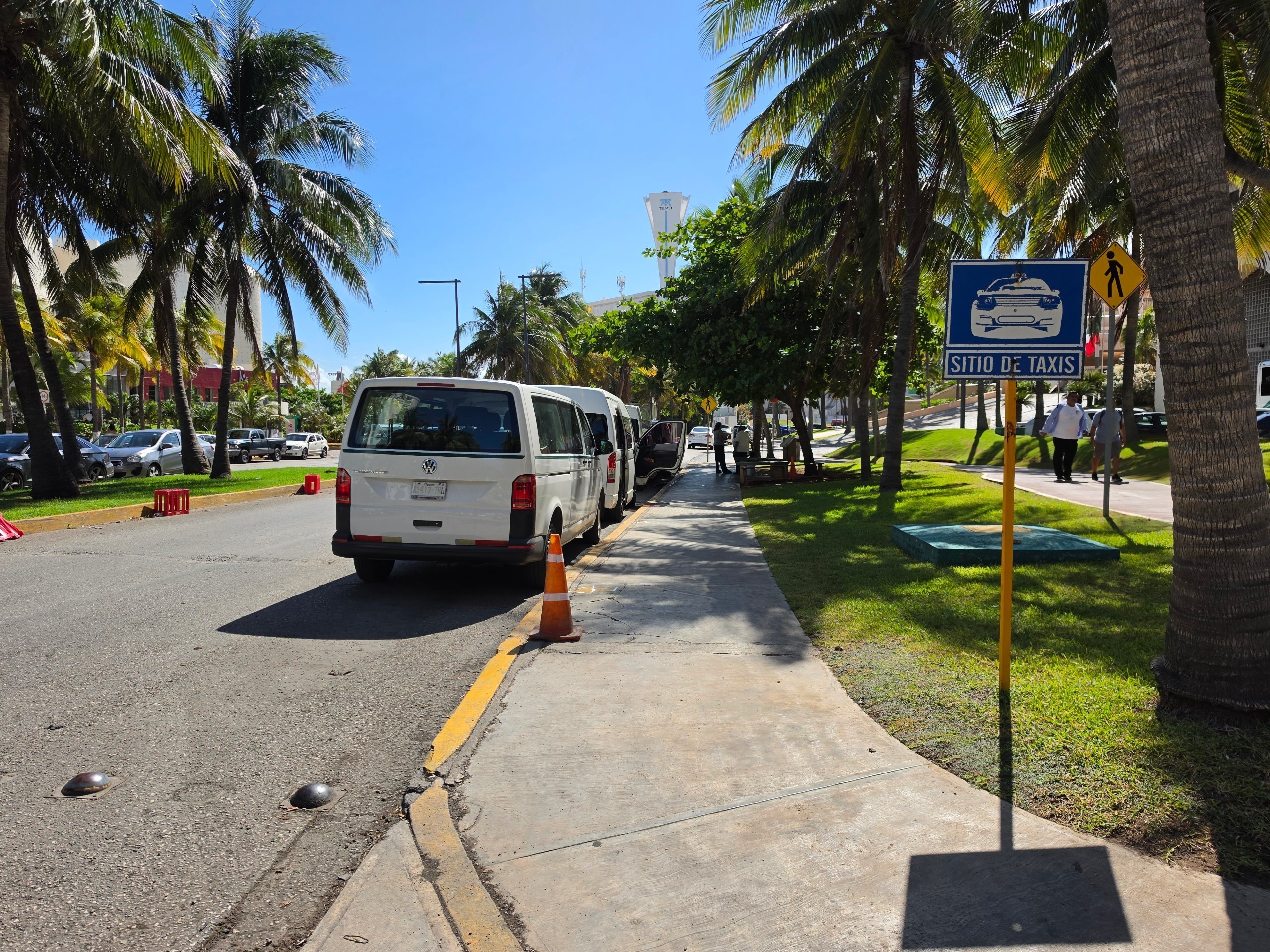
Yes, the main advantage is immediate availability. You can often get in straight away outside a hotel or shopping centre without having to wait, whereas an Uber driver may be some distance away or may only pick you up outside the hotel’s designated pick-up point.
A taxi makes sense particularly:
In most other situations, we prefer Uber. You can see the price in advance, there’s no need to haggle, you can pay by card, and the app keeps a record of the driver, the car and the route.
| Uber | Taxi | |
|---|---|---|
| Price before the journey | Yes, in the app | You need to arrange it |
| Card payment | No problem via the app | Preferably cash |
| Waiting | 5–15 minutes | Often no waiting |
| Collection in front of the resort | Sometimes at the gate or on the road | Usually right by the entrance |
| Record of route and driver | Yes | No |
| Negotiation | Not necessary | Often yes |
| Best use | Most journeys around town | When you need to set off straight away |
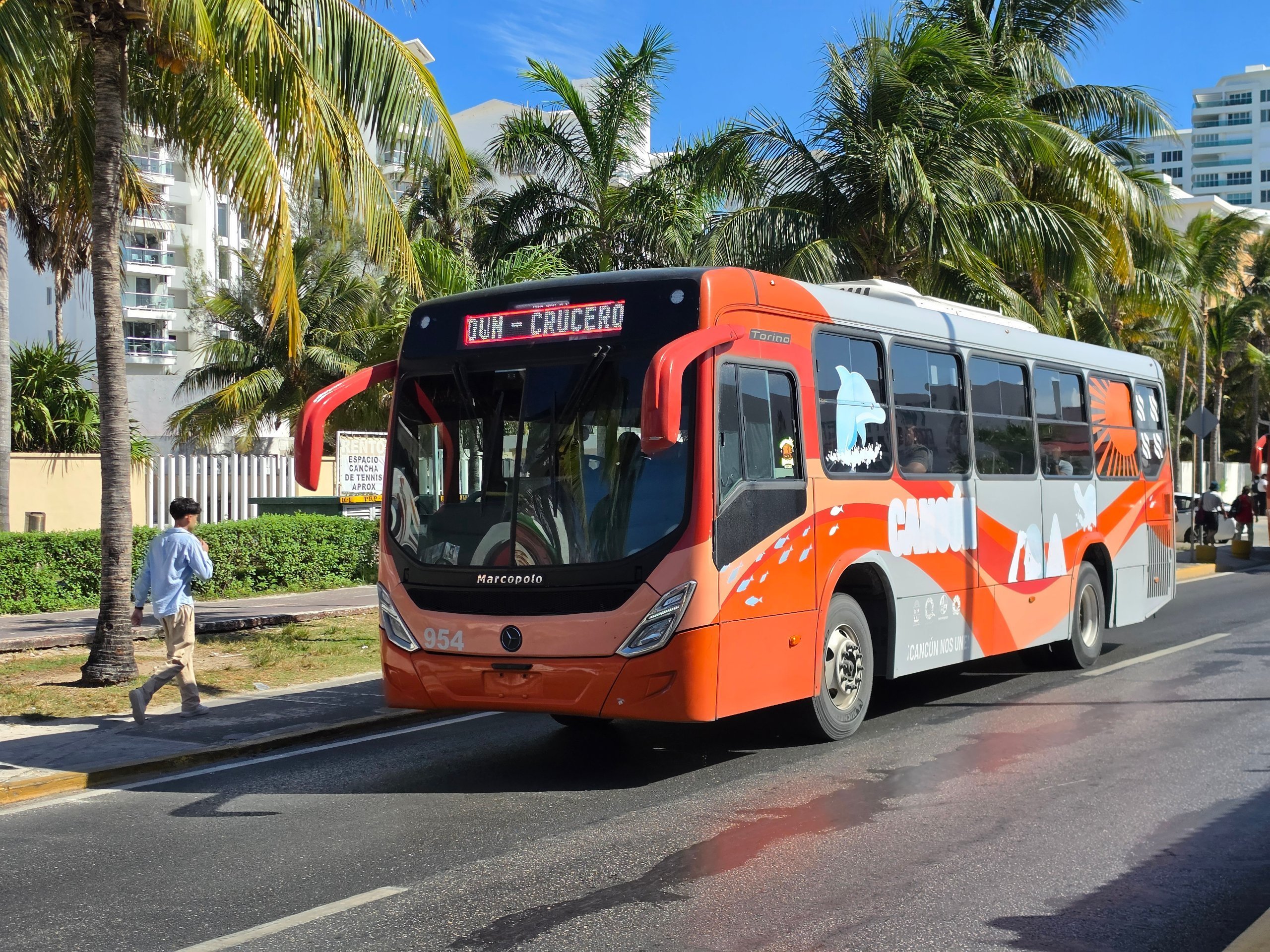
City buses are the cheapest way to get around Cancún. The R1, R2 and R10 routes are particularly important for tourists, as they run through the entire hotel zone along Boulevard Kukulcán.
The current fares are:
The most up-to-date prices are provided byTuricún, one of several transport operators.
💬 Do you have any more recent experience with fare prices? Please let us know in the comments below the article.
Fares are paid in cash to the driver when boarding via the front door. There are not usually any conductors on the buses.
Payment cards and tourist season tickets are not accepted on regular routes.
Make sure you have coins or small notes ready. The driver can usually give change up to 20 mxn, but do not rely on receiving change for 200 or 500 mxn notes.
A new fare is payable when changing buses.
| Route | Route and service |
|---|---|
| R1 | Zona Hotelera, Avenida Tulum, ADO terminal and El Crucero |
| R2 | Zona Hotelera, Avenida Kabah and Mercado 28 |
| R10 | Hotel Zone and Puerto Juárez, from where ferries depart for Isla Mujeres |
| R27 | Hotel Zone, Plaza Las Américas and Avenida Tulum (some services run via the new Puente Nichupté) |
R1 is the most convenient route for travelling between the hotel zone, Cancún city centre and the ADO coach station.
You can use the R2, for example, when travelling to Mercado 28 or the area around Avenida Kabah.
The buses have several different terminus stops.
Always check the sign behind the windscreen before boarding. If you’re travelling to Puerto Juárez, only board a bus marked ‘Puerto Juárez’. Not every R10 bus goes all the way there.
New buses, stops and electronic payment are being introduced gradually, so I wouldn’t rely on this route as the main means of tourist travel just yet. Continue to pay in cash on the traditional R1 and R2 routes.
Routes along Boulevard Kukulcán stop within walking distance of most public beaches and tourist attractions. You can easily reach the following places by bus, for example:
When travelling between the beaches in the Zona Hotelera, it doesn’t matter whether you take the R1, R2 or R10. Both routes follow the same main road. The difference only becomes significant once you head towards the centre.
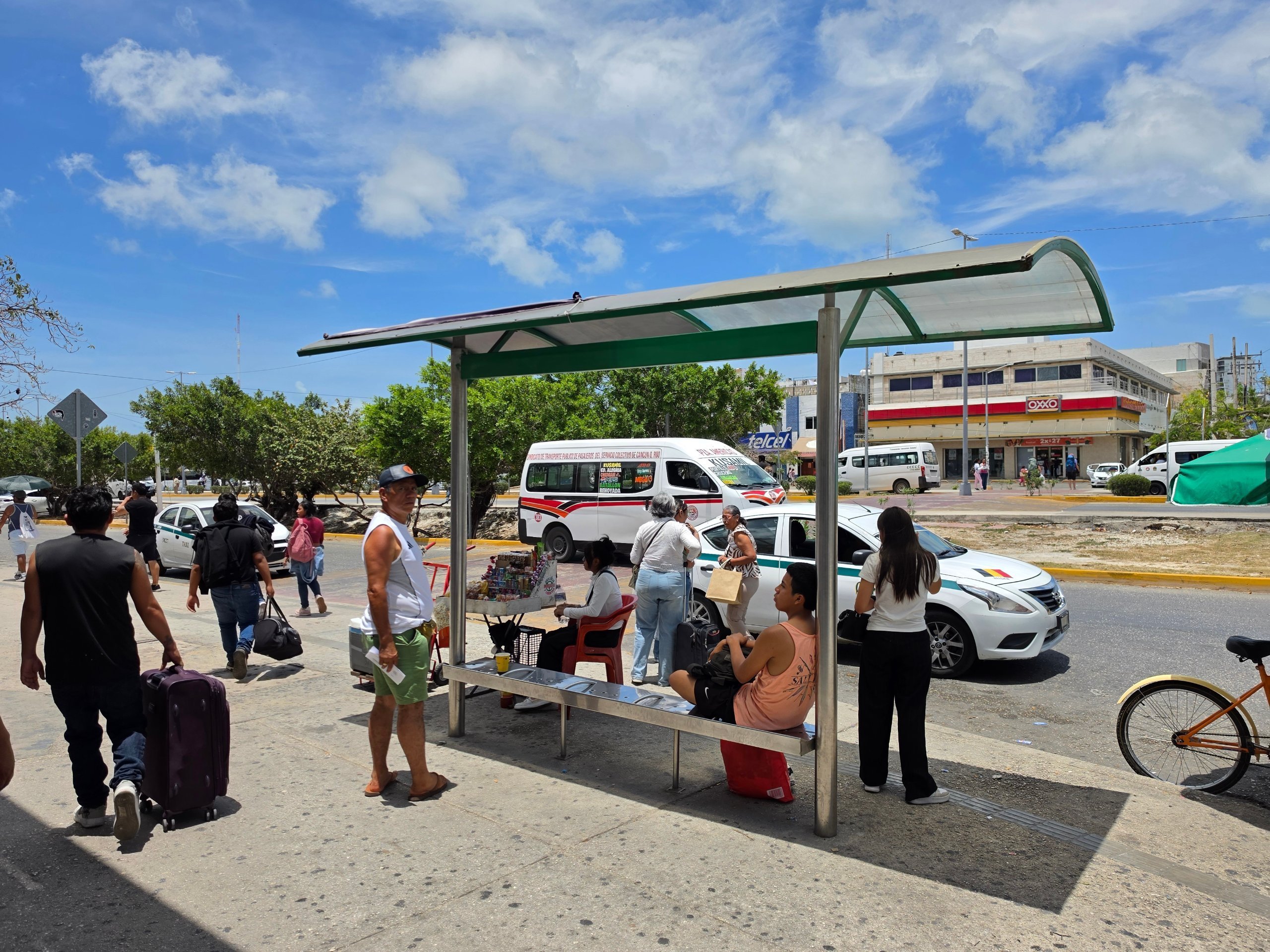
In the Zona Hotelera, bus stops are fairly easy to spot. In the city centre, they may be less clearly signposted, and you’ll often recognise them mainly by the people waiting there.
It’s best to wave at an approaching bus. When getting off, press the button in good time, pull the signal cord or tell the driver “Baja, por favor”.
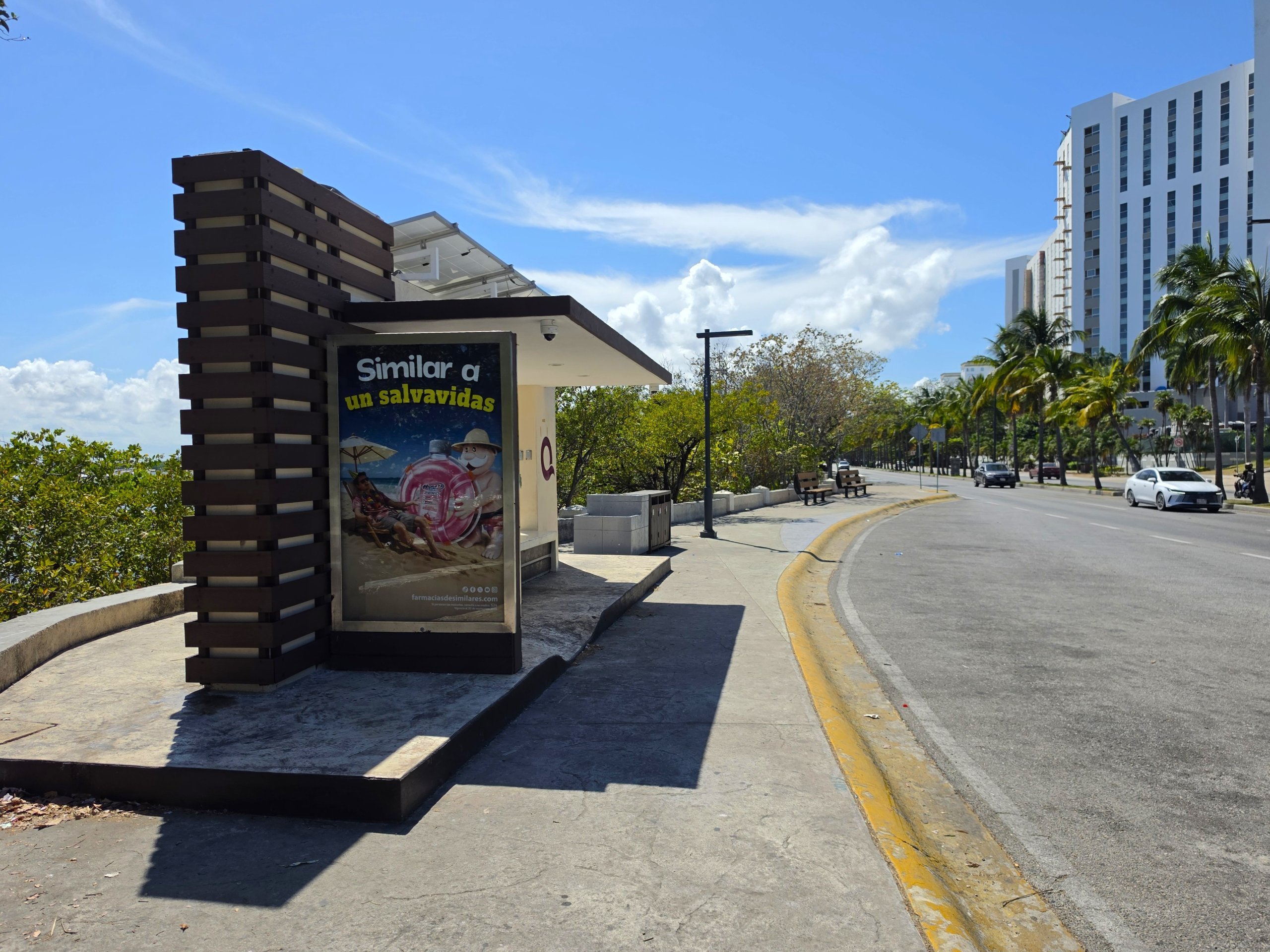
For an overview of routes, use:
Treat the times shown in the apps as a guide only. In Cancún, it’s more practical to follow the direction and the bus’s final stop than to rely on a precise timetable.
Not yet.
It is not possible to reliably search for public transport in Cancún using Google Maps.
The usual interval on individual routes is 10 to 15 minutes. As there are several routes and operators running along Boulevard Kukulcán, you’ll usually have a shorter wait on the shared section.
On average, buses run along the Zona Hotelera every 3–5 minutes.
Buses tend to be at their busiest during hotel staff shift changes, roughly between 6.30 am and 9.00 am and between 4.00 pm and 7.00 pm. They can also be full in the evenings around the clubs in Punta Cancún.
Expect to have to stand quite often. If a bus arrives completely full and you’re not in a hurry, it’s usually worth waiting for the next one.
If you’re travelling with a large suitcase, a pushchair or have limited mobility, Uber is a more practical option. Sometimes, a driver may even refuse to take you if you have a large suitcase.
Most routes run from 6.00 am to 10.00 pm; some services continue between 10.30 pm and 11.00 pm, but in the evening, Uber or a taxi is definitely more practical.
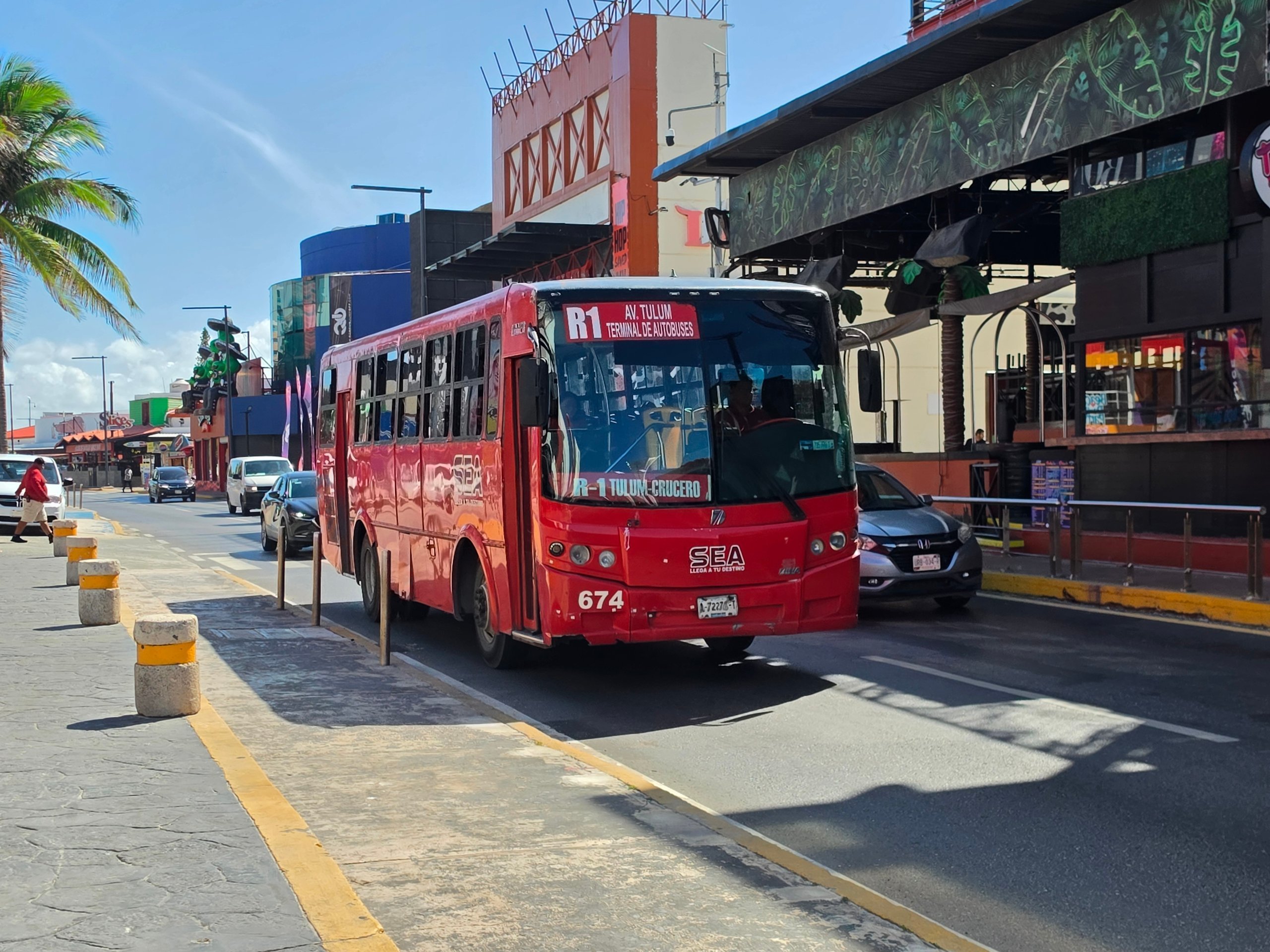
The bus is a good option if:
Uber is worth it if:
For two people, the bus is significantly cheaper. With three or four people, the difference in price per person tends to be smaller, and the comfort of an Uber often outweighs the cost.
Book hotels in the Zona Hotelera
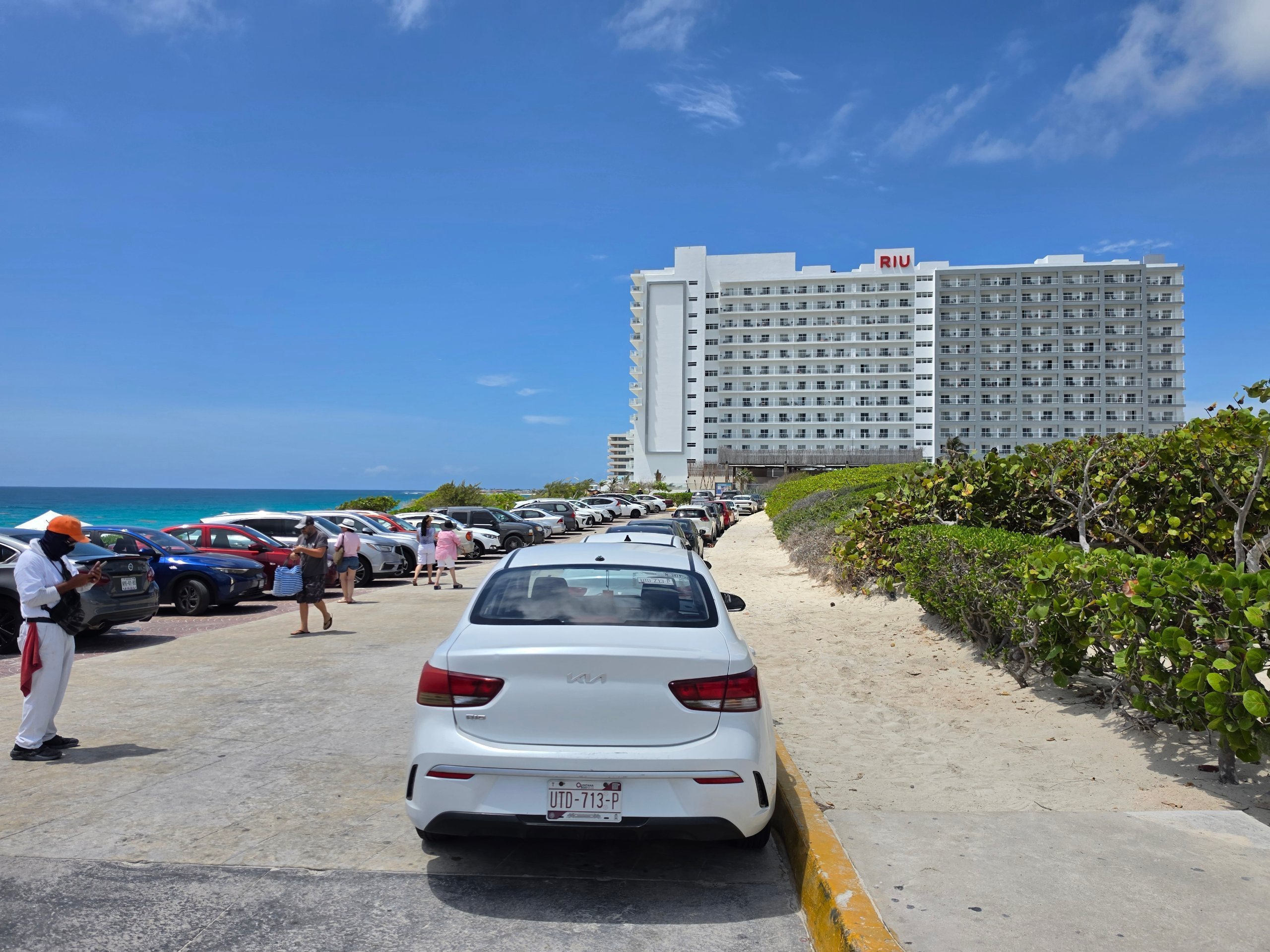
We drove to the city centre and the Zona Hotelera in a hire car, but to be honest, I wouldn’t really recommend it.
Free car parks are practically only available at Playa Delfines, Playa Langosa and in front of the Hyatt Ziva hotel in Punta Cancún.
There are very few spaces, and it’s possible that they’ll all be taken by 9.30 am.
For me, driving around Cancún was more stressful than liberating, and next time I’d definitely prefer to take an Uber or the city bus.
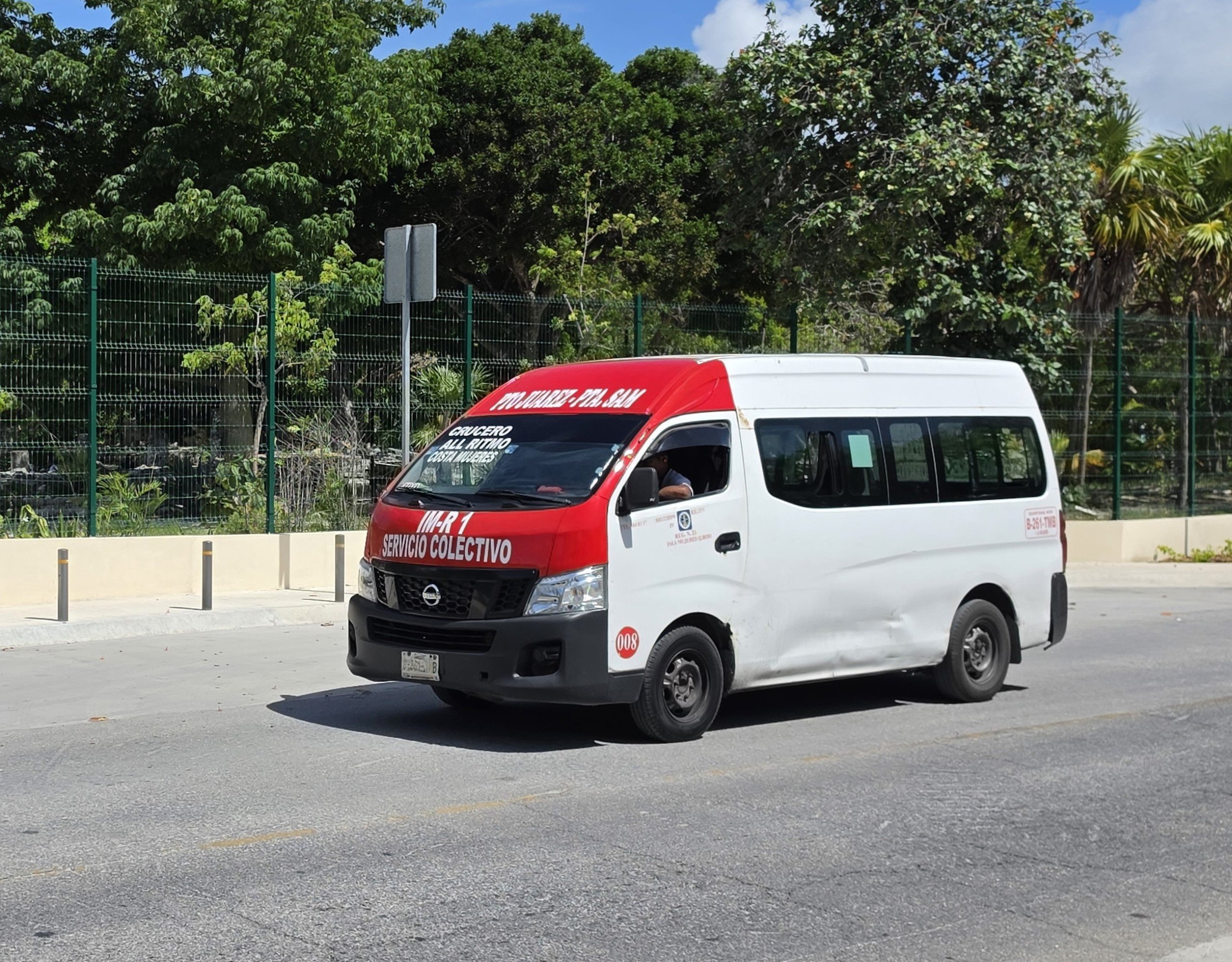
The term ‘colectivo’ is used in Cancún to refer to two different types of transport.
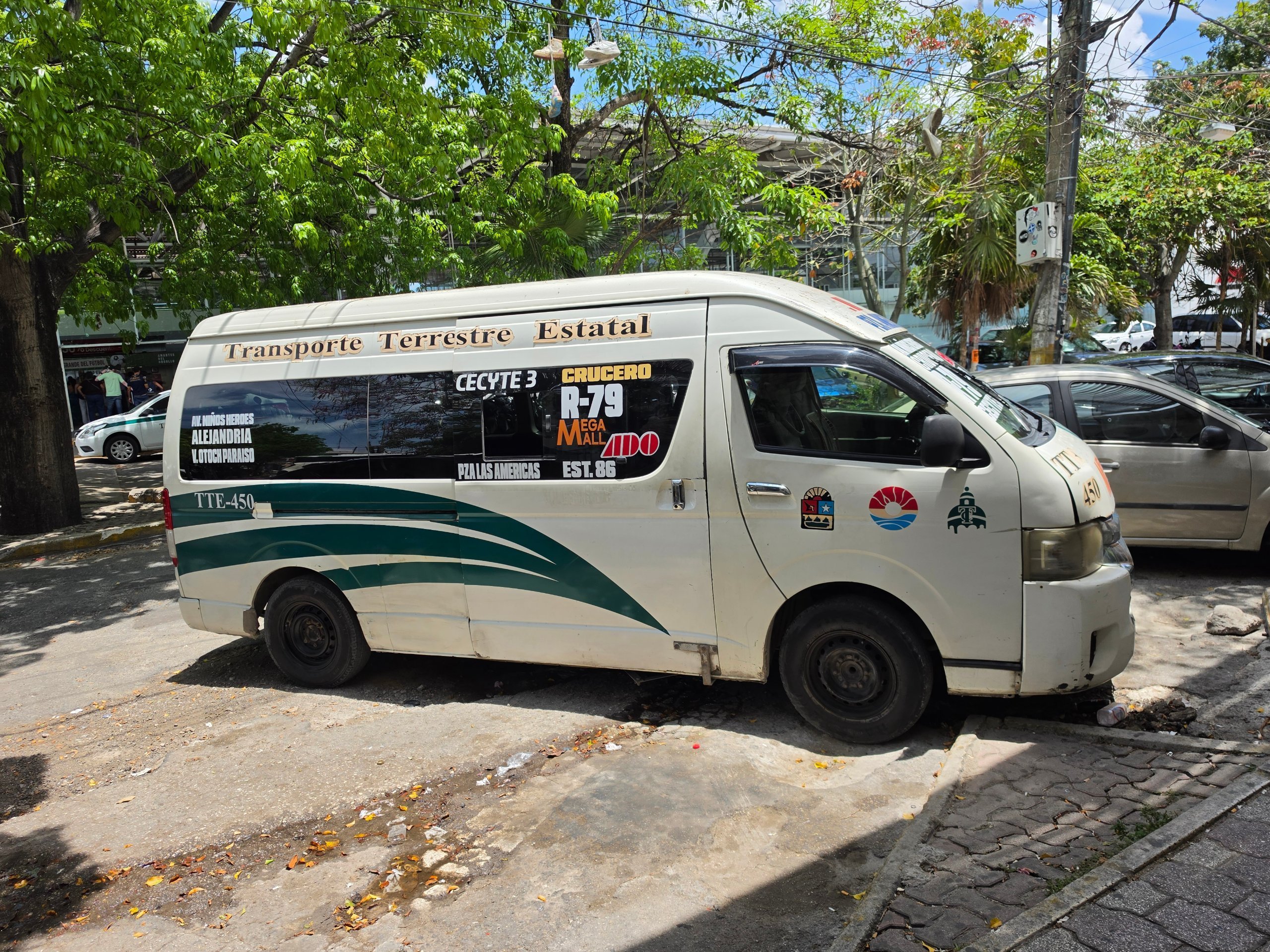
City colectivos are small white or white-and-red vans, known as ‘combis’, which connect the city centre with the residential neighbourhoods.
They run on fixed routes, but do not have clear timetables and are mainly guided by the destination displayed behind the windscreen.
Please note! Combi routes are often numbered the same as bus routes, but they are part of a different system and the routes go to completely different areas! For example:
Fares within the city are approximately 10 mxn, payable in cash to the driver. The minibuses tend to be very full, have no space for suitcases and aren’t particularly useful for standard tourist journeys around the Zona Hotelera.
They are mainly useful if you are staying in the centre of Cancún or need to get to one of the residential areas outside the routes of the main buses. Always ask the driver before boarding whether the bus is going to your destination.
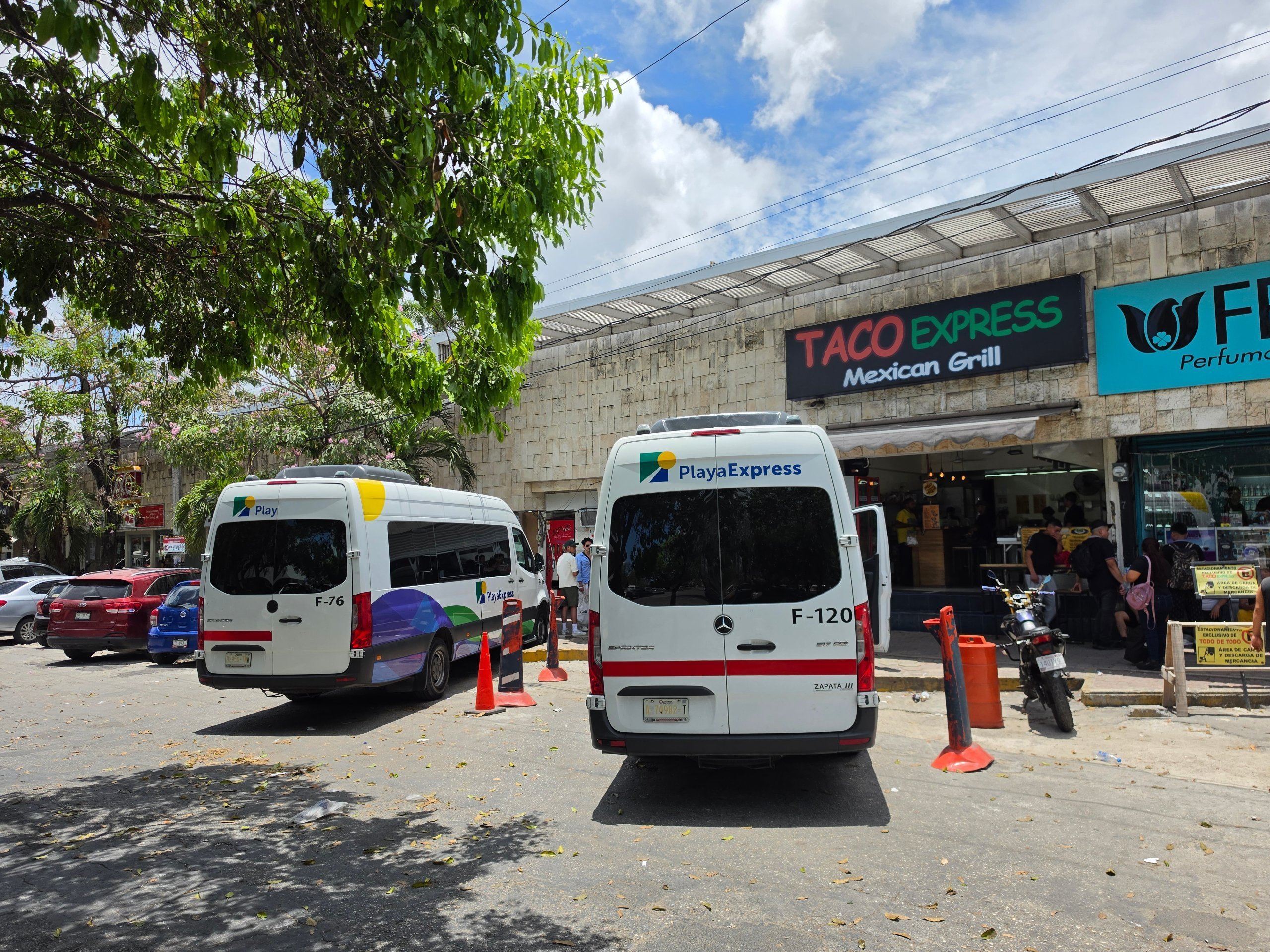
Intercity colectivos and the larger Playa Express minibuses depart from the area around the ADO terminal in the centre of Cancún. They travel along the main road, Route 307, towards Puerto Morelos and Playa del Carmen.
They depart without a fixed timetable, usually once the van is full. The journey to Playa del Carmen costs approximately 60 mxn and payment is made in cash.
Colectivos are cheaper than ADO, but have less space for luggage and make more frequent stops along the way.
They do not go directly to the airport or to Tulum. When travelling to Tulum, you will need to change to another colectivo in Playa del Carmen.
You probably won’t use them for getting around Cancún itself, but they are one of the cheapest ways to travel on from Cancún along the Riviera Maya.
There is no direct city bus service suitable for tourists running to either Costa Mujeres or Isla Blanca.
You can travel to the resorts in Costa Mujeres by Uber, hotel transfer or taxi. There may be fewer Uber drivers available on the return journey, so please check availability in advance or use a taxi booked by the hotel.
I wouldn’t rely on an Uber for the return journey from Isla Blanca. You’ll probably be able to find a driver travelling from Cancún, but in the more remote parts of the coast, there may be no cars available on your return journey. A hire car or a taxi with a pre-arranged return time is a more practical option.
Hiring a car also makes sense if you’re combining a visit to Playa Blanca with other destinations outside Cancún. However, it isn’t worth it if you’re only using it for getting around the Zona Hotelera.
Short distances can be covered on foot, for example around Punta Cancún, the nightclubs or between nearby hotels.
However, the entire Zona Hotelera is over 20 km long, and the high temperatures and humidity make walking there considerably less pleasant.
Walking within the Zona Hotelera is, nevertheless, quite comfortable, as there are pavements running the entire length of Kukulcán Boulevard.
Neither the beaches nor the hotel grounds form a continuous public promenade. It is therefore not possible to walk the entire length of the hotel zone along the sea.
Resort fences, rocky outcrops and the lack of a public path can make it completely impossible to pass through, for example between Playa Gaviota Azul and the stretch of coastline around the Hyatt Ziva.
I wouldn’t recommend a bicycle as your main means of transport. There are few cycle paths, traffic on Boulevard Kukulcán tends to be heavy, and it gets very hot during the day.
The regular city bus routes R1 and R2 do not run to the airport. The cheapest option is usually the ADO bus to the city centre, whilst a pre-booked transfer is more convenient for travelling directly to your hotel.
We describe all the options, current prices and stop locations in our guide to transport from Cancún Airport.
To get around the Zona Hotelera, take the R1, R2 or R10 buses for 12 mxn. They’re cheap, run frequently and stop at all the main beaches.
For evening journeys, travelling in larger groups, journeys with luggage and transport outside Boulevard Kukulcán, use Uber.
Use a taxi mainly when you need to leave immediately and agree on the fare in advance.
A transfer, Uber or taxi is a good option for getting to Costa Mujeres. For Playa Blanca, we recommend a hire car or a taxi with a pre-arranged return journey.
If you have any questions or comments about the article...