
Spring in France: Lyon and Nantes from Prague with Volotea
59 €


After about 12 hours on a flight from Cancún, we landed in Istanbul and still had 6 hours to go before our flight to Prague.
On paper, a long lay-over. In reality, it was far too short a time to venture from Istanbul Airport into the city centre.
What’s more, I was absolutely knackered after the previous flight. So no sightseeing, no Bosphorus and no heroic exploits. We headed straight for the Turkish Airlines lounge.
The flight from Istanbul to Prague was the second leg of the Cancún–Istanbul–Prague award ticket, which I’d bought just under three weeks before the trip for 55,000 Aegean Miles+Bonus and 393 eur per person.
I describe the full story of the booking, as well as what the twelve-hour flight on a Boeing 787-9 was like, in my previous review of the Turkish Airlines flight from Cancún to Istanbul.
Our flight in a nutshell
Not in my opinion.
IST Airport is a long way from the city centre and is huge. By the time you’ve gone through passport control, travelled into the city and then made your way back with plenty of time to spare, there’ll be almost nothing left of your six-hour layover.
I’d only head into town from IST Airport if I had a connection of at least 8 hours. And even then, not when I can barely keep my eyes open after a transatlantic flight.
I discuss how to make decisions based on the length of the layover, realistic travel times and what you can manage to do in the city centre in the article ‘Istanbul during a layover: is it worth heading into the city?’.
You can also find practical information on security checks, minimum layover times and getting around the terminal in our guide to transferring at Istanbul IST Airport.
We knew exactly what we wanted to do: the lounge, a shower and a chance to wake ourselves up a bit.
Business class passengers have two important privileges during a stopover.
The first of these is fast-track access at security, which you (sometimes) have to go through when transferring.
It was completely quiet everywhere during our visit, but from past experience in Istanbul, I know that the fast-track can easily save you 15 minutes.
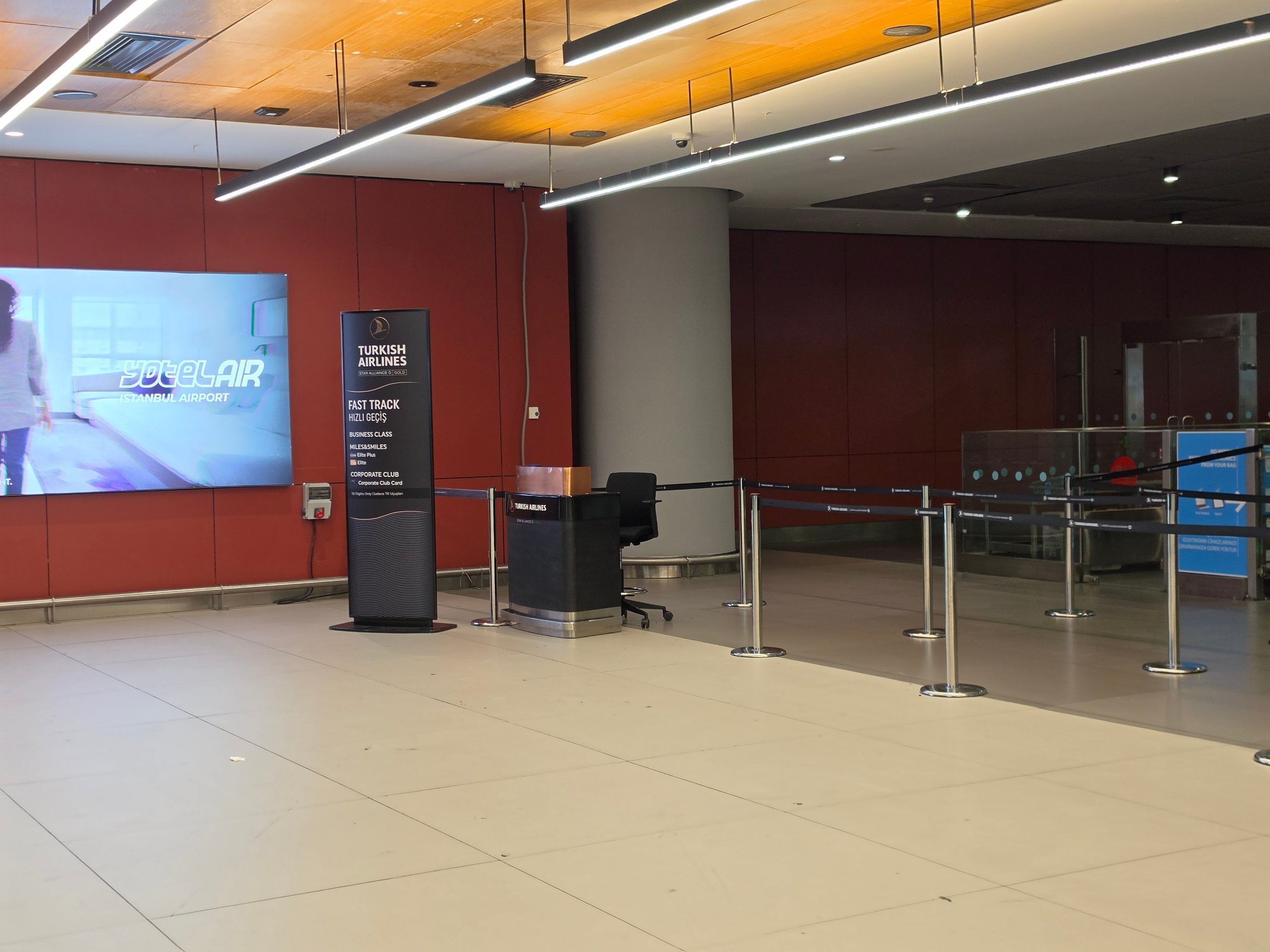
The second, and far greater, benefit is, of course, the lounge.
The Turkish Airlines Business Lounge is one of those that look fantastic in photos.
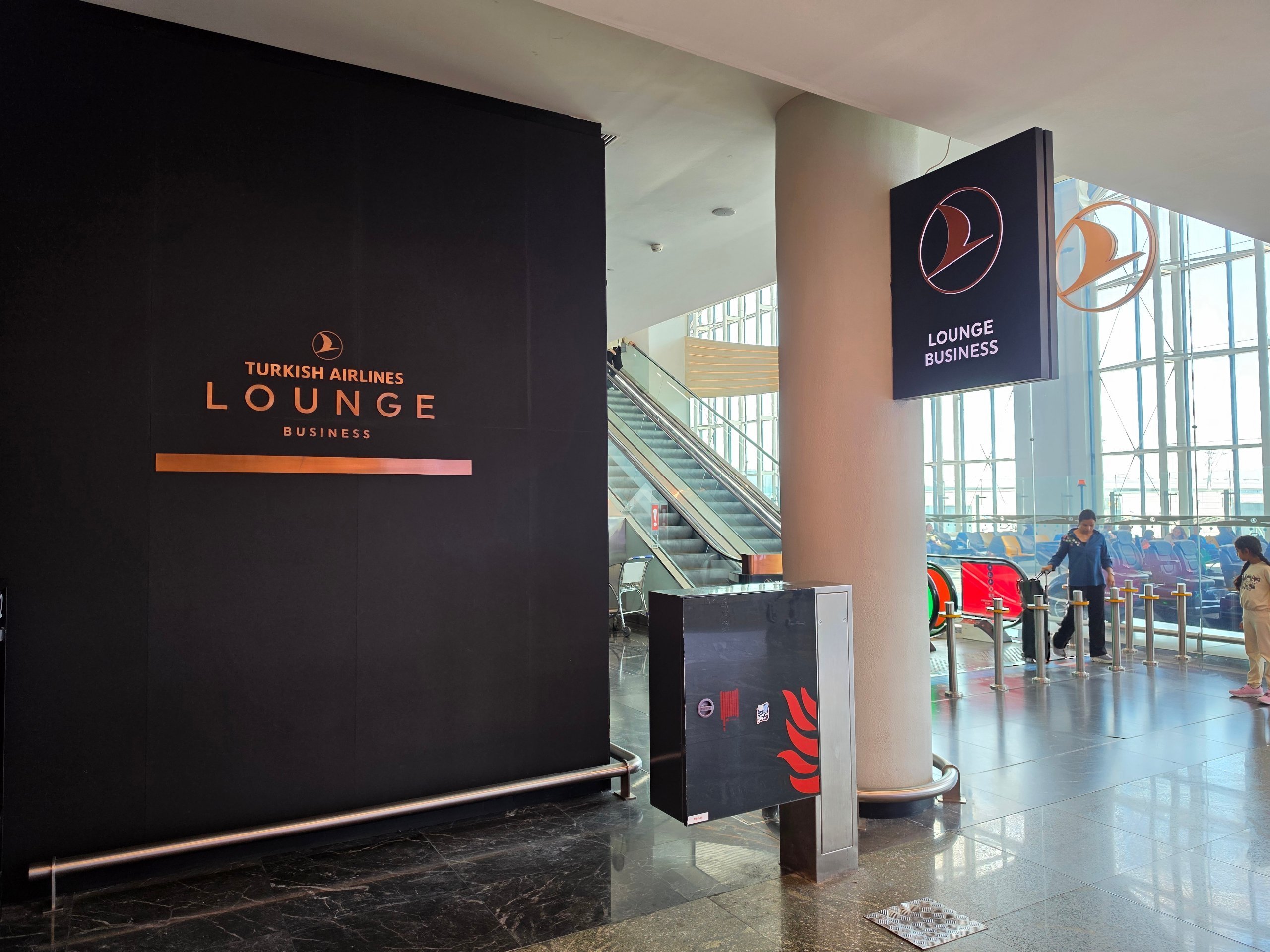
It’s huge. It offers a variety of seating areas and plenty of live cooking stations. On paper, it really lacks almost nothing.
But I don’t really like it.
Although it’s spacious, it’s always packed whenever I visit, and it’s certainly not peaceful. Mind you, it’s still better than the public area of the airport...
Above all, though, I’m not very keen on the way the food is served.
There aren’t many of the classic buffet stations where you can help yourself to exactly what you want. Most hot meals are served at individual stalls, where the chef serves you your portion.
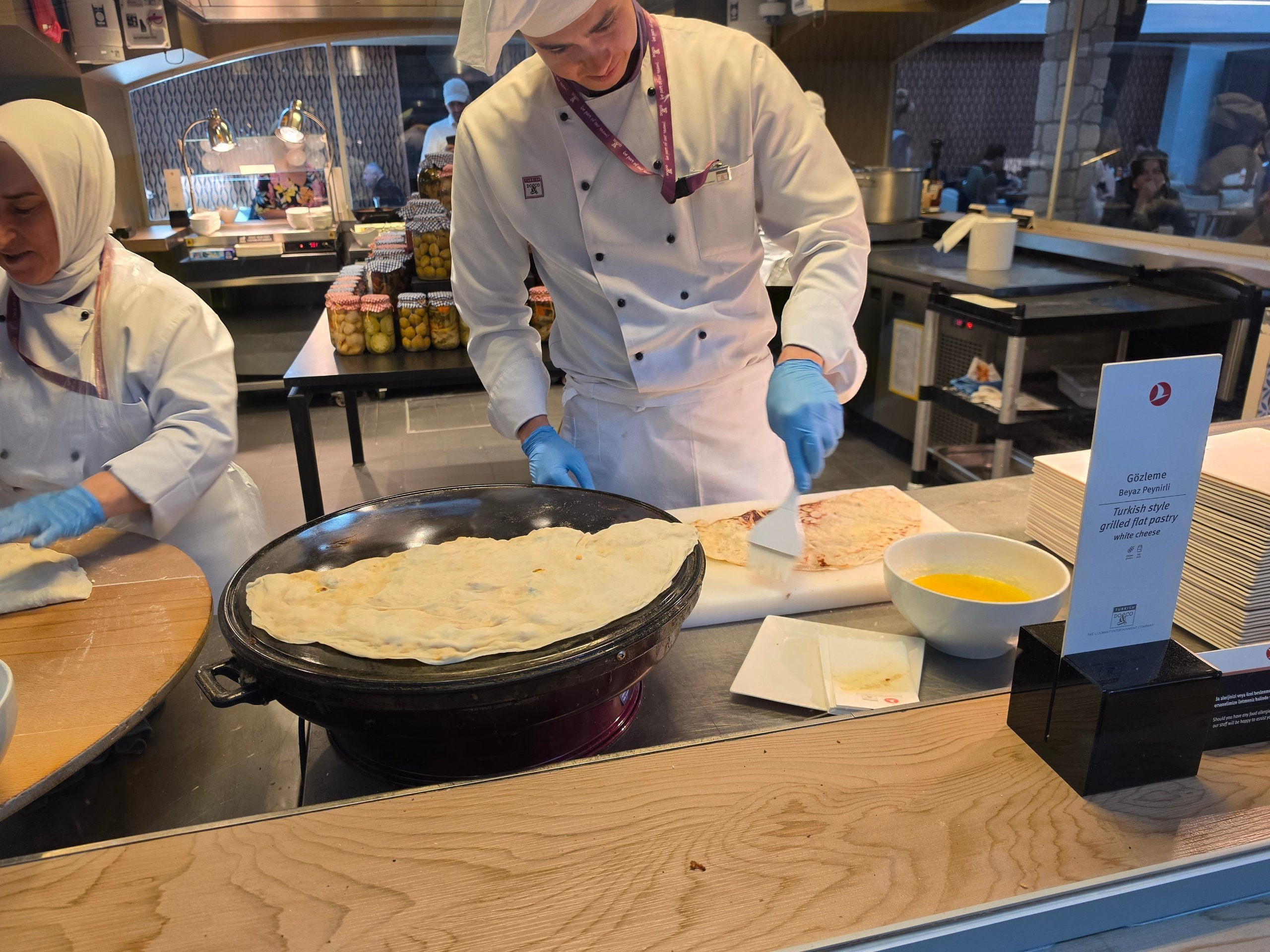
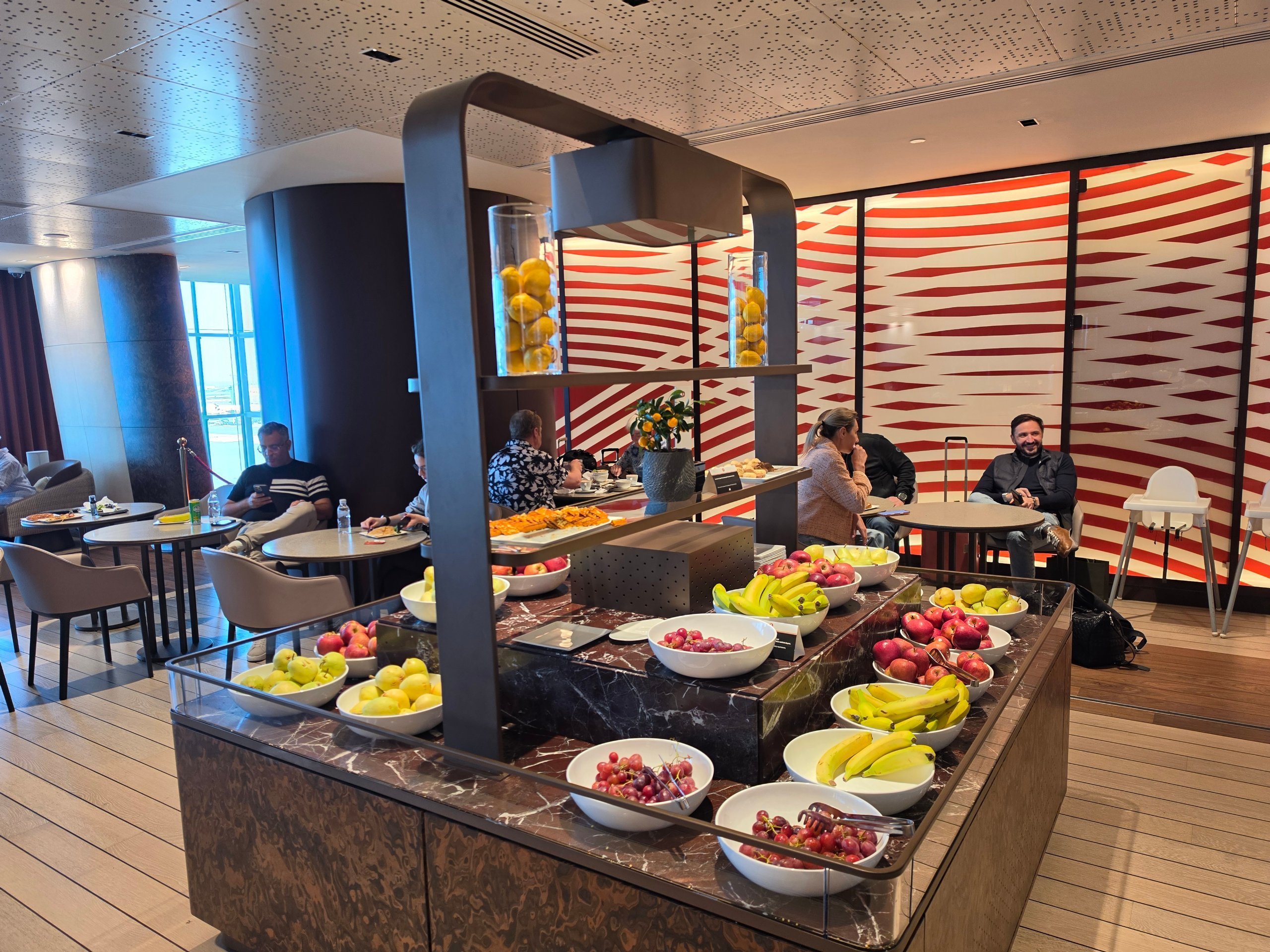
I get the idea. The food is fresh and the whole thing looks more impressive than a few stainless-steel containers with lids.
But when I’m tired and hungry, I don’t want to walk round several stalls, wait in queues and have to explain what I want all over again at each one. I just want to get my food and sit down. Maybe I’m a bit of a lout in this respect, but a traditional buffet suits me better.
I also found the selection of soft drinks surprisingly poor. I’d have expected considerably more from Turkish Airlines’ flagship lounge.
On the other hand, I have to give credit to the showers. There are plenty of them and the individual shower cubicles are quite spacious. After a long flight from Cancún, that was exactly what I needed.
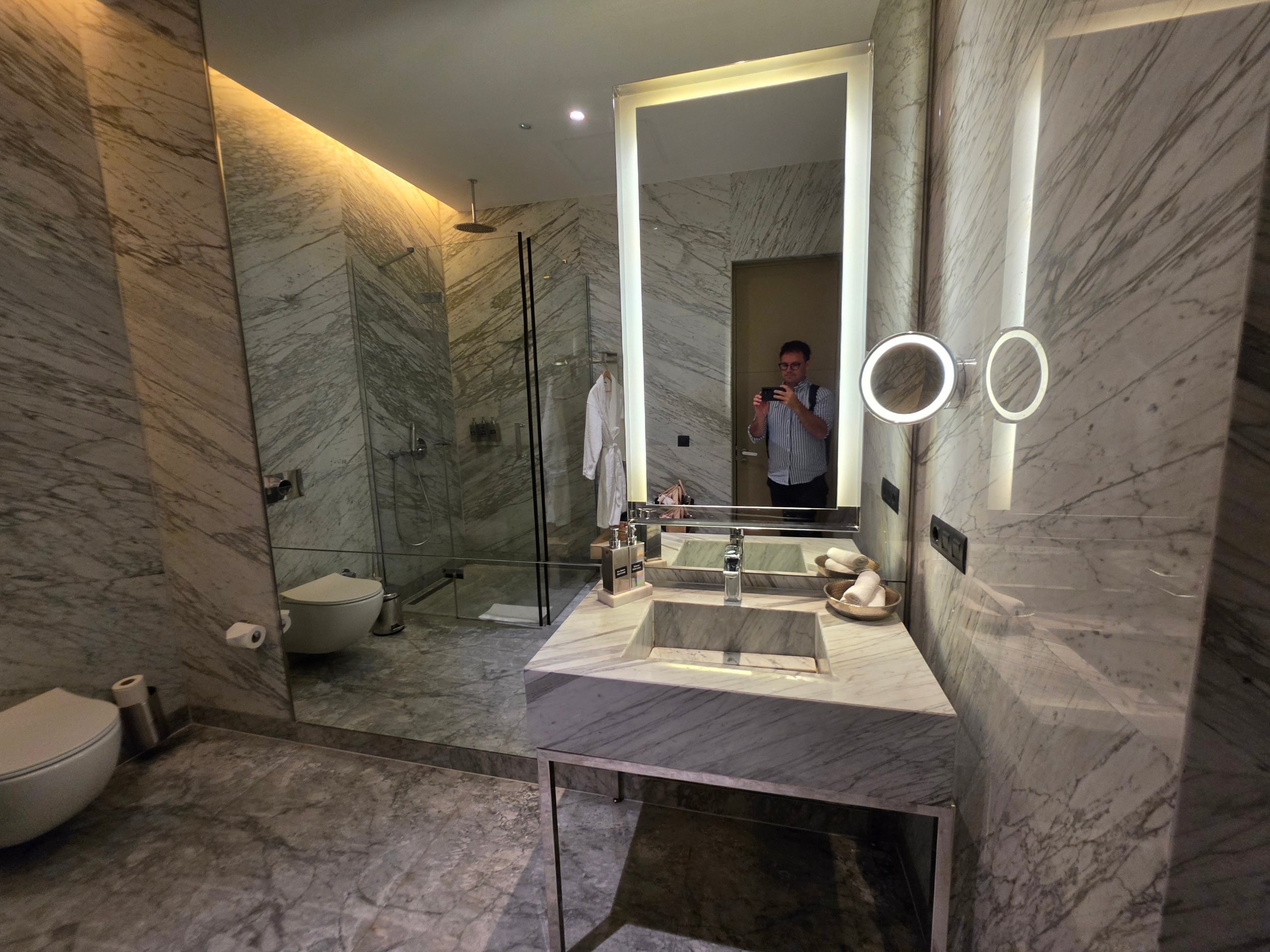
If you don’t have access to the lounge and are facing a long overnight layover, do check out the hotel options near Istanbul Airport and the possibility of sleeping right in the terminal.
After six hours at the airport, we finally made our way to the gate.
Boarding took place by zone and was very orderly.
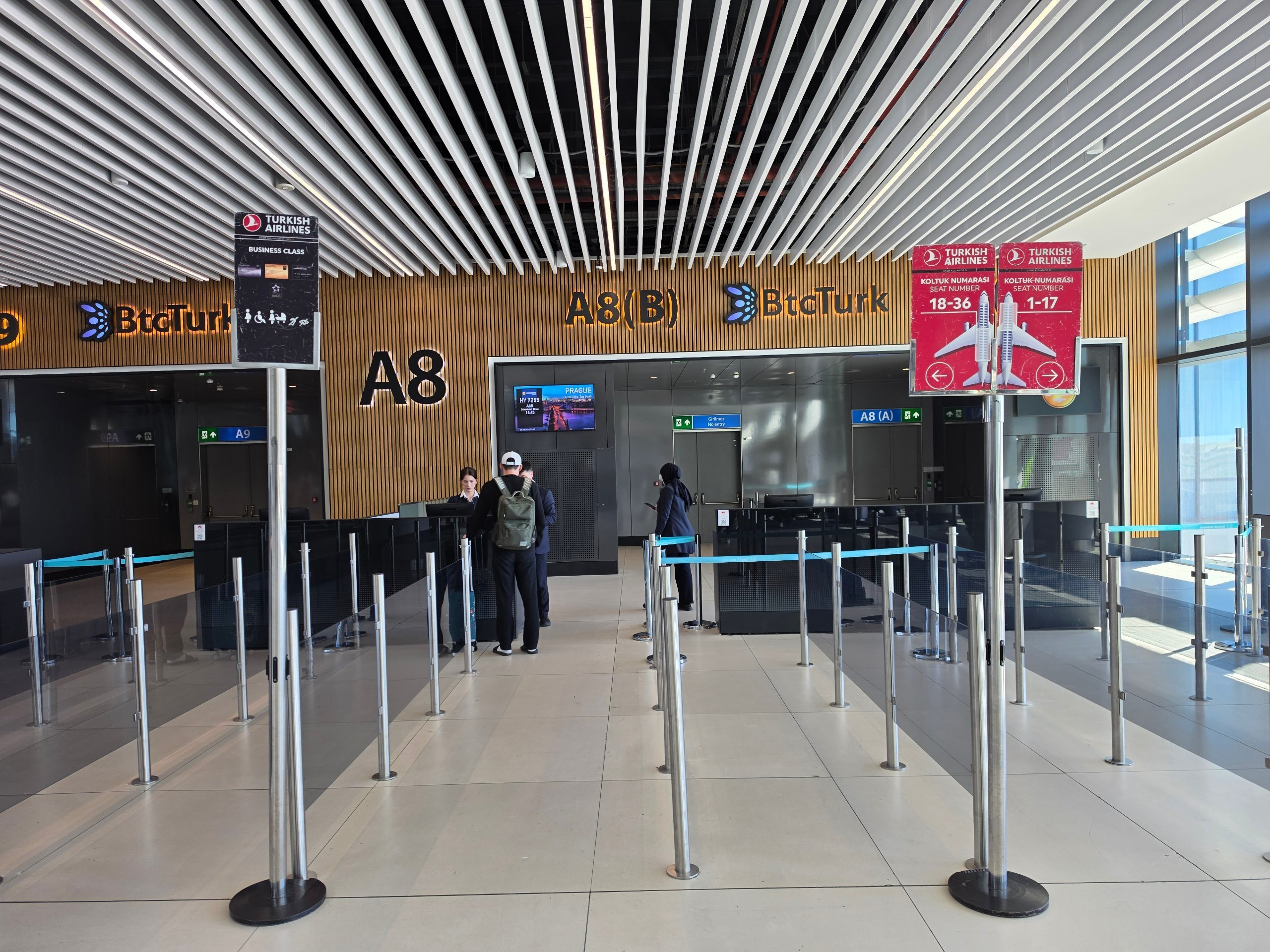
The flight from Istanbul to Prague takes only about two hours. To be honest, I could have easily managed such a short hop in economy class without too much trouble.
However, on short-haul routes, Turkish Airlines offer something that is still very unusual amongst European airlines: a genuine business class.
With most European carriers, you get the same narrow seats as in economy. Only the middle seat remains free and a curtain is drawn somewhere at the front.
On our Airbus A321neo, there was a separate cabin with wide seats in a 2–2 configuration.
Turkish Airlines is probably the only airline in Europe to deploy such a product extensively across virtually all its aircraft designated for short- and medium-haul routes.
Or is there another airline?
I haven’t come across one yet, even though I’ve already reviewed several European business classes here:
On my previous flight in a Boeing 787-9, I found the black and dark grey cabin a bit cold and dull.
On the A321neo, I didn’t mind the same colours at all.
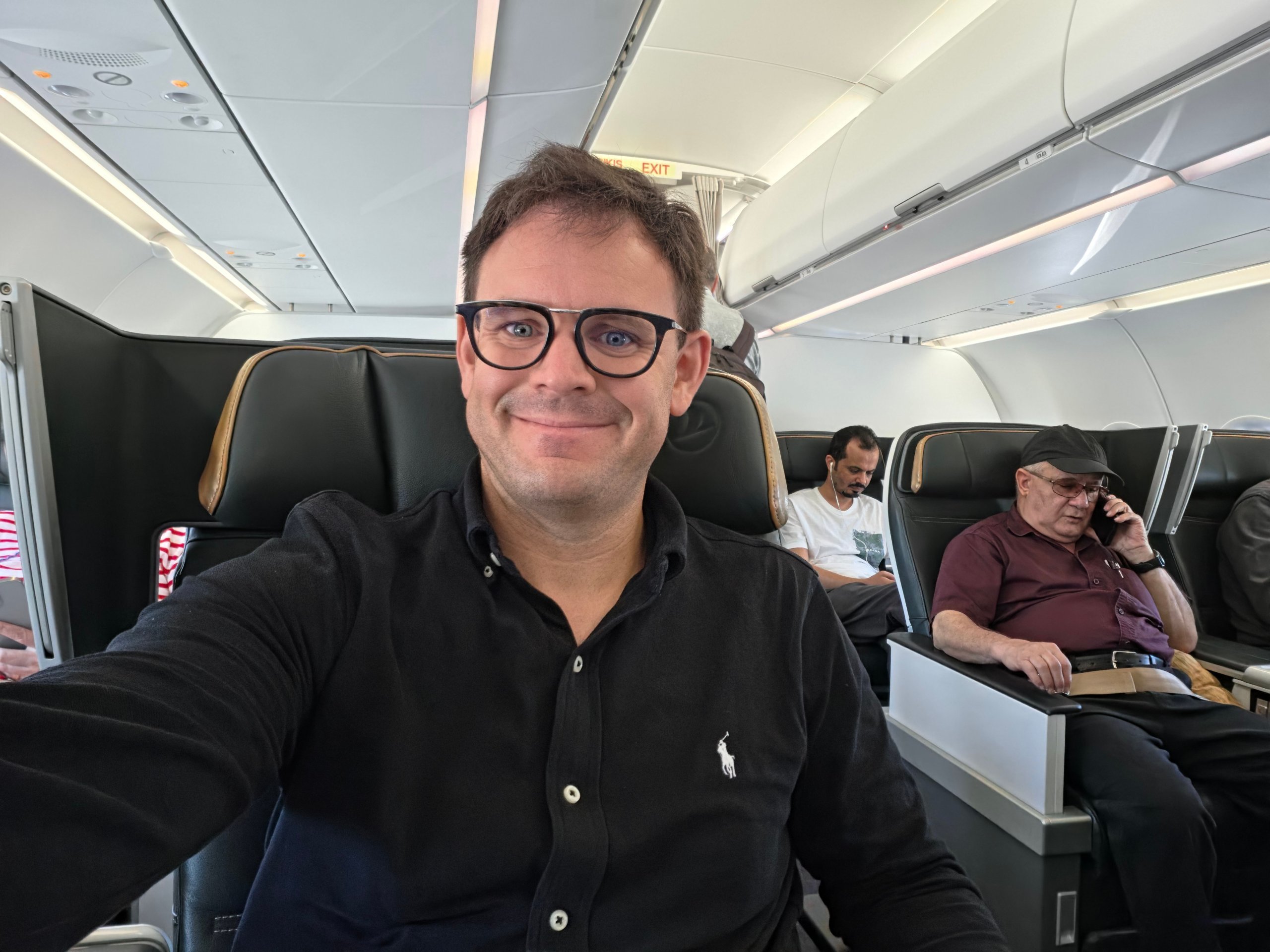
The dark seats are complemented by more striking beige trim and a light-coloured cushion. As a result, the whole cabin feels more elegant and cosy than the business class on the Dreamliner.
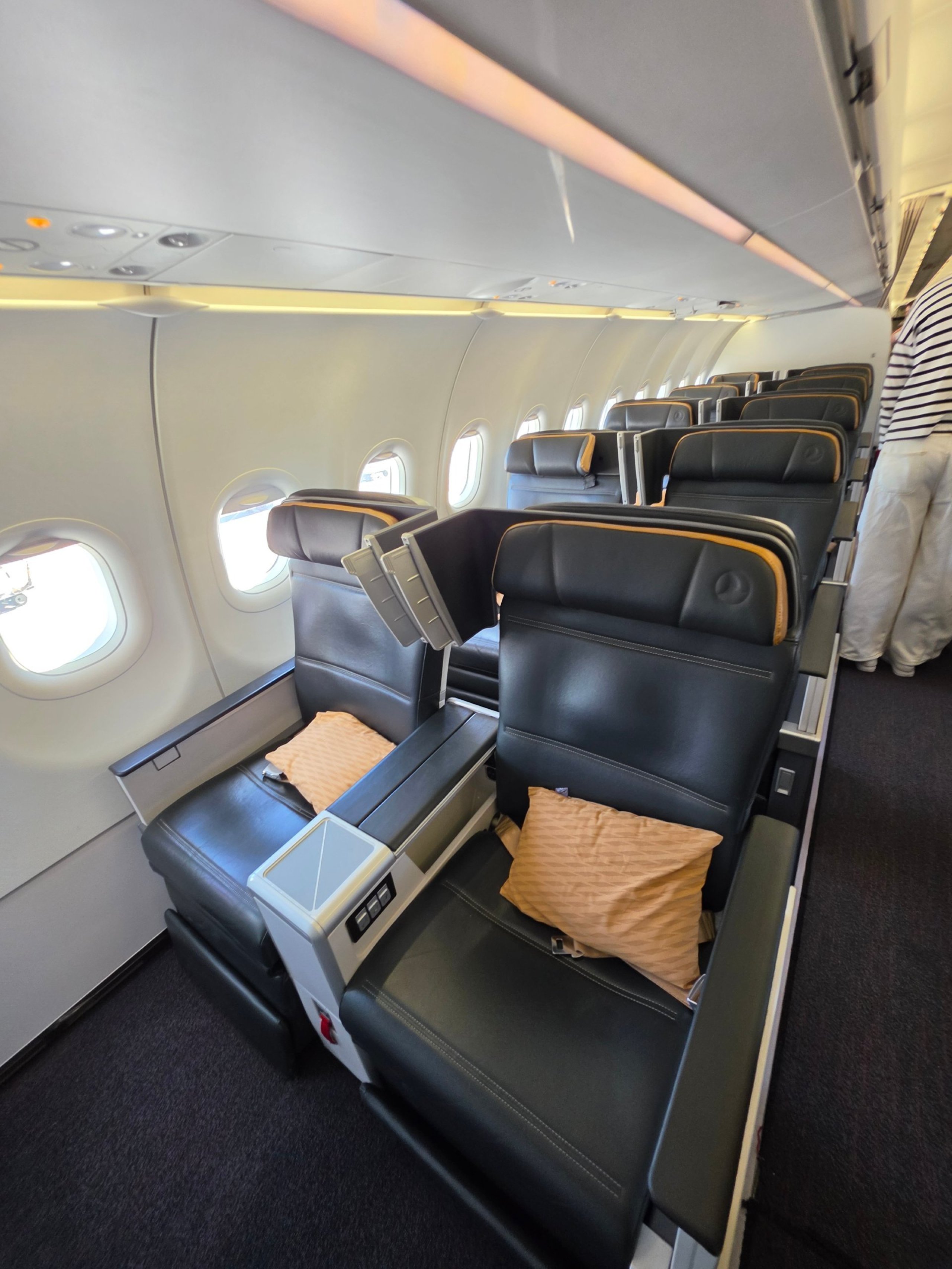
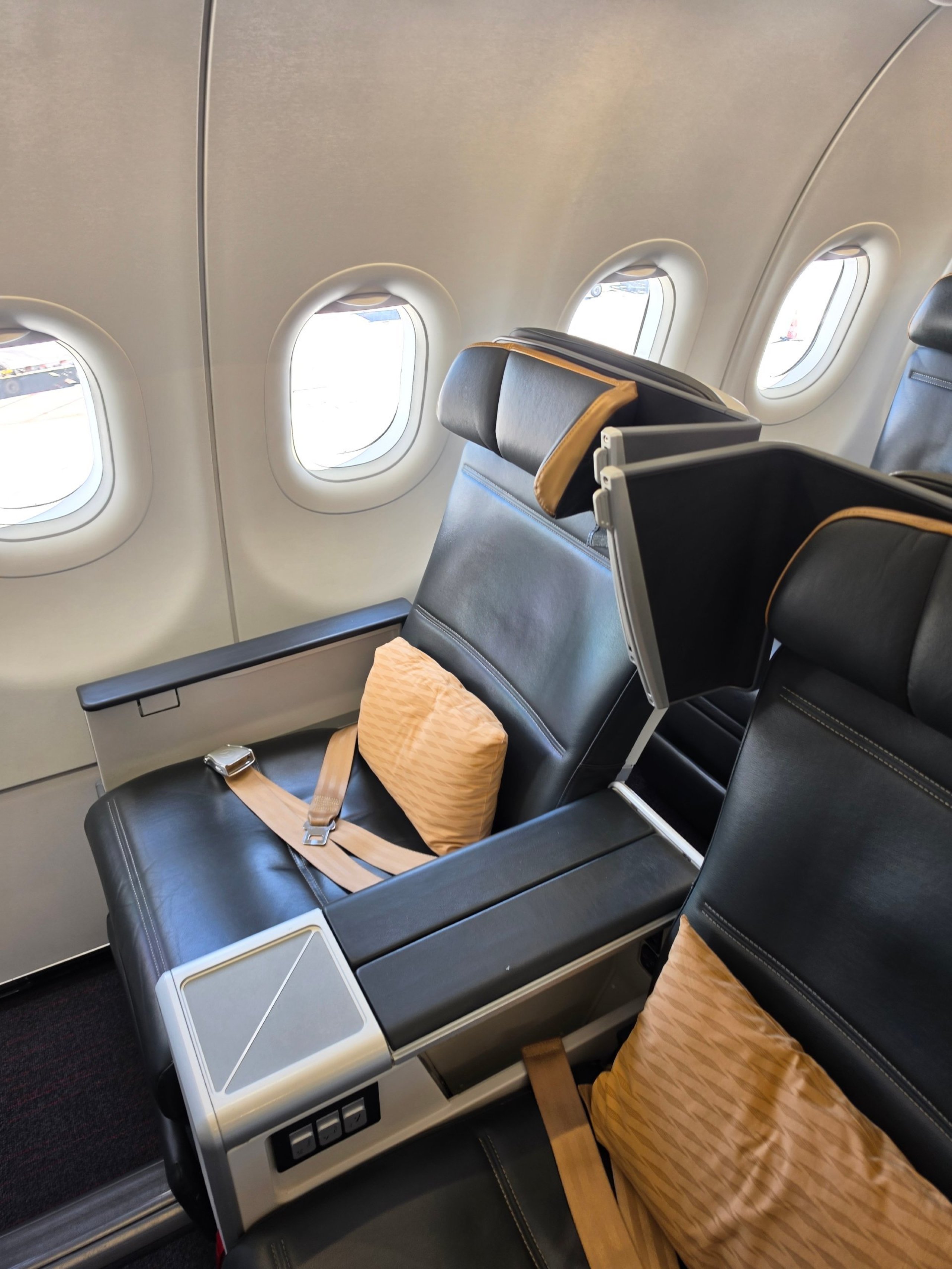
Or perhaps I was simply in a better mood because I was already on my way home – who knows
The main difference compared to economy, of course, isn’t the colour, but the space.
| Business class | Economy class | |
|---|---|---|
| Seat width | 21 inches / 53 cm | 18 inches / 46 cm |
| Seat pitch | 45 inches / 114 cm | 31 inches / 79 cm |
| Seat-back recline | 5 inches / 13 cm | 3 inches / 8 cm |
The seat is really wide and there’s plenty of legroom even when you stretch out.
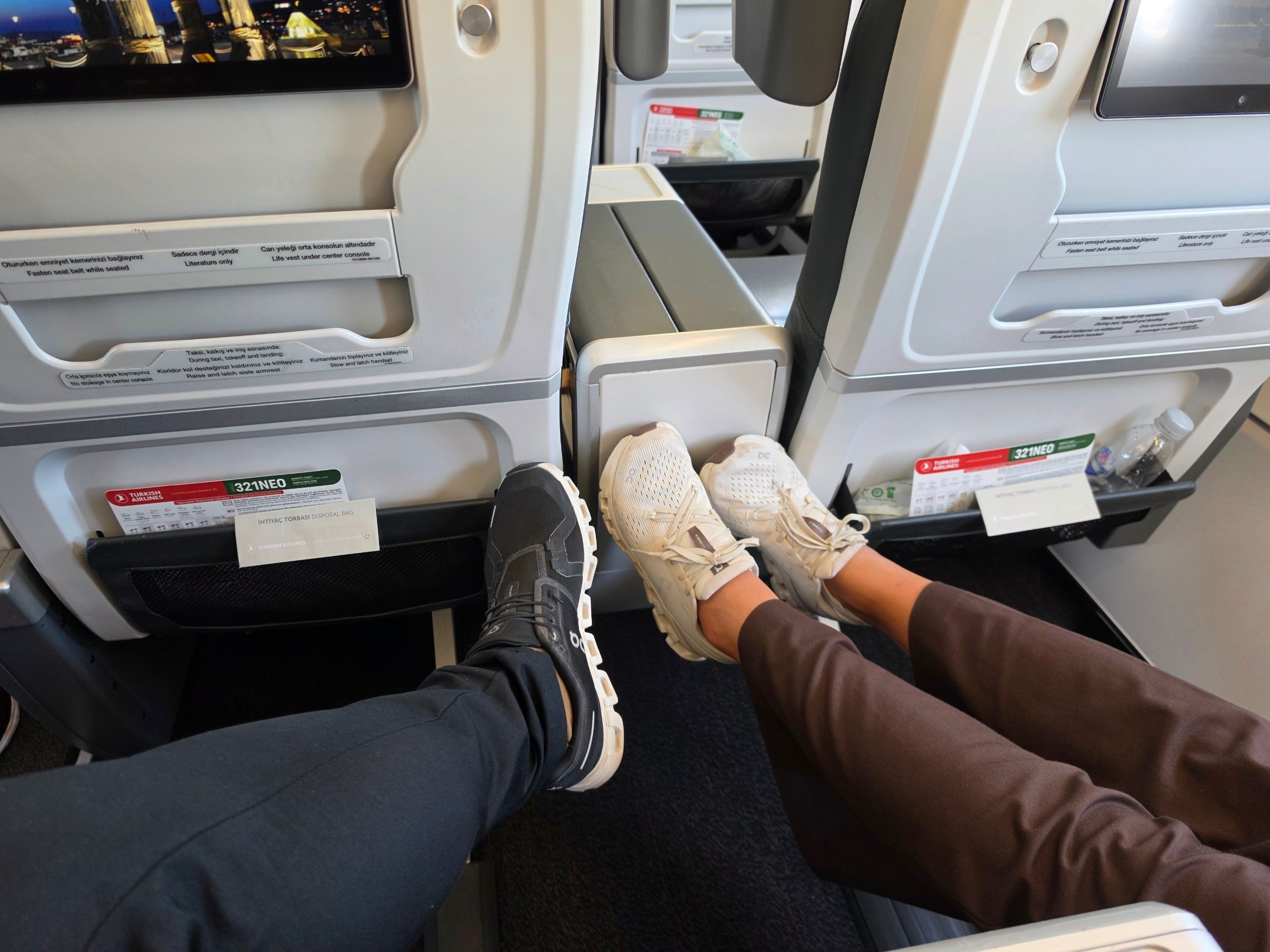
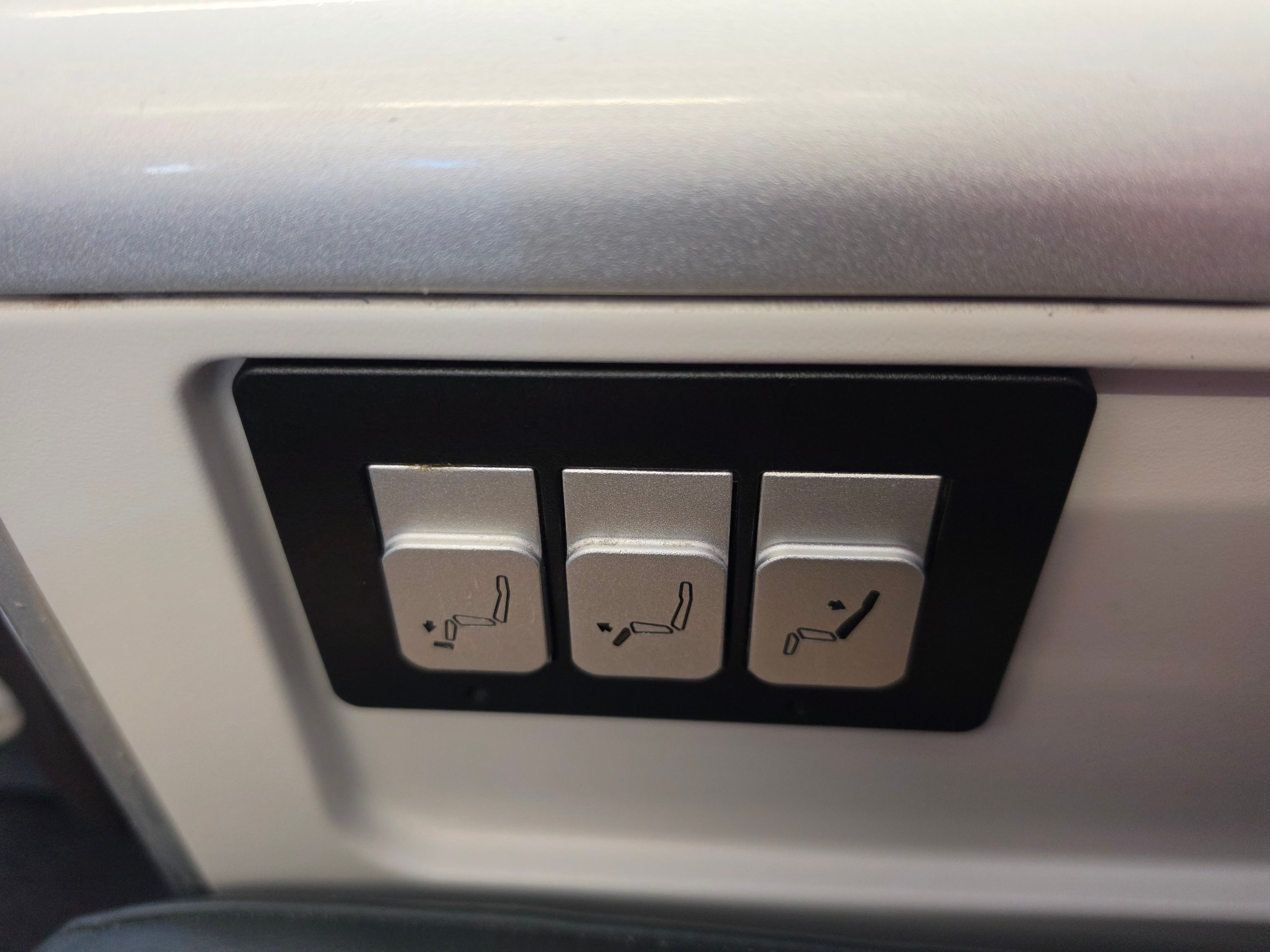
I might have expected the backrest to recline a little further. However, on a two-hour daytime flight, this isn’t a problem at all.
The headrest is a bit of a let-down. Although it can be adjusted, it’s so wide that it didn’t really support my head very well. It’s not a disaster, just a rather strangely underutilised feature.
In front of the seat is a 13-inch touchscreen. The screen is fine, but because of the wide spacing between the seats, it’s quite a long way away for comfortable operation by hand. That’s why each seat also has its own remote control.
There’s plenty of storage space. There’s a universal power socket as well as a standard larger USB-A port.
There was no USB-C port on our seat.
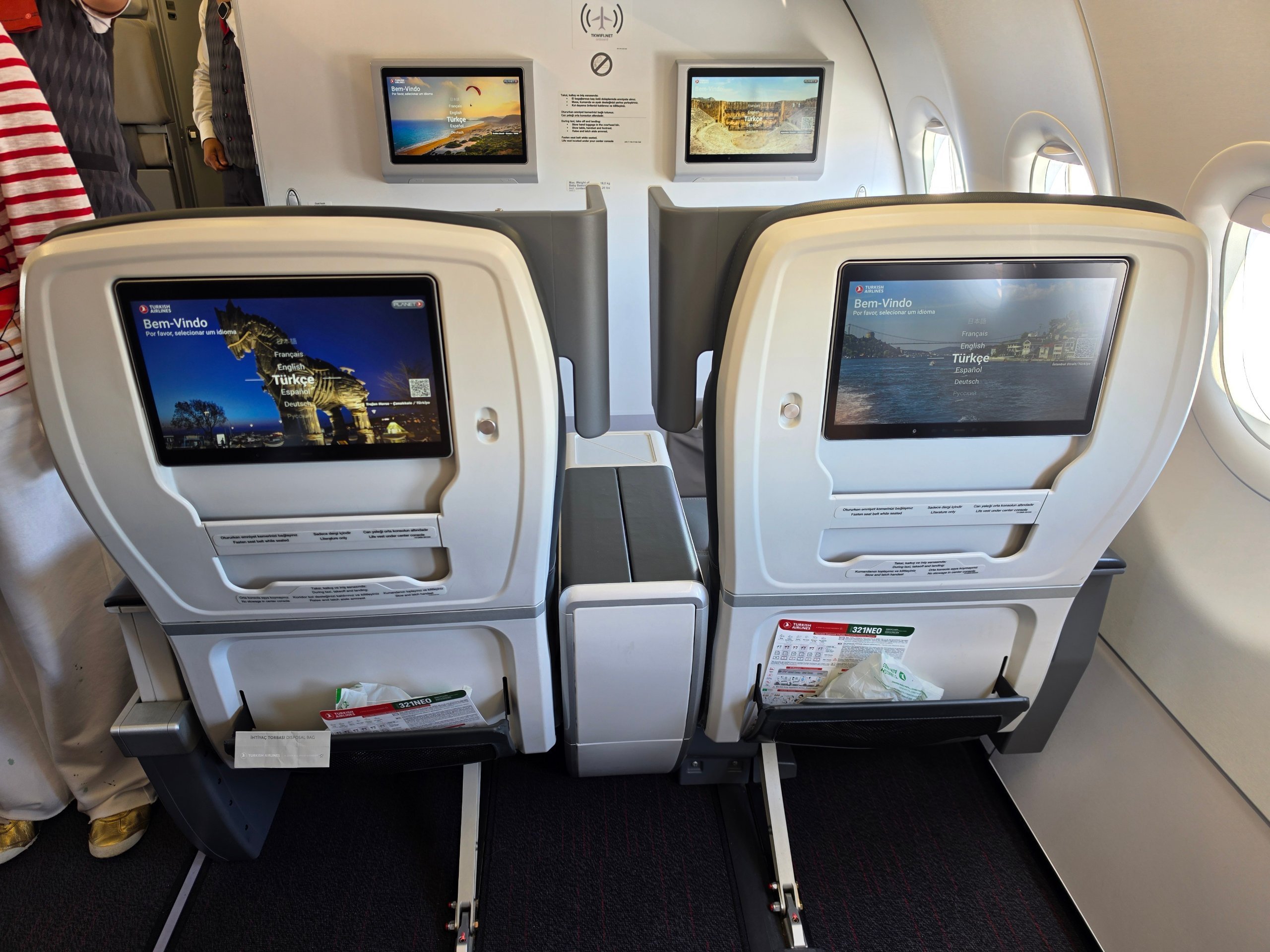
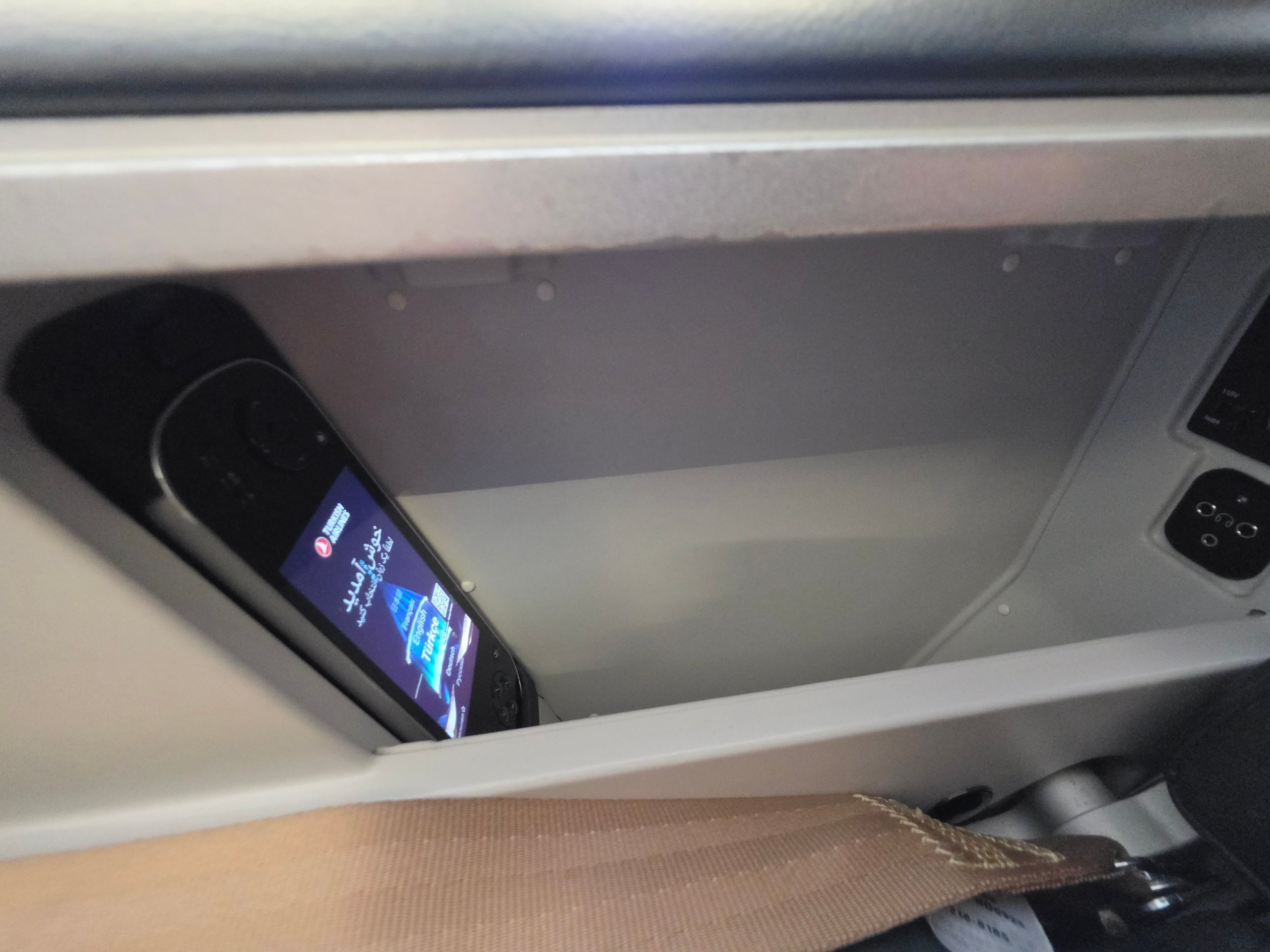
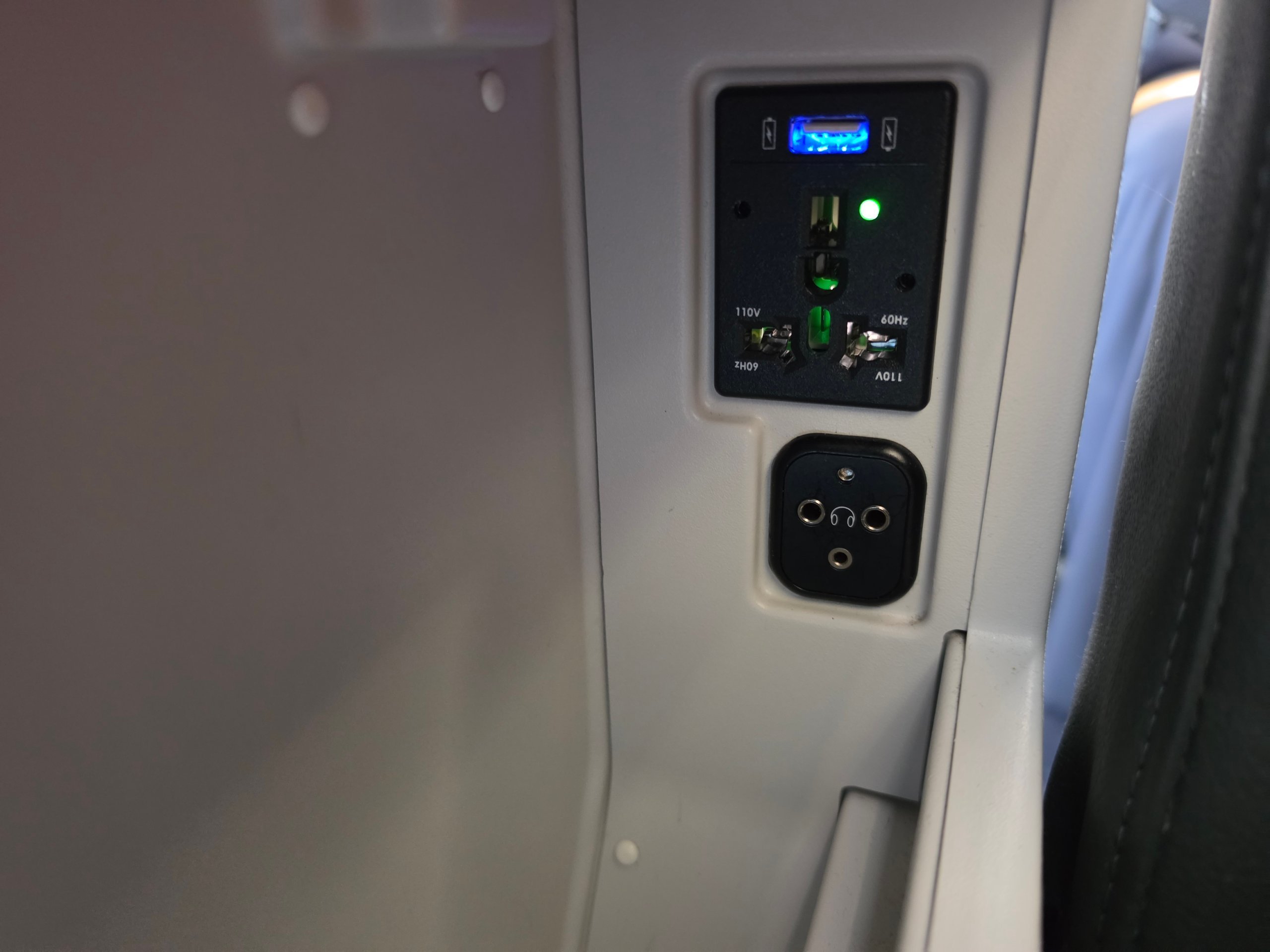
The mini partition between the two seats looks a bit odd if you’re travelling on your own.
It’s actually quite comical, because in reality this divider is only about 5 cm wide and serves absolutely no purpose.
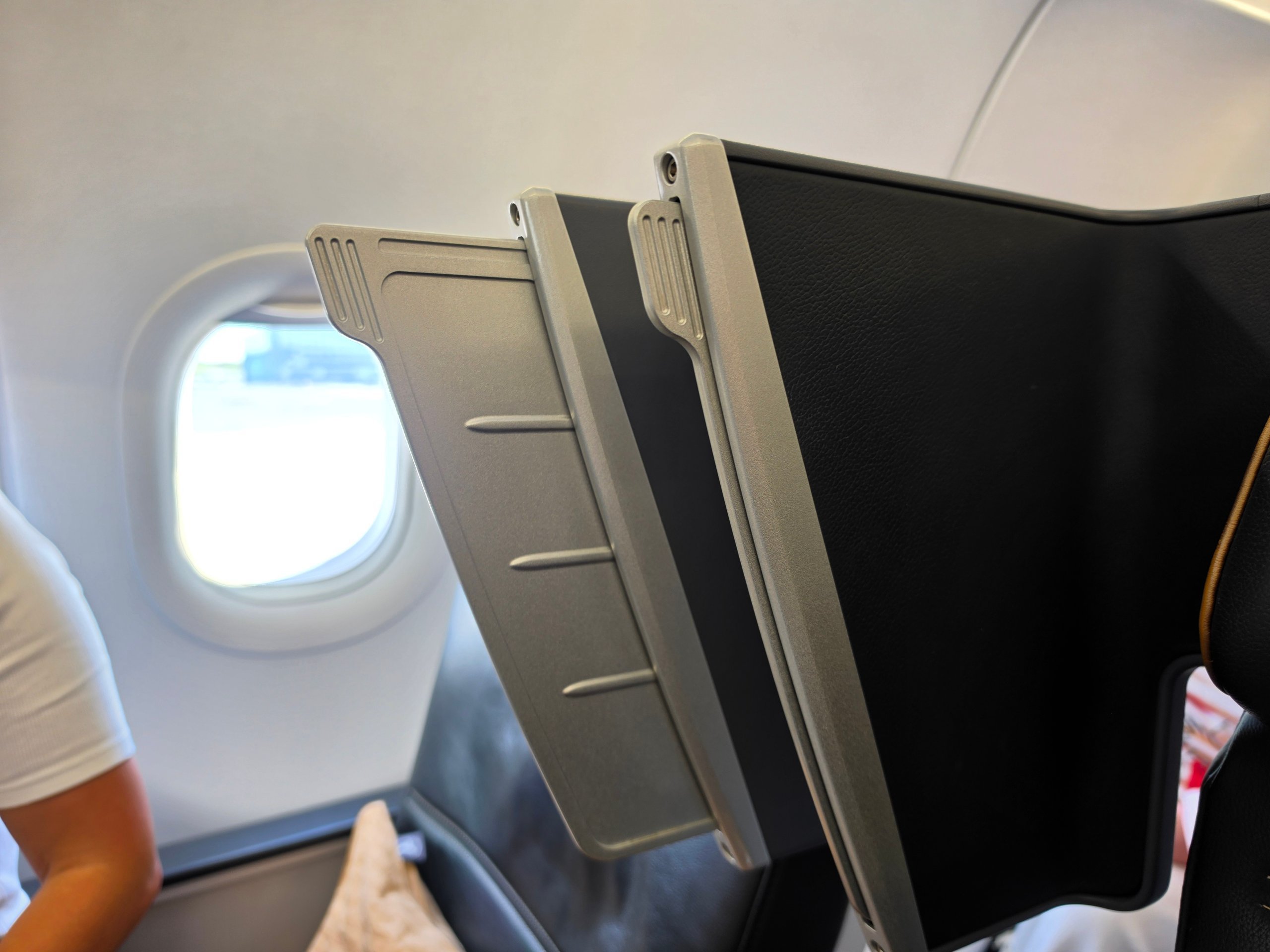
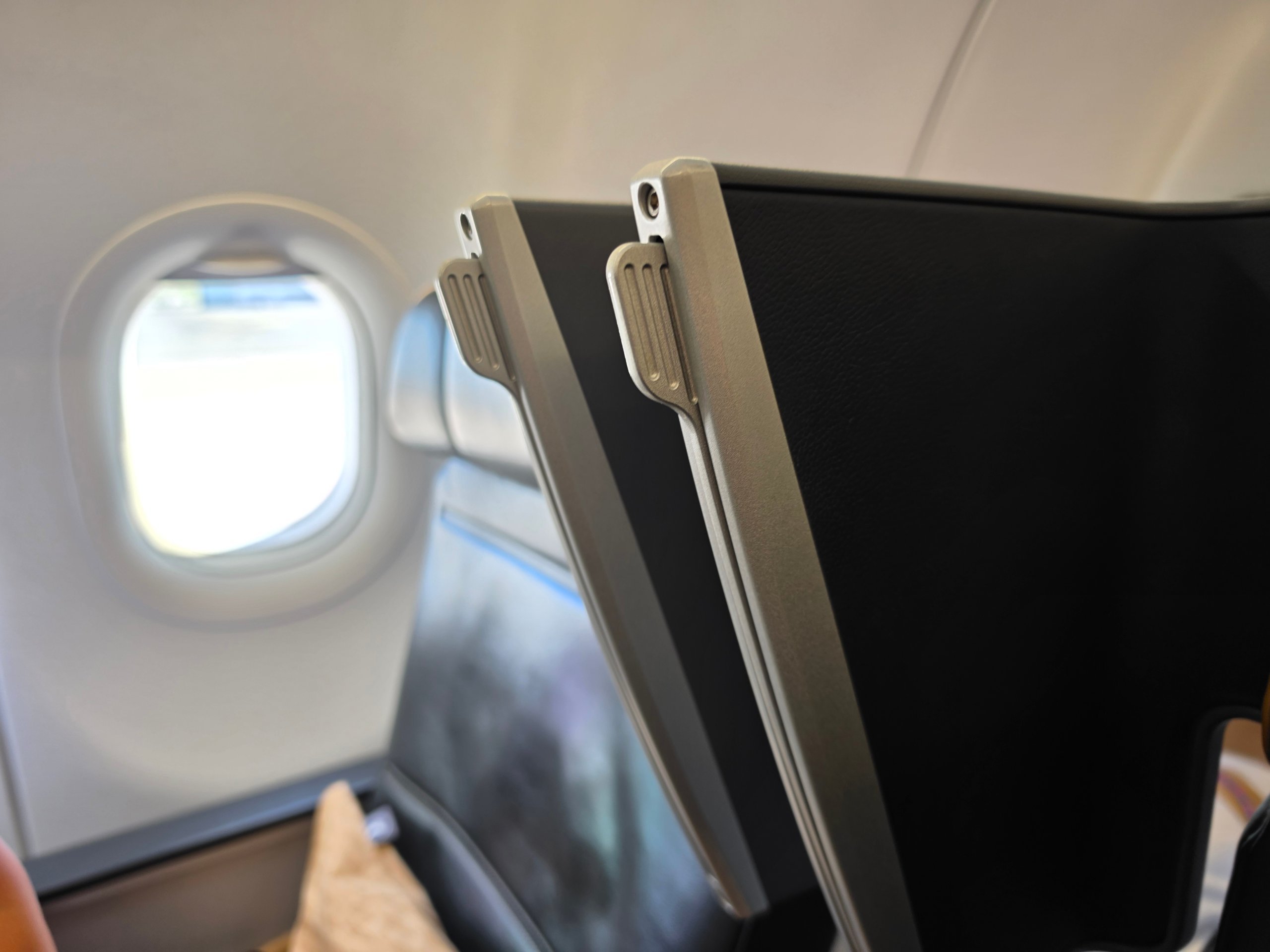
It was only then that it became clear what Turkish Airlines are really good at.
Even before take-off, we were served a welcome drink and a hot towel. At the same time, the cabin crew handed out menus and began taking orders.
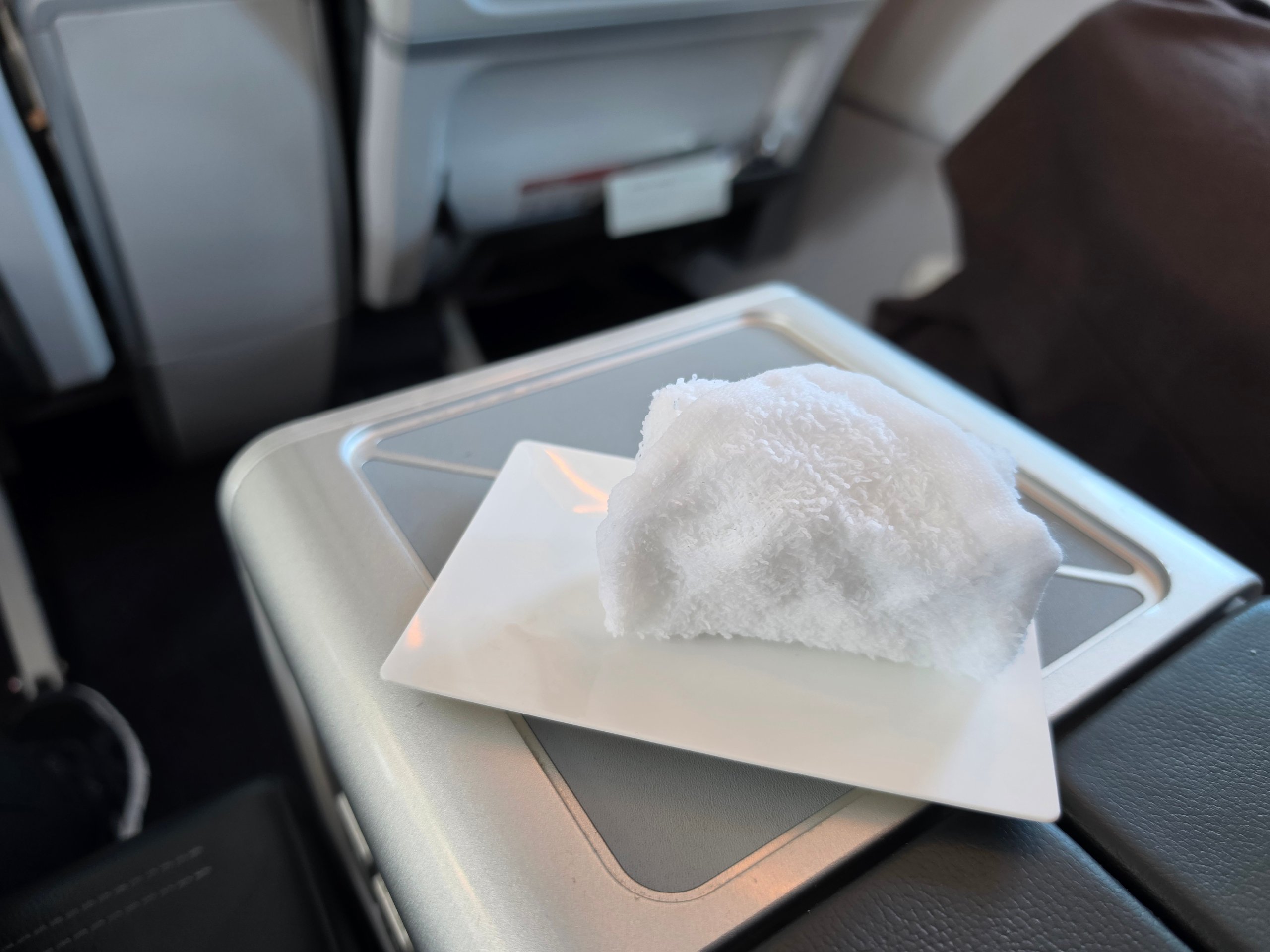
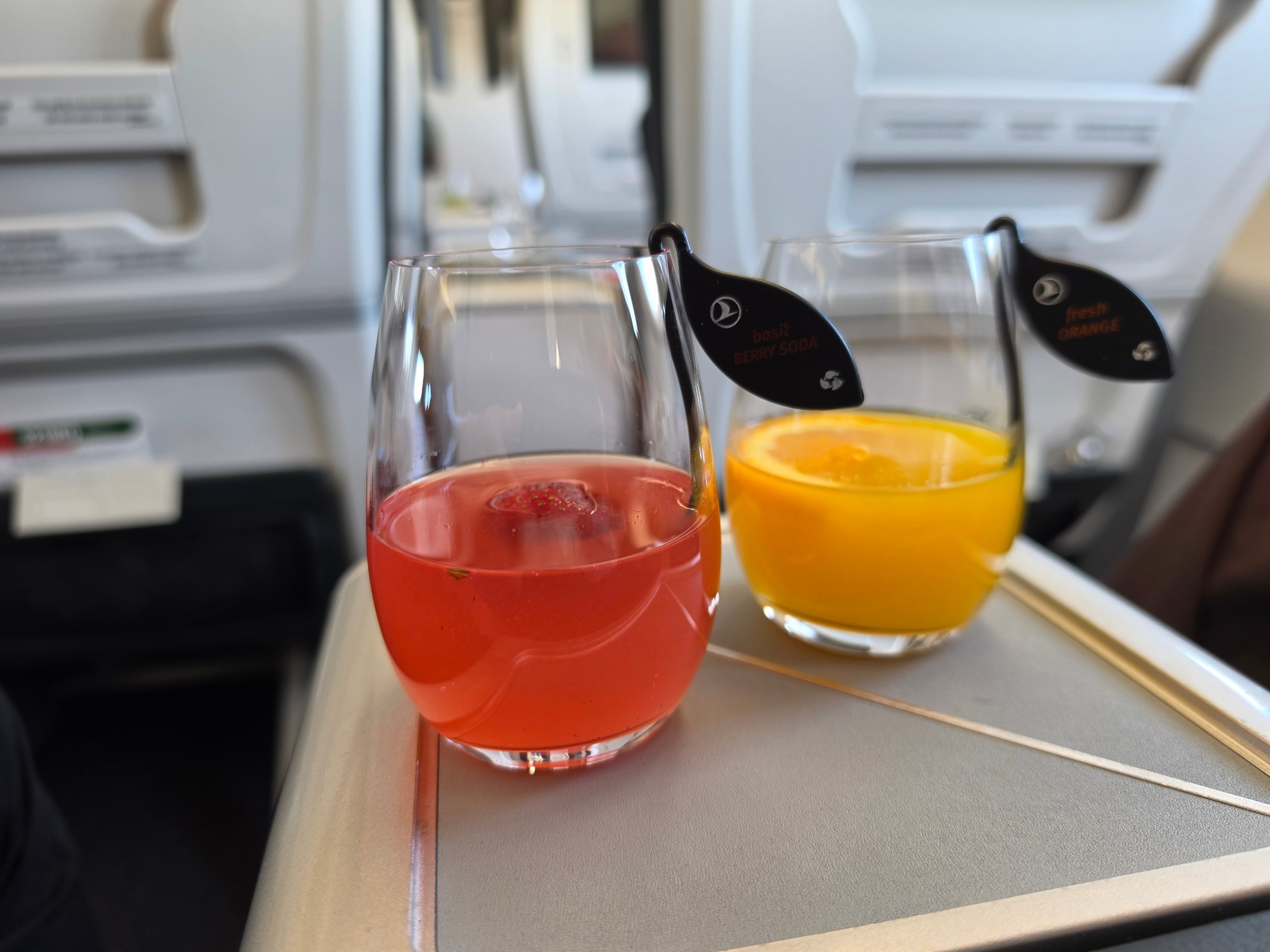
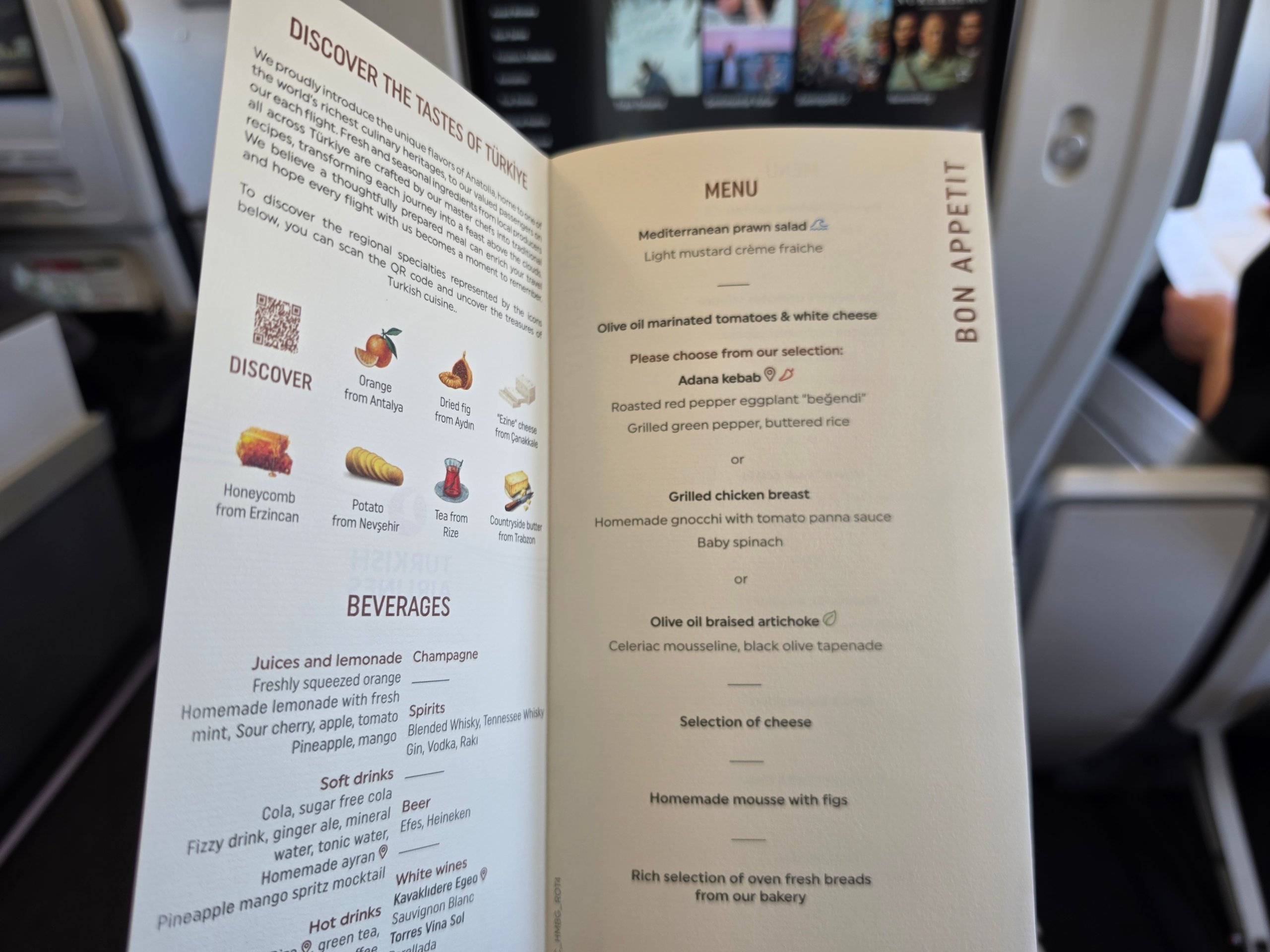
The service began in exactly the same way as on a long-haul flight.
On European routes, business class is often mainly about having the middle seat free, a higher baggage allowance, lounge access and more flexible ticketing. The flight itself is then nothing out of the ordinary.
Turkish didn’t skimp on the service even on this two-hour flight. And that’s exactly what I enjoy most about it.
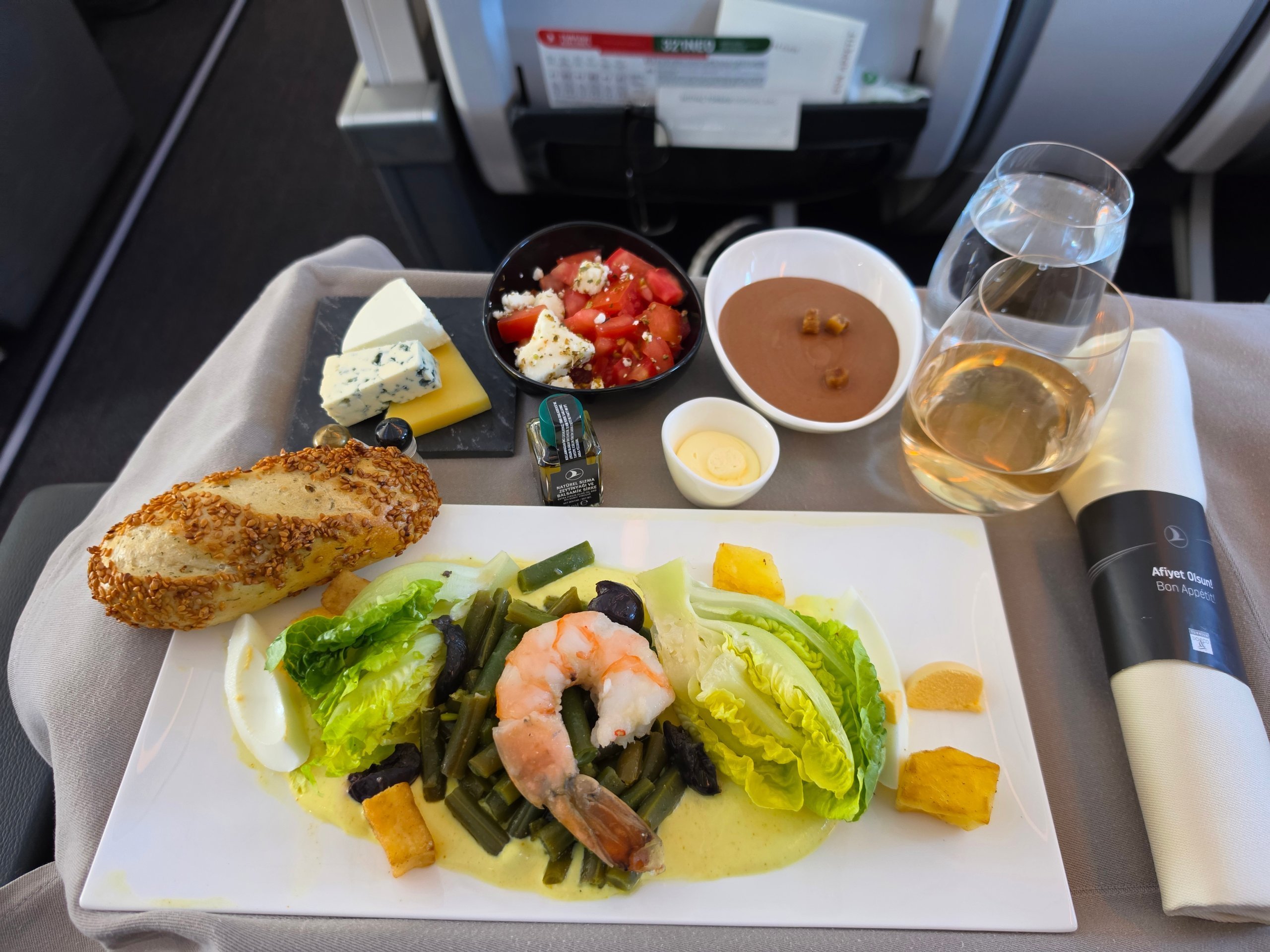
After take-off, we were served a tray with a starter, salad, dessert, bread and a drink.
To be honest, I’ve had slightly better meals before; the salad was a bit ‘worn out’. But it’s possible that, after I don’t even know how many hours, I was the only one who was tired.
As soon as I’d finished the starter, the crew brought a hot main course on the same tray.
No plastic containers and no quick, perfunctory snacks. A proper, full-service meal, just squeezed into a significantly shorter flight.
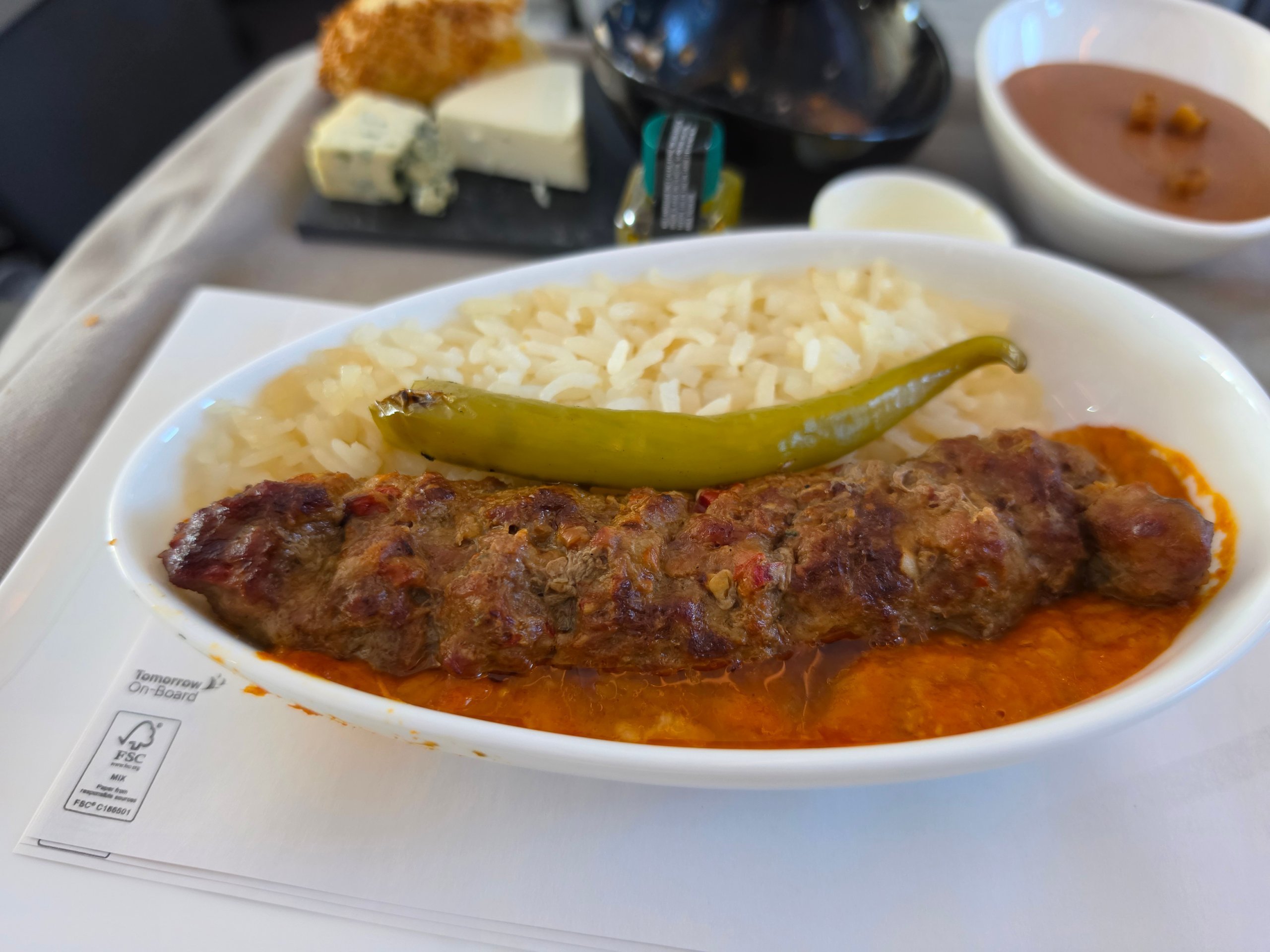
For my main course, I chose the Adana kebab with rice.
I didn’t get it right this time. The dish seemed very dense to me, a bit dry, and overall it didn’t really agree with me.
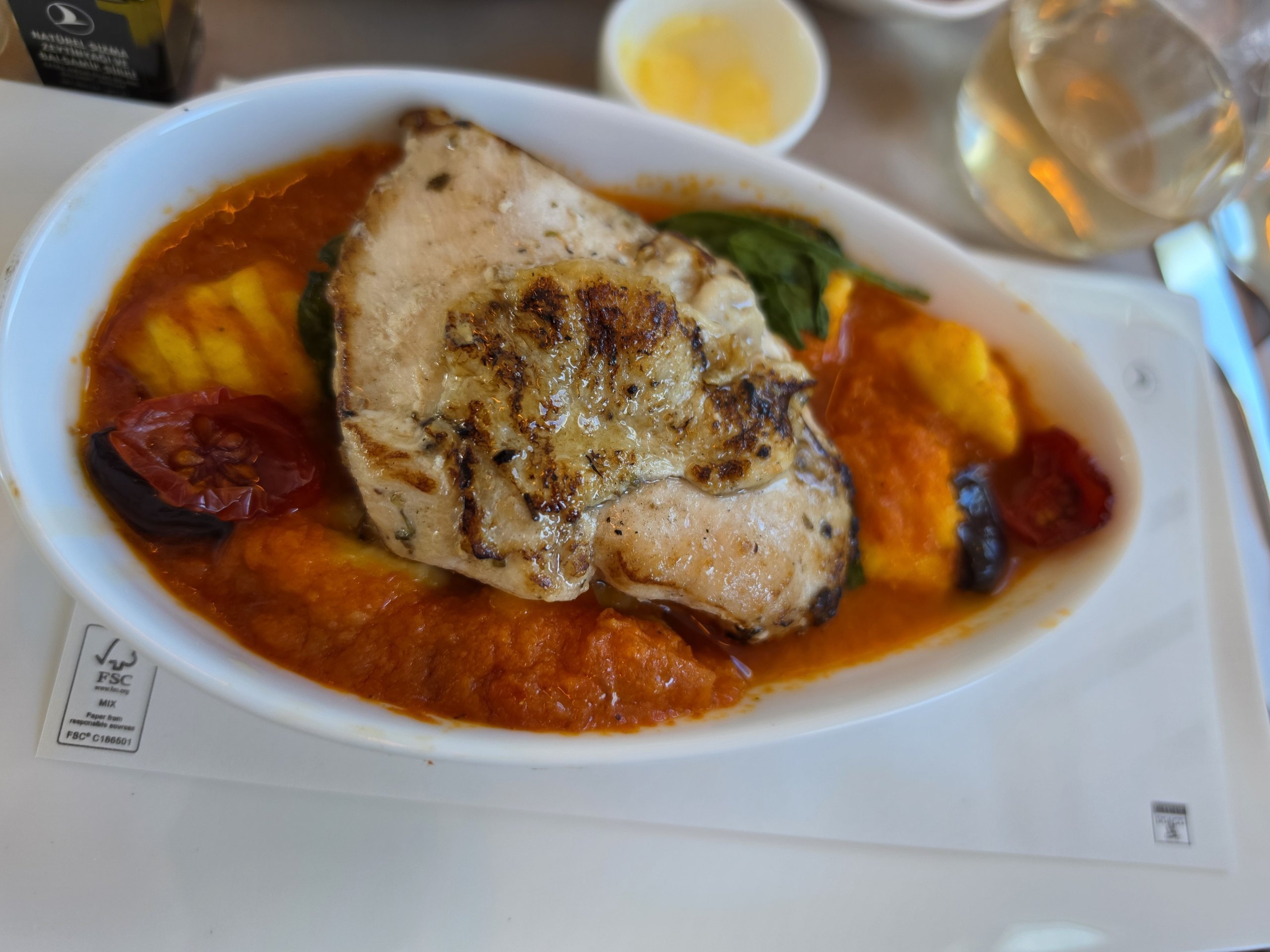
My girlfriend ordered the chicken supreme. Of course, I had a taste, and of course, it was much better than my meal.
So she won the main course contest. The rest of the service, however, was very good and, for such a short flight, actually surprisingly extensive.
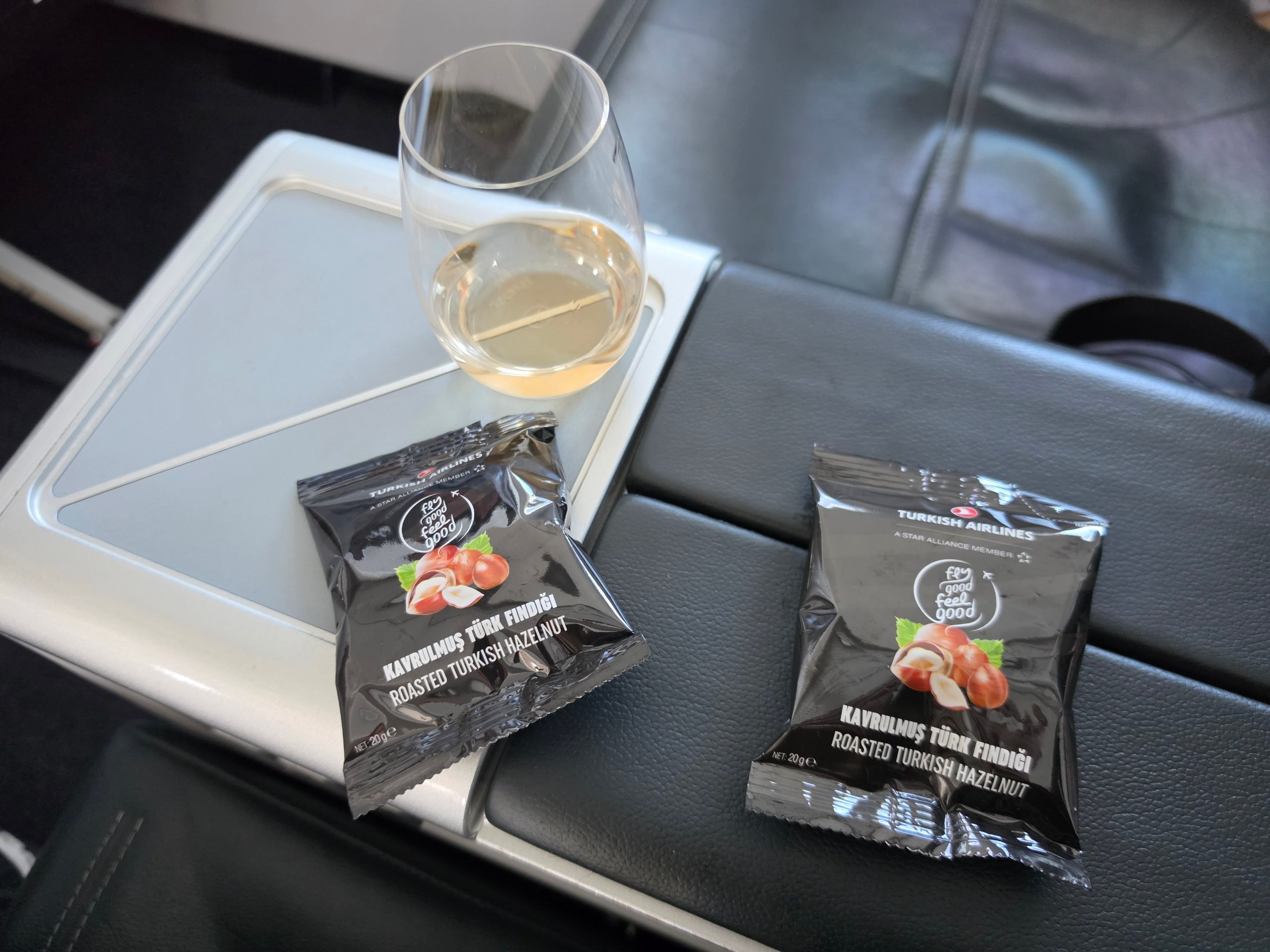
Both alcoholic and non-alcoholic drinks were available without restriction throughout the flight. We were also given some nuts before landing.
The crew managed the entire service without any unnecessary delays and without giving the impression that they had to rush to finish everything before beginning the descent.
I certainly wouldn’t pay any price difference for a two-hour flight. Two hours is still only two hours, and I’d have no trouble getting through them in economy class.
However, if you’re looking to book European business class for the flight itself, Turkish Airlines makes much more sense than most of its competitors.
On our A321neo, we didn’t just get an economy seat with an empty seat next to it.
We were actually given a wider seat, huge legroom, our own screen and a full-service meal with several courses.
Add to that lounge access, priority check-in, a higher baggage allowance and more flexible ticket conditions.
As a short connecting flight on a long-haul journey in Business Class, I think it’s almost the ideal product. And if the price difference compared to Economy Class weren’t unreasonable, I could well imagine buying it as a standalone ticket.
You can find baggage allowances, check-in options and other practical information in our Turkish Airlines guide.
The lounge in Istanbul didn’t impress me again. I wouldn’t have an Antalya kebab a second time. As for the flight itself, however, I have almost nothing to criticise.
For a short hop within Europe? Absolutely brilliant.
If you have any questions or comments about the article...
Hi, I’d like to ask about booking partner flights via AEGAN – what’s your experience been like with this? Did you book one for the first time and find good availability, or are there very few flights available? So far, we’ve mainly been using our Revolut miles for Qatar, but the availability of award flights to destinations we want, such as Thailand, is absolutely dreadful, so I’m looking for better options :D
Hello. Aegean has been my main choice for many years. Now my preference is shifting slightly towards airlines in the OneWorld alliance – but that’s just down to my current flights and future plans.
Availability in business class isn’t great with Aegean, but these days I reckon it’s more or less the same across many loyalty programmes. Put simply, there are a lot of people with loads of miles and not enough bonus seats on the planes :)
When booking through Aegean, I’ve found it pays to wait until relatively the last minute on a few occasions.
I’ve found the best availability on routes to Asia with Air India; I’ve often seen Lufthansa, Thai or Emirates as well.
In First Class, of course, there’s absolutely nothing.
In Economy, on the other hand, there’s practically unlimited availability to anywhere.

So, it’s probably better than standard Euro business class, but then again, if you’re flying on an Embraer 195, for example, I can be sure that nobody’s sitting next to me, and it’s also just a 2-2 – so I’m on my own on one side of the aisle, even if there are two of us flying = in which case we have the whole 2-2 row to ourselves. This one in TK looks much more comfortable, of course, but if I were flying alone, I probably wouldn’t want a stranger sitting next to me in business class like that (and having to climb over them to get to the loo, etc.). What’s more, it significantly limits the airline’s revenue, as they can’t simply adjust the business class layout by moving a partition – something all the classic narrow-body airlines do, and which must, on the contrary, be incredibly flexible. So, to be honest, I’m not entirely sure if this is the right product from TK for European flights; fortunately, there’s a choice depending on personal preference and the airline.
From my perspective as a passenger, it’s definitely a better product than anything else.
Sure, on an Embraer – or, for that matter, on one side of the A220 – you can be sure you’ll always be on your own in the row; that’s true – I hadn’t actually thought of it that way :D
But I really like this. I just feel that TK offers something genuine. Not just ‘business class on paper’.
Oh, and it’s true that the airline’s revenue is also an issue. In other 2-2 configured aircraft, they simply have to leave one seat empty next to every seat. This way, they can easily seat four business class passengers next to each other (which is simply not possible on an Embraer 195 or an A220). And the imbalance between classes can be addressed in ways other than shifting rows – for example, with last-minute discounts in business class or upgrades from economy, whether paid or complimentary. Even so, I found it interesting that almost half the A220 on the Zurich–Prague flight were in Business Class, and they’d moved that partition right to the back :-)