Getting around Thailand

Thailand

It is very easy to travel around Thailand without a car. Domestic flights, trains and long-distance buses operate between the major cities, minibuses run on shorter routes, and ferries sail to the islands.

For the journey from Bangkok to Chiang Mai, a flight or overnight train is a good option; between Phuket and Krabi, a minibus is best; and for Ko Samui, a combined bus and ferry ticket is recommended.

The easiest way is to search for all land and sea options in one place. 12Go compares trains, buses, minibuses, ferries and combined tickets.

Almost everyone in Thailand uses this search engine, and we’ve never had any problems with it whilst travelling. Some buses and ferries can even only be booked via 12Go.

Compare transport options in Thailand on 12Go

Which mode of transport should you choose?

The situation Best option Why
Journey over 700 km Plane Fast, very cheap and frequent
Bangkok -> Chiang Mai / Surat Thani Overnight train Saves a night’s stay in a hotel and is more comfortable than the bus
Cities without a railway Bus or minivan The densest network of connections, usually with several departures a day
Travelling to the islands Combined ticket Includes bus/minivan and connecting ferry
Trips to the countryside and remote areas Hired car / Organised tour Maximum flexibility
Short journeys within cities Grab, Bolt or songthaew Cheap and ubiquitous
Bangkok Metro, BTS and boats Cheap and reliable

The most popular routes and approximate prices

Prices are for a one-way journey and vary depending on the season, the operator and the date of booking.

Route Our recommendations Journey time Price from
Bangkok ->Ayutthaya Train / minivan 1.5 hours 25 thb by train
Bangkok -> Kanchanaburi Train / Minivan 2.5 hours 150 thb
Bangkok -> Chiang Mai Plane / overnight train 1.5 hours by plane / approx. 12 hours by train 1 000 thb
Bangkok → Phuket Plane 1.5 hours 1 000 thb
Bangkok -> Krabi Plane 1.5 hours 1 000 thb
Bangkok → Ko Samui Train + bus + ferry
Plane (Surat Thani) + ferry
Direct flight
approx. 17 hours
approx. 8.5 hours
1.5 hours
900 thb
3 500 thb
7 000 thb
Chiang Mai → Pai Minivan 3 to 4 hours 250 thb
Phuket → Krabi Minivan / ferry 3 hours 350 thb
Krabi → Ko Phi Phi Ferry 1.5 to 2 hours 500 thb
Surat Thani → Ko Samui Bus + ferry 3.5 to 5 hours 450 thb

Find specific connections and current prices

Where can I find connections and buy tickets?

For most tourists, 12Go is the most convenient option. It displays various modes of transport, departure points, operator ratings and combined minibus and ferry tickets all in one place.

Always check the following before paying:

  • the exact departure and arrival points
  • whether the price includes a transfer between the railway station and the port
  • the permitted amount of luggage
  • the terms and conditions for changes and cancellations
  • the name of the operator, as several companies may operate from the same terminal

The names ‘Bangkok’, ‘Phuket’ or ‘Surat Thani’ are not sufficient. A single city may have several bus stations, airports or ports located tens of kilometres apart.

12Go may not always be the absolute cheapest option. A local train or minivan booked on the spot may cost less, but for long-distance journeys, you’ll find booking much easier and be guaranteed a seat.

Domestic flights

Air travel in Thailand is very well-developed and busy, which is reflected in the low airfares.

AirAsia is one of the most prominent and cheapest airlines.

You can also travel cheaply with airlines such as Nok Air, Thai Lion Air or Thai VietJet Air.

Thai Airways and Bangkok Airways tend to be more expensive, but their fares may include more services and luggage allowances.

Flying makes the most sense on the following routes:

  • Bangkok -> Chiang Mai or Chiang Rai
  • Bangkok -> Phuket or Krabi
  • Bangkok -> Hat Yai
  • Chiang Mai -> Phuket or Krabi
  • Bangkok -> Surat Thani, continuing on to the islands

The exception is Ko Samui USM Airport, which is owned by Bangkok Airways.

Direct flights to Samui are therefore several times more expensive than flights to Phuket, Krabi or Surat Thani. We describe cheaper options in the chapter ‘How to get to Ko Samui’.

How much do domestic flights cost?

If purchased a few weeks before departure, a basic one-way ticket typically costs around 1 200 thb.

It is not always the case that you have to book at least a month in advance. Outside the peak season, cheap flights can sometimes be found even a few days before departure.

However, for Christmas, New Year, Songkran and during the peak season from December to March, we recommend booking 1 to 3 months in advance.

With low-cost airlines, be sure to compare the final price. The basic fare usually does not include checked-in luggage or seat selection.

Be aware of the two airports in Bangkok

When searching for flights from Bangkok, always pay attention to the departure or arrival airport. There are, in fact, two airports in Bangkok.

Airport Most commonly used
Bangkok Suvarnabhumi BKK Thai Airways, Bangkok Airways, Thai VietJet Air and some AirAsia flights
Bangkok Don Mueang DMK AirAsia, Nok Air and Thai Lion Air

AirAsia uses both airports, depending on the specific route.

Suvarnabhumi and Don Mueang are on opposite sides of Bangkok. The journey can take between 1½ and 2½ hours.

For connecting flights booked separately, we recommend allowing at least 6 hours between arrival and departure.

By train

Anyone wishing to travel cheaply and relatively comfortably can use the train service on the main routes.

The rail network radiates out from Bangkok in four directions:

  • north via Ayutthaya to Chiang Mai
  • south via Hua Hin, Surat Thani and Hat Yai as far as Malaysia
  • north-east to Nong Khai and Ubon Ratchathani
  • eastwards towards Pattaya and the border with Cambodia
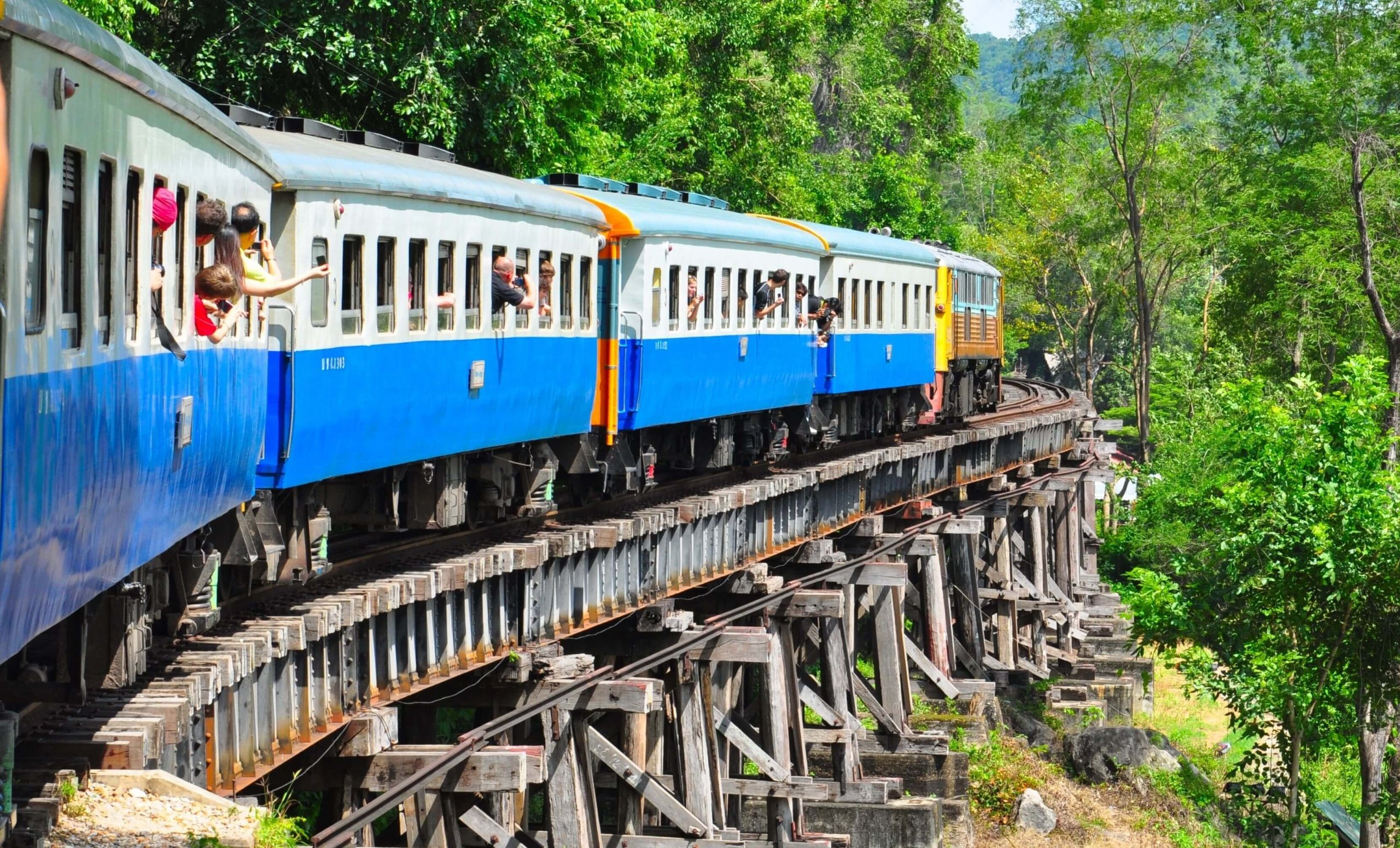
  • west towards Kanchanaburi and the ‘Death Railway’

There is no railway line to Phuket or Krabi. The nearest major station for journeys to the islands in the Gulf of Thailand is Surat Thani.

Night trains and sleeper carriages

The sleeper carriage on the night train between Bangkok and Chiang Mai is very popular. Sleeper trains also run south via Surat Thani and Hat Yai to the Malaysian border.

On the main lines, Thai Railways uses modern, air-conditioned carriages, but on regional routes you will still come across old trains with simple wooden seats.

You can choose from several classes:

  • 3rd class: the cheapest seats, suitable for shorter regional journeys
  • 2nd class with seats: both air-conditioned and non-air-conditioned carriages
  • 2nd class with berths: the best value for money and comfort
  • 1st class: lockable compartments with two berths

In 2nd class, we recommend the lower berth. It is wider, more comfortable and serves as a pair of seats during the day.

The air conditioning tends to be very strong, so do bring a jumper or some long-sleeved clothing.

Where can I buy tickets?

You can book long-distance trains via the official Thai Railways website, D-Ticket, or via 12Go.

The official website is cheaper, but 12Go has a clearer search function and allows you to compare train journeys with bus or air travel.

Find a sleeper train via 12Go

How far in advance should I book a train?

Selected express, fast and tourist trains are available for booking up to 180 days before departure.

Regional and commuter trains cannot be booked online; you’ll need to buy your ticket at the station.

If you want a specific sleeper train, please book:

  • usually at least 2 to 4 weeks in advance
  • during peak season, 1 to 2 months in advance
  • for Songkran, New Year and other Thai public holidays, as soon as possible after tickets go on sale

The previous recommendation to book a berth just 2 to 3 days before departure is no longer sufficient. Lower berths and first-class berths sell out the quickest.

If you have purchased a ticket via the official D-Ticket website, please print it out in accordance with SRT’s terms and conditions. For bookings made via 12Go, please follow the instructions on the voucher.

Which stations do trains depart from in Bangkok?

All long-distance trains to the north, north-east and south depart from the modern Krung Thep Aphiwat Central Terminal, which is located next to Bang Sue MRT station.

Some regional trains still use Hua Lamphong. Trains to Kanchanaburi and Nam Tok mainly depart from Thon Buri station.

Always follow the station name shown directly on your ticket.

Buses and minivans

The bus network is extensive and reliable, and is one of the most widely used forms of transport in Thailand.

Buses are particularly suitable for travelling to towns and cities not served by the railway, such as Pattaya, Sukhothai, Chiang Rai, Pai, Krabi and Phuket.

Long-distance buses

For long journeys, we recommend air-conditioned buses with adjustable seats.

You can usually choose between standard express coaches and more comfortable VIP options with fewer seats.

On night services, blankets, water or light refreshments may be available, but the range of services depends on the operator. The air conditioning is quite powerful, so keep your warmer clothes with you rather than in the luggage compartment.

Check the reviews of a particular operator before booking. The difference between a standard bus and a well-reviewed VIP bus is often greater than the price difference itself.

Minivans

On shorter routes, less comfortable minivans are often used instead of buses. Most of them are air-conditioned and depart either according to a timetable or once they are full.

Minivans are fast, but have limited luggage space. If you are travelling with a large suitcase, the operator may charge an extra fee or require you to purchase an additional seat.

Where can I buy tickets?

You can book long-distance buses and minibuses via 12Go or buy tickets directly at the bus station.

For regular routes, booking a few days in advance is usually sufficient. Before weekends, during peak season and on Thai public holidays, buy your ticket earlier.

Compare buses and minivans on 12Go

After purchasing your ticket, check the carrier’s terms and conditions. For many services, a QR code or voucher on your phone is sufficient, but this does not apply to all companies.

Bus stations in Bangkok

Bangkok has several large bus terminals:

  • Mo Chit: northern and north-eastern Thailand, such as Chiang Mai, Chiang Rai or Sukhothai
  • Ekkamai: eastern Thailand, such as Pattaya, Rayong and connecting services to Ko Chang
  • Southern Bus Terminal (also known as Sai Tai Mai): southern and western Thailand, such as Phuket, Krabi, Hua Hin or Kanchanaburi

For details on transport between the terminals, see the section on Transport in Bangkok.

Ferries and transport to the islands

Traditional ferries, fast boats and speedboats operate to the Thai islands. Many journeys can be booked as a combined ticket, which includes minivan pick-up, transfer to the harbour and the onward boat journey.

Island or region Main departure point
Ko Samui and Koh Phangan Donsak near Surat Thani
Ko Tao Donsak, Chumphon or Ko Samui
Ko Phi Phi Phuket, Krabi or Ao Nang
Ko Lanta Krabi, Trang, Phuket or Ko Phi Phi
Ko Yao Noi and Ko Yao Yai Phuket or Krabi
Ko Lipe Pak Bara, and during the high season also Ko Lanta and Phuket

Phuket is connected to the mainland by a bridge and Ko Lanta by car ferries, so minivans and cars also travel to both islands.

We describe the transport links in detail in our guidebooks:

When should you book a ferry?

It is usually sufficient to book a ferry a few days in advance. We recommend booking earlier:

  • during Christmas and the peak season
  • before the Full Moon Party on Koh Phangan
  • if you are travelling in a larger group
  • if you need a specific connecting bus or train
  • if you’re catching the last ferry of the day

In the Andaman Sea, there are fewer services during the rainy season and some seasonal routes do not operate at all. Services may also be affected by waves and weather conditions.

Compare ferries and combined tickets

Please check the specific port before paying.

For example, in Phuket, Krabi and Ko Samui there are several piers, and travelling by car between them can take tens of minutes.

Do not plan a tight connection to the ferry when travelling on a separately booked flight, train or bus. The weather may cause delays, and the ferry operator is not responsible for missed separate bookings.

Car hire

Hiring a car is particularly worthwhile when travelling around the islands, national parks and rural areas.

For journeys between major cities, it is usually cheaper to travel by plane, train or bus.

There are many large international car hire companies operating in Thailand. A small car typically costs around 1 000 thb per day.

We recommend, for example, the following car:

  • in Phuket and Koh Samui
  • in Krabi province
  • when travelling around northern Thailand
  • when visiting national parks
  • if you’re travelling in a group of two to four people

In Bangkok, on the other hand, a car is more of a hassle due to traffic jams, difficult parking and the high standard of public transport.

Compare car hire prices in Thailand

What do you need to drive?

In Thailand, they drive on the left.

To drive, you need a national driving licence and a valid international driving permit. The car hire company may not check it when you collect the car, but you will need it in the event of a police check or an accident.

Before setting off, please check:

  • the excess amount and the scope of cover
  • the terms of the security deposit and the type of payment card required
  • the option to return the car in a different city
  • the condition of the tyres and the compulsory equipment
  • any pre-existing damage

Take photos and videos of the car from all angles when you collect it.

You can find our specific experiences in the articles ‘Car hire in Ko Samui ’ and ‘Car hire in Phuket’.

Scooter hire

Travelling by scooter or motorbike is a very popular means of transport for both locals and tourists.

A scooter is cheap and flexible, but carries a significantly higher risk of an accident than a car. Local traffic is chaotic, heavy in towns, and on the islands the roads can be steep, winding and very slippery after rain.

A standard scooter costs around 250 thb per day. You’ll find hire companies in all holiday resorts, and advance booking is usually not necessary.

What kind of driving licence do you need?

Standard Thai scooters have an engine capacity of 110 to 160 cc and are legally classified as motorbikes.

To ride legally, you will need:

  • the appropriate category for a motorbike on your national driving licence
  • an international driving licence
  • a helmet

Category B for passenger cars alone is not sufficient. Just because a hire company hands you a scooter without checking your licence does not mean you are allowed to ride it.

In the event of an accident, the insurance company may refuse to cover medical treatment and damage if you did not hold the correct driving licence.

What should you look out for at a hire company?

  • Do not leave your passport as collateral.
  • Take a photo of the whole scooter before collecting it.
  • Check the brakes, lights, tyres and helmet.
  • Get any existing damage confirmed in writing.
  • Check the scope of the insurance cover, which is often very limited.
  • Only hire a scooter if you already have experience riding a motorbike.

Taxis, Grab and Bolt

For getting around cities and holiday resorts, the easiest option is to use the Grab or Bolt mobile apps.

Grab has the widest coverage and operates in Bangkok, Chiang Mai, Pattaya, Hua Hin, Phuket, Krabi, Ko Samui and many other cities.

Bolt tends to be cheaper, but operates in fewer areas and may have fewer drivers available.

Uber does not operate in Thailand.

Advantages of mobile apps:

  • you can see the price before booking
  • you don’t have to explain the address
  • you can track the route
  • For most journeys, you can pay by card or in cash
  • Your journey history and driver details are saved in the app

The price may not include motorway tolls, airport surcharges or parking fees. At some airports, Grab and Bolt drivers have designated pick-up points away from the usual taxi ranks.

In remote areas and on smaller islands, do not rely on the apps being available. Arrange your return journey in advance with the driver or your hotel.

If you’re arriving at night, travelling with children or heading to a remote holiday resort, you can book a private airport transfer in advance.

Book an airport transfer via Booking

Regular taxis

Traditional taxis, which you can hail on the street, are available everywhere and at almost any time of day or night.

However, the fare is usually negotiated (except for some taxis in Bangkok, which use meters).

Booking transport online

Grab, Bolt, navigation and communication with the driver all require mobile internet. You can install an eSIM before you fly and connect immediately upon arrival.

Buy an eSIM for Thailand via Airalo

Songthaew, tuk-tuks and motorbike taxis

Songthaew

A songthaew is a pick-up truck with benches in its covered load area. In smaller towns and on the islands, it serves as a substitute for regular public transport.

Some songthaews run on fixed routes, whilst others operate as shared taxis. Before getting on, ask the driver if they are going to your destination and confirm the fare.

Payment is usually made in cash when you alight.

Tuk-tuk

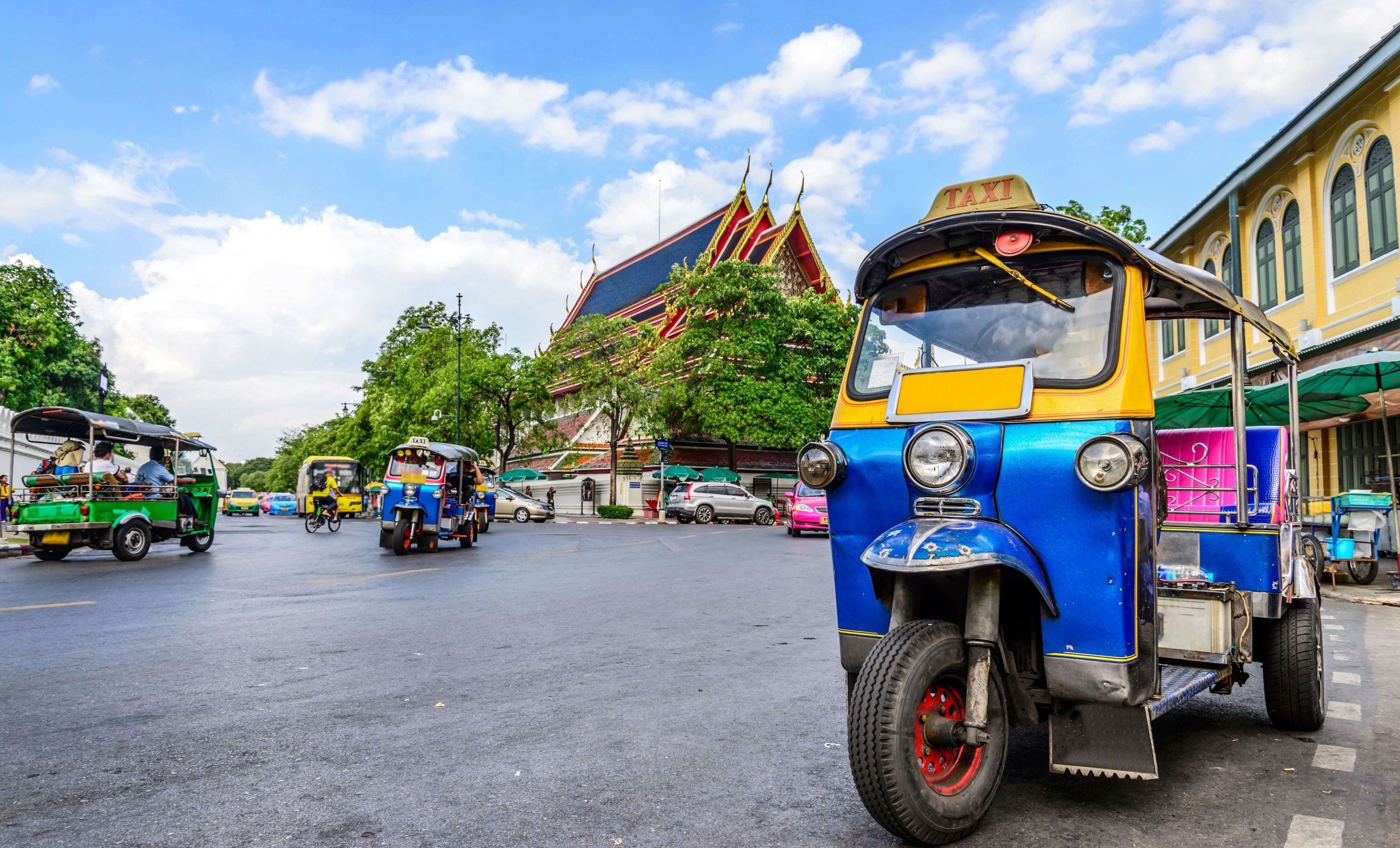
A tuk-tuk is more of a tourist experience than the cheapest form of transport. It doesn’t have a meter, so you’ll need to agree on the price in advance.

In the tourist areas of Bangkok and Phuket, tuk-tuks tend to be more expensive than taxis booked via an app. Refuse any offers of suspiciously cheap rides that involve visits to shops, tailors or currency exchange bureaux.

Motorcycle taxis

You can recognise motorbike taxis by their drivers wearing colourful vests. They’re handy for short journeys in heavy traffic, but we don’t recommend them if you have a lot of luggage or aren’t wearing a good-quality helmet.

In Bangkok, you can also book a mototaxi via Grab.

Public transport

In the capital, Bangkok, you can use the metro, the BTS Skytrain, buses, commuter trains and boats. It is the only Thai city with an extensive, modern public transport system.

For your first visit, we recommend combining the metro and the BTS with boats on the Chao Phraya River. Buses are cheap, but their routes are less straightforward for visitors.

You can find full prices, maps and payment methods in the guides ‘Transport in Bangkok ’ and ‘The Metro in Bangkok’.

Other Thai cities do not have public transport systems of a comparable scale. They rely on local buses, songthaews, tuk-tuks, taxis and mobile apps.

You can find detailed local information here:

Organised excursions

Although you can reach some places in Thailand by public transport, an organised tour often makes more sense due to the need for several changes, a lack of local connections or the need to hire a boat.

The advantages usually include being picked up directly from your hotel, transport between the various destinations, and a return journey on the same day. We particularly recommend organised trips to:

  • from Bangkok to Ayutthaya, Kanchanaburi or the floating markets
  • from Chiang Mai to Doi Inthanon National Park and the mountainous regions
  • from Phuket and Krabi to Ko Phi Phi, the Hong Islands or Phang Nga Bay
  • from Koh Samui to Ang Thong National Park or the surrounding islands
  • when visiting places where you need several different transfers in a single day

The best way to compare the range of tours, prices and reviews of specific tour operators is via GetYourGuide.

Compare tours and prices on GetYourGuide

Before booking, check that the price includes:

  • pick-up and drop-off at your hotel
  • entrance fees to attractions or national parks
  • ferry transport and any transfers between islands
  • food and drinking water
  • snorkelling equipment
  • an English-speaking guide

For cheaper trips, pick-up may only be included from the main resorts. For more remote hotels, there is sometimes a surcharge, or you may have to make your own way to the designated meeting point.

Practical advice for travelling in Thailand

  • Arrive at the railway station, coach station or port at least 30 minutes before departure.
  • Make sure you have cash and small notes for buses, minibuses, songthaews and regional trains.
  • When travelling during Thai public holidays, book your transport well in advance.
  • Do not plan tight connections for separately purchased flight tickets, trains and ferries.
  • For minibuses, check in advance whether large suitcases are permitted.
  • If arriving at night, check that you can still get from the terminal to your hotel.
  • Your ticket may list the transport operator’s office or your hotel as the departure point, rather than the main station.
  • On air-conditioned buses and trains, make sure you have warmer clothes with you.

If you are staying overnight before a morning flight, train or ferry, choose accommodation based on the specific terminal.

In Bangkok, Surat Thani, Krabi or Phuket, individual stations, airports and ports may be some distance apart.

Book a hotel in Thailand


This article may contain affiliate links from which our editorial team may earn commissions if you click on the link. See our Advertising Policy page.

Any questions left?

If you have any questions or comments about the article...

3 comments

Sign in to Cestee

... the worldwide travel community

Continue with Facebook

Do not have your travel account yet? Sign up