Riga from Prague with airBaltic on a wide range of dates until August 2027
99 €



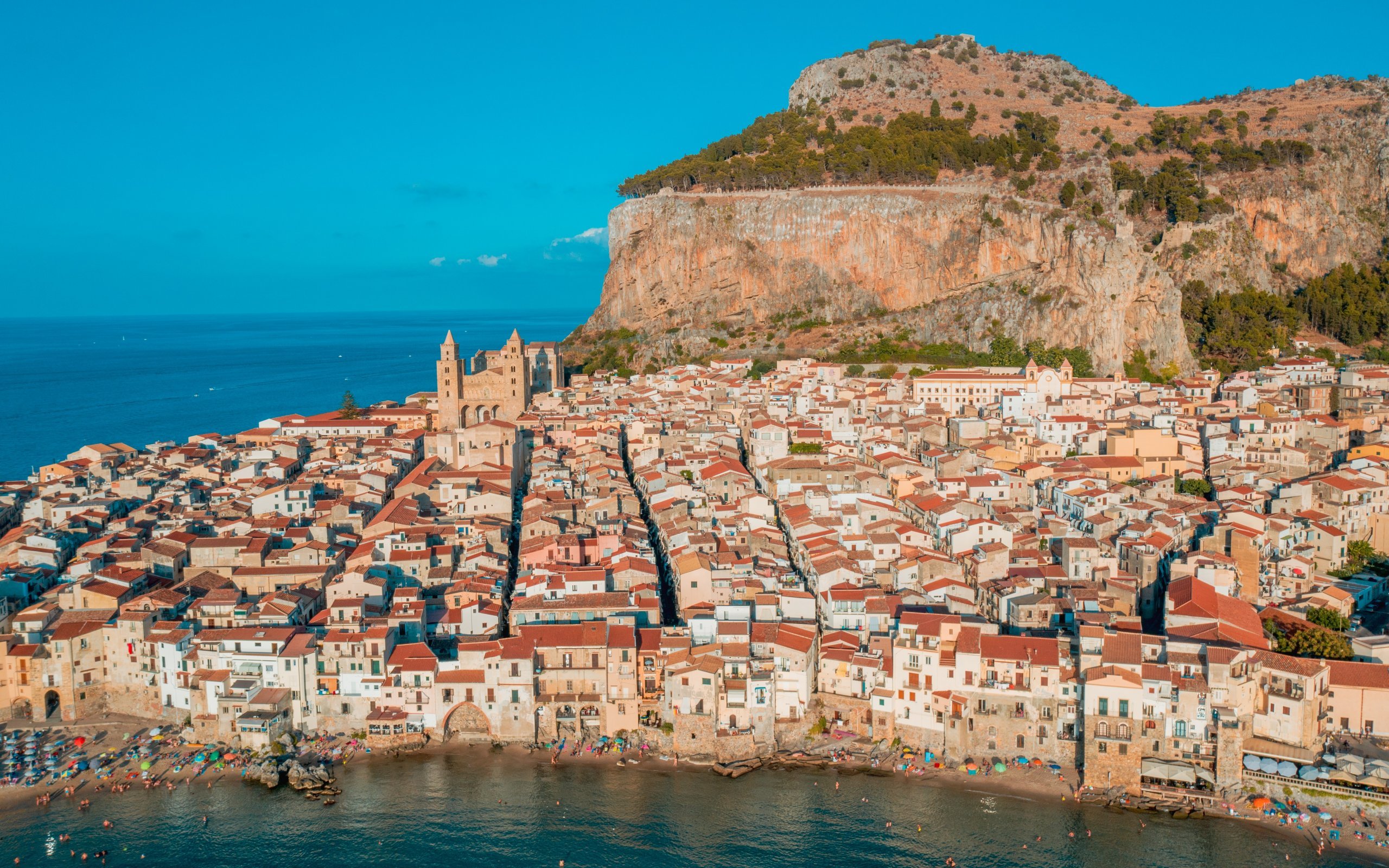
Cefalù is a historic seaside town on the northern coast of Sicily, about 70 km east of Palermo. It combines a sandy beach, medieval streets, a Norman cathedral and a viewpoint from the Rocca di Cefalù cliff, all in one place.
It is easy to get here from Palermo by direct train. Cefalù is therefore one of the best day trips in Sicily.
If your itinerary allows, we recommend staying here for at least one night. The town centre is quieter in the mornings and evenings, and the town has a much more pleasant atmosphere than during the middle of the day.
You’ll need about 4 to 5 hours to explore the historic centre, the cathedral and enjoy a short break on the beach. If you also want to climb up to the Rocca di Cefalù, set aside a whole day.
We reckon the best plan is to spend one night in Cefalù. The afternoon visitors will gradually leave, and you can enjoy dinner in the centre, the sunset on the beach and the following morning without the biggest crowds.
For a holiday focused purely on the beach or trips to the Madonie Mountains, it makes sense to stay for 2 to 4 nights. However, Cefalù is not a suitable base for trips to Catania, Mount Etna or south-eastern Sicily.
The main town beach, Spiaggia di Cefalù, stretches along the Lungomare Giuseppe Giardina promenade. It is covered in fine, light-coloured sand and the entry into the sea is gentle. The beach is therefore also suitable for families with children.
It takes about 10 minutes to walk to the beach from the railway station. It’s a further 5 to 10 minutes’ walk to the historic centre.
The beach is divided into freely accessible sections and paid beach clubs.
The price for a set of two sun loungers and a parasol usually ranges from around 25 eur to 45 eur per day. It depends on the time of year, the specific club and the distance from the sea. The front rows can be even more expensive during the peak season.
The public sections of the beach are free, but they fill up quickly during the summer.
If you want a good spot for your own towel, it’s best to arrive in the morning. Another option is to go for a swim in the late afternoon, when some of the visitors have left.
The most photogenic spot is the small beach by the old harbour, from where you can see historic houses built right on the seafront. However, for a full day’s swimming, the wide beach along the promenade is more practical.
You’ll find quieter alternatives outside the town centre:
The historic centre is small and can easily be explored on foot. The most picturesque route leads from the old harbour through Porta Pescara, past the medieval washhouse (Lavatoio Medievale) and along the main street, Corso Ruggero, to Piazza del Duomo.
The town’s main landmark is the Cattedrale di Cefalù, one of the most significant Norman buildings in Sicily. It forms part of the UNESCO World Heritage Site ‘Arab–Norman Palermo and the Cathedral Churches of Cefalù and Monreale’.
Construction of the cathedral began in 1131 during the reign of Roger II. The most valuable part of the interior consists of Byzantine mosaics featuring a monumental figure of Christ Pantocrator.
Entry to the main part of the cathedral is free. Paid guided tours include, depending on the option chosen, the towers, the roof, the cloister, the treasury and a closer look at the mosaics.
Entry to the cathedral itself is free. There are three paid guided tours:
You can find the latest opening times on the cathedral’s official website.
Cefalù is not a town with dozens of major sights. Its main charm lies in the interplay of its medieval alleyways, stone houses, small squares and views of the sea.
The most interesting sights include the medieval washhouse, the Lavatoio Medievale; the town’s only surviving gate, the Porta Pescara; and the old harbour, the Vecchio Molo. It is from the pier that the famous view of the houses built right above the coastline opens up.
The massive limestone rock of Rocca di Cefalù towers 268 metres above the town. From the summit, you can see the entire historic centre, the coastline and the Madonie Mountains.
The start of the trail is located above Via Saraceni. Along the way, you’ll pass medieval fortifications, the remains of the Tempio di Diana and the ruins of the castle at the summit.
Allow approximately 1.5 to 2.5 hours for the ascent, stops and return journey. The route isn’t long, but it is steep and there is little shade for most of the day.
Open-toed shoes, sandals and flip-flops are not permitted. Staff may refuse entry if you are not wearing closed shoes with a solid sole. Make sure you take plenty of water with you, and in summer it is best to set off in the morning.
Check the official Cefalù tourism website for current opening times and rules.
Staying in Cefalù is worthwhile for more than just the beach. The best moments in the town come in the evening and early in the morning, when the day-trippers from Palermo have left.
When choosing accommodation, location is the key factor:
Accommodation and hotels in Cefalù
Based on location, we particularly recommend the following accommodation options:
In summer, well-located hotels are among the quickest to sell out on Sicily’s northern coast. It is therefore worth booking your accommodation in advance, ideally with the option of free cancellation.
If you’re including Cefalù as part of a longer tour, do have a look at our section on where to stay in Sicily.
From Palermo, Messina or Milazzo, I’d take the train to Cefalù. It’s fast, direct and runs much more frequently than buses. Cefalù railway station is about a 10-minute walk from the beach and 15 minutes from the cathedral.
A car is mainly worth it if Cefalù is one of the stops on a tour of Sicily or if you want to carry on to the Madonie Mountains.
Check train timetables and buy tickets on the Trenitalia website.
Fares for regional trains are fixed, and it is not necessary to buy a ticket well in advance. For Intercity trains, fares may vary and the ticket includes a seat reservation.
Buses are not the best option when travelling from Palermo, but they are important for connecting Cefalù with the inland areas and the villages in the Madonie Mountains.
Check timetables on the SAIS Trasporti website. Google Maps may not show all regional services or their current times. For SAIS buses, you must book a specific service, so buy your ticket in advance online or at the ticket office.
Cefalù is situated on the A20 motorway, about 70 km from Palermo, 160 km from Messina and 180 km from Catania. A car is practical for travelling along the north coast and into the Madonie Mountains, but the train is more convenient for a day trip from Palermo.
Do not drive into the historic centre. Most streets are part of the ZTL zone, and entry is permitted only to residents and registered guests of certain accommodation providers.
You can park along the Lungomare Giuseppe Giardina, near the railway station, or in private car parks to the west of the city centre.
In July and August, beach car parks tend to be full during the morning. It is best to arrive before 9.00 am or choose accommodation in Cefalù with its own parking space.
You can find details on travelling around the island in the sections ‘Transport in Sicily ’ and ‘Car hire in Sicily’.
Discover all the places to see in Sicily.
If you have any questions or comments about the article...