From Ostrava to Uzbekistan from November to March 2027
409 €



The Mexican Caribbean coast looks perfect in the catalogue photos. White sand, turquoise water and palm trees.
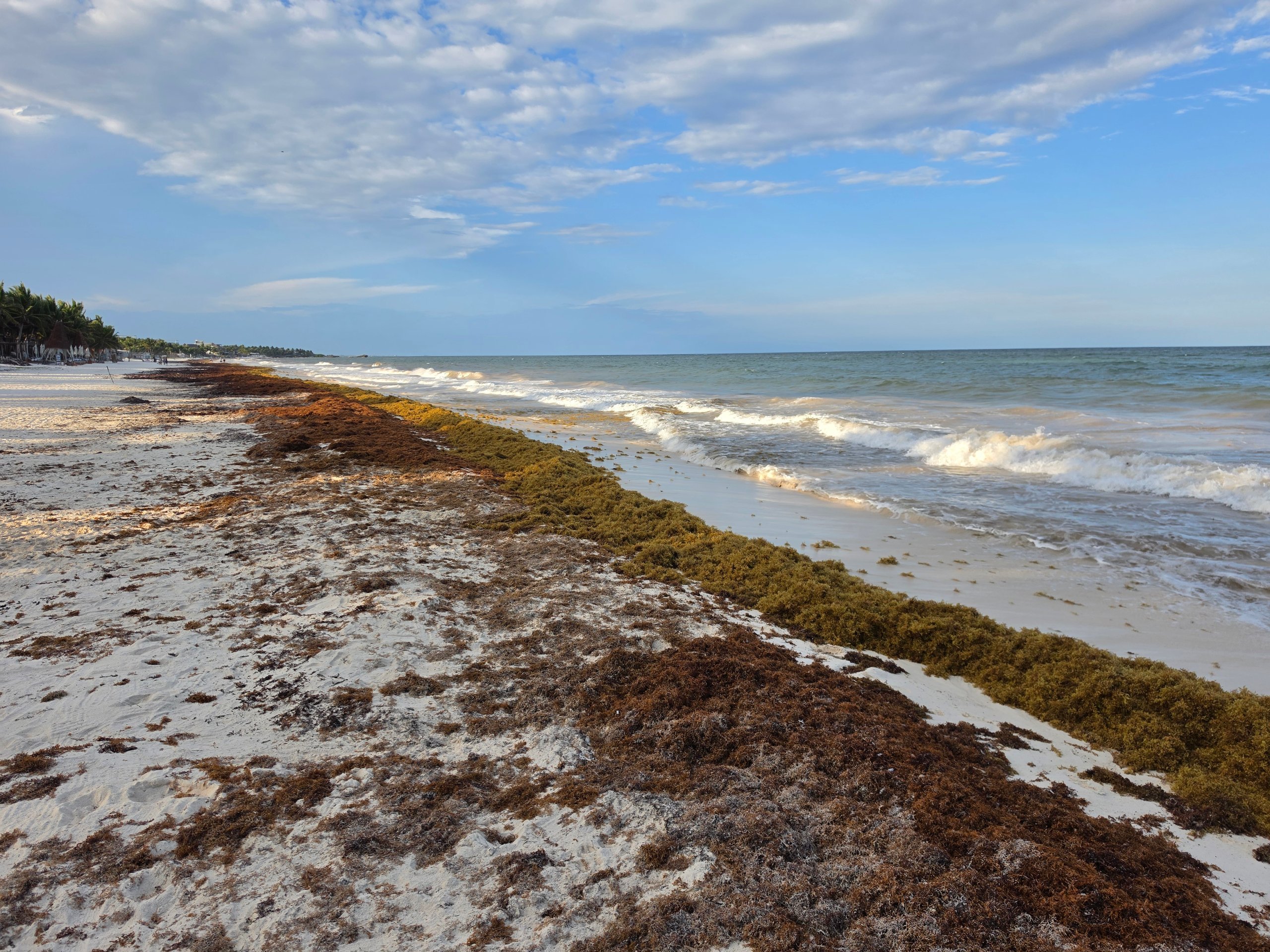
The reality during the sargassum season can be quite different.
During our trip in May 2026, we saw beaches almost free of seaweed as well as stretches of coastline covered in a continuous brown layer several metres wide.
The situation was worst in Tulum, Playa del Carmen and on the open southern side of the Zona Hotelera in Cancún.
By contrast, we found clear water on the west coast of Isla Mujeres, on Isla Contoy and in the small sheltered bay of the Bahia Principe Akumal hotel.
This article is therefore not a list of beaches that will always be free of sargassum. No such guarantee exists in the Mexican Caribbean.
We’ll show you places where, thanks to the orientation of the coastline, the location of the islands or artificial breakwaters, the sea is most likely to remain clear in the long term.
If you’re still choosing a holiday destination, start with our comparison of Cancún, Playa del Carmen, Tulum and other areas. In this article, we focus solely on beaches and sargassum.
There is no exact start or end date, and it varies from year to year.
Generally speaking, however:
Even a winter trip is no absolute guarantee, and in particularly heavy years the season may start earlier (as early as the end of March).
When choosing a holiday several months in advance, the location of the beach is therefore more important than photos from last week.
We consider the following to be the best options:
The map distinguishes between four types of locations:
The map shows the long-term risk based on the location and nature of the coastline, not the current conditions on a specific day.
If your main priority is a lovely sandy beach with as little risk of sargassum as possible, we’d choose Isla Mujeres.
The best areas are the northern and western coasts, facing towards Cancún. The island itself shields this side from the seaweed drifting in from the open Caribbean, and the water in Bahía de Mujeres is also calmer.
The most reliable spots are, in particular:
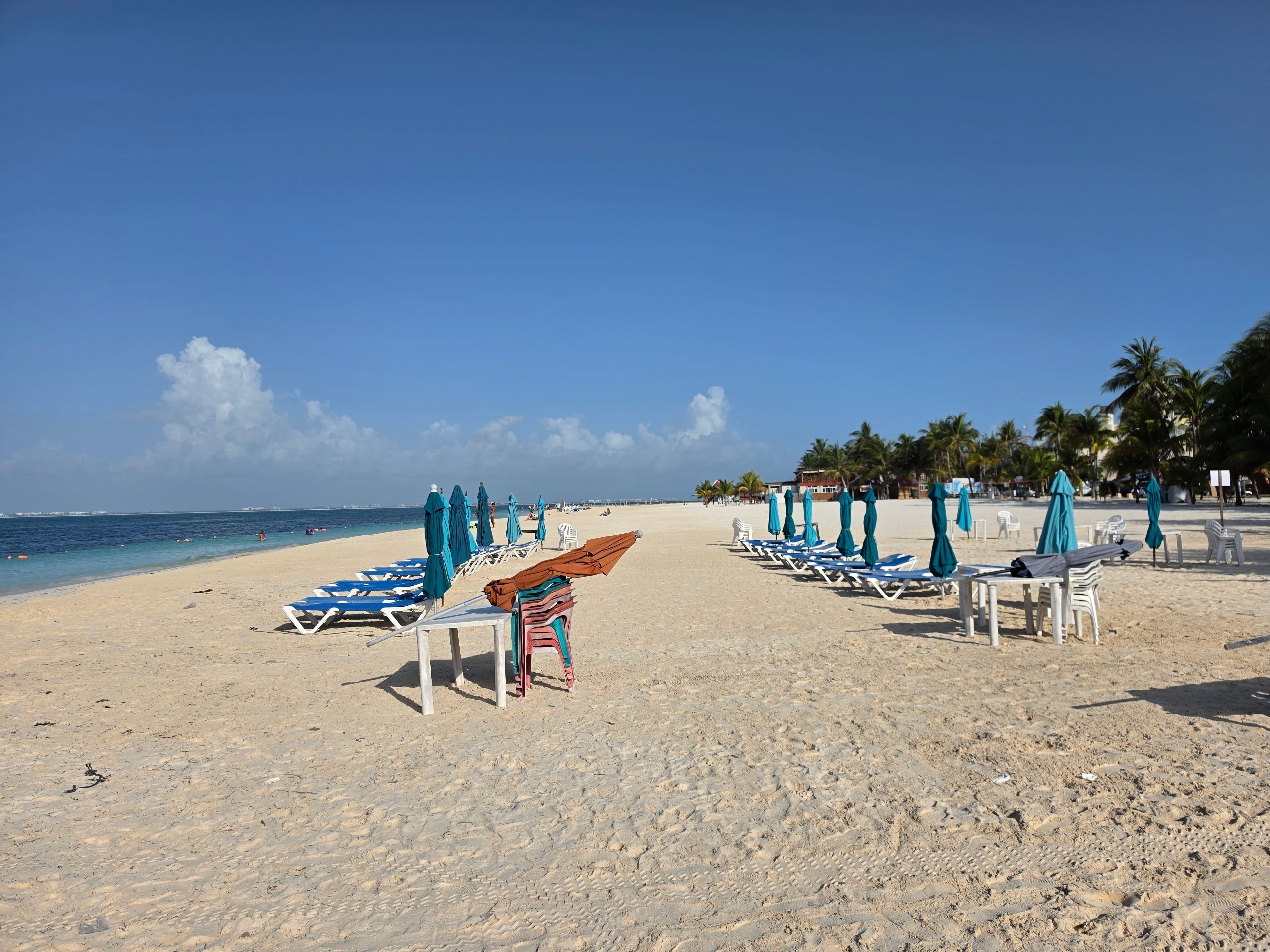
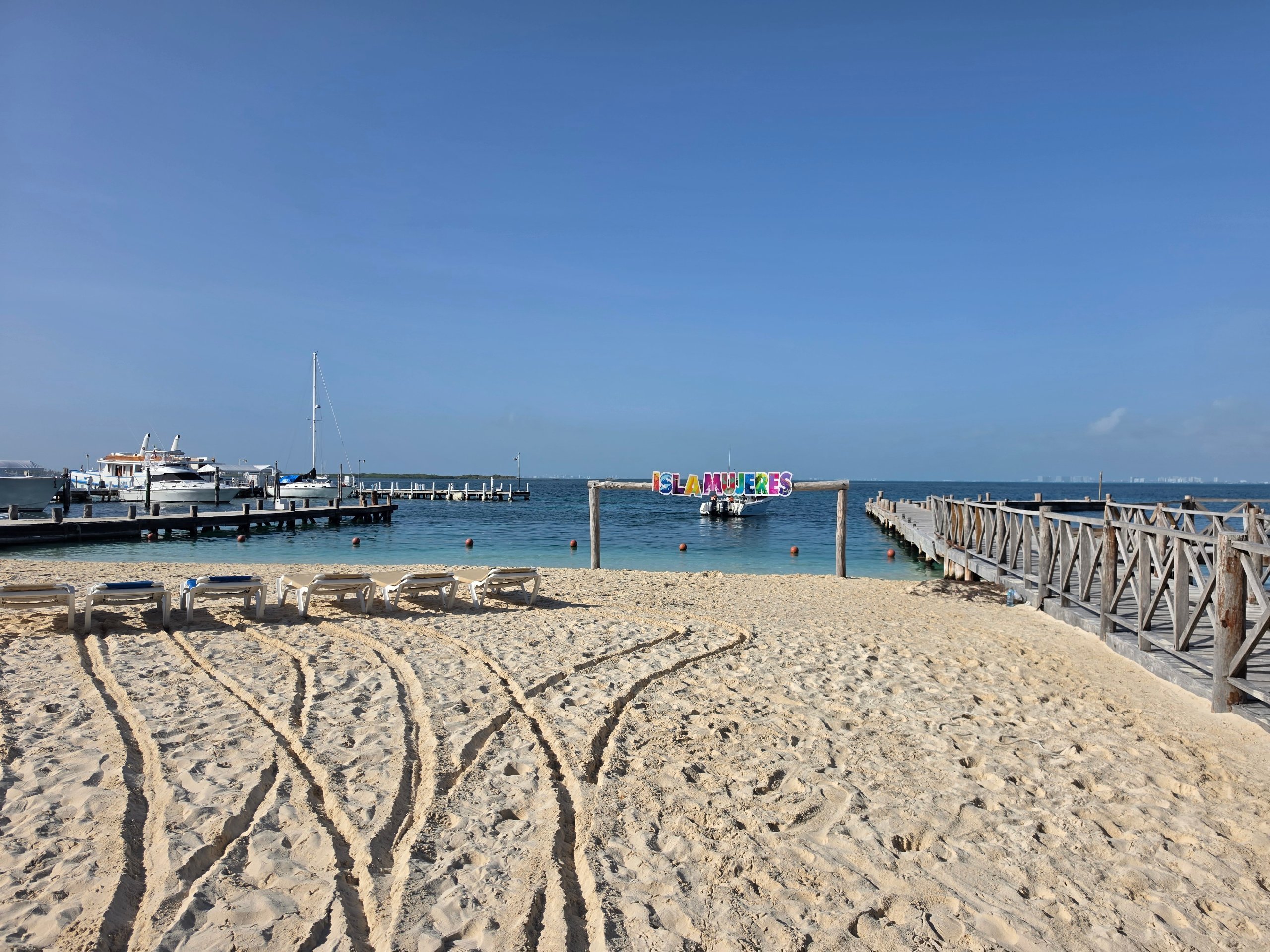
We stayed in the south-west of the island at the Impression Isla Mujeres hotel.
During our stay, the water was clear and free of sargassum, whilst on the mainland we saw significantly more of it on the same days.
Playa Norte also has fine sand, very shallow turquoise water and minimal waves. Its downside isn’t the seaweed, but the crowds.
It’s best to stay right on the island and enjoy the beach in the morning before the day-trippers arrive, or later in the afternoon.
Be careful on the east coast of Isla Mujeres. It faces the open sea and sargassum appears there in large quantities.
You can find details on transport, beaches and accommodation in our Isla Mujeres guide.
Recommended hotels:
We didn’t visit Cozumel during this trip, so we don’t want to present this as our own personal experience.
In terms of location, however, the west coast of Cozumel is one of the best choices in the entire Mexican Caribbean.
The island acts as a natural barrier. Most of the seaweed is caught on its eastern side, which faces the open sea, whilst the tourist beaches, hotels and diving spots are mainly located on the sheltered western side.
We would particularly highlight:
On the other hand, avoid the east coast of Cozumel. It is wilder, less developed and, during the sargassum season, is one of the most affected parts of the island.
You can get to Cozumel for a day trip by ferry from Playa del Carmen. However, if clear seas are one of the main priorities of your holiday, it makes sense to stay on the west coast for a few nights.
During our trip, Isla Contoy came closest to our idea of a deserted tropical paradise. Light-coloured sand, palm trees, crystal-clear shallow water and no buildings.
The public beach lies on the sheltered side of the long, narrow island and is usually completely free of sargassum.
However, this has two major drawbacks:
Standard full-day trips from Cancún or Isla Mujeres currently cost approximately 139 usd to 199 usd per person.
Most combine a visit to Isla Contoy with snorkelling and a short stop at Isla Mujeres.
It’s expensive. However, if you’re looking for a truly beautiful beach even during the peak sargassum season, we believe this is where an organised trip makes the most sense.
On the open coast between Playa del Carmen and Tulum, there is no hotel that can guarantee a sargassum-free sea.
However, several resorts have small bays sheltered by rocks, a narrow entrance or artificial breakwaters. Seaweed may still find its way in, but the risk is lower than on the neighbouring open beaches.
Below is a list we have verified.
💬 Do you have any personal experience of another hotel without seaweed? Please let us know in the comments below the article – thanks!
We noticed the biggest difference at Bahia Principe Explore Akumal.
In May, the main, long beach was full of sargassum and it was practically impossible to get into the sea. A few hundred metres further on, however, lies a smaller, north-facing cove protected by artificial breakwaters. The water there remained clear and free of seaweed throughout our stay.
It does have one drawback, though: the water is very shallow across almost the entire bay. It’s great for children and for cooling off, but less so for a proper swim.
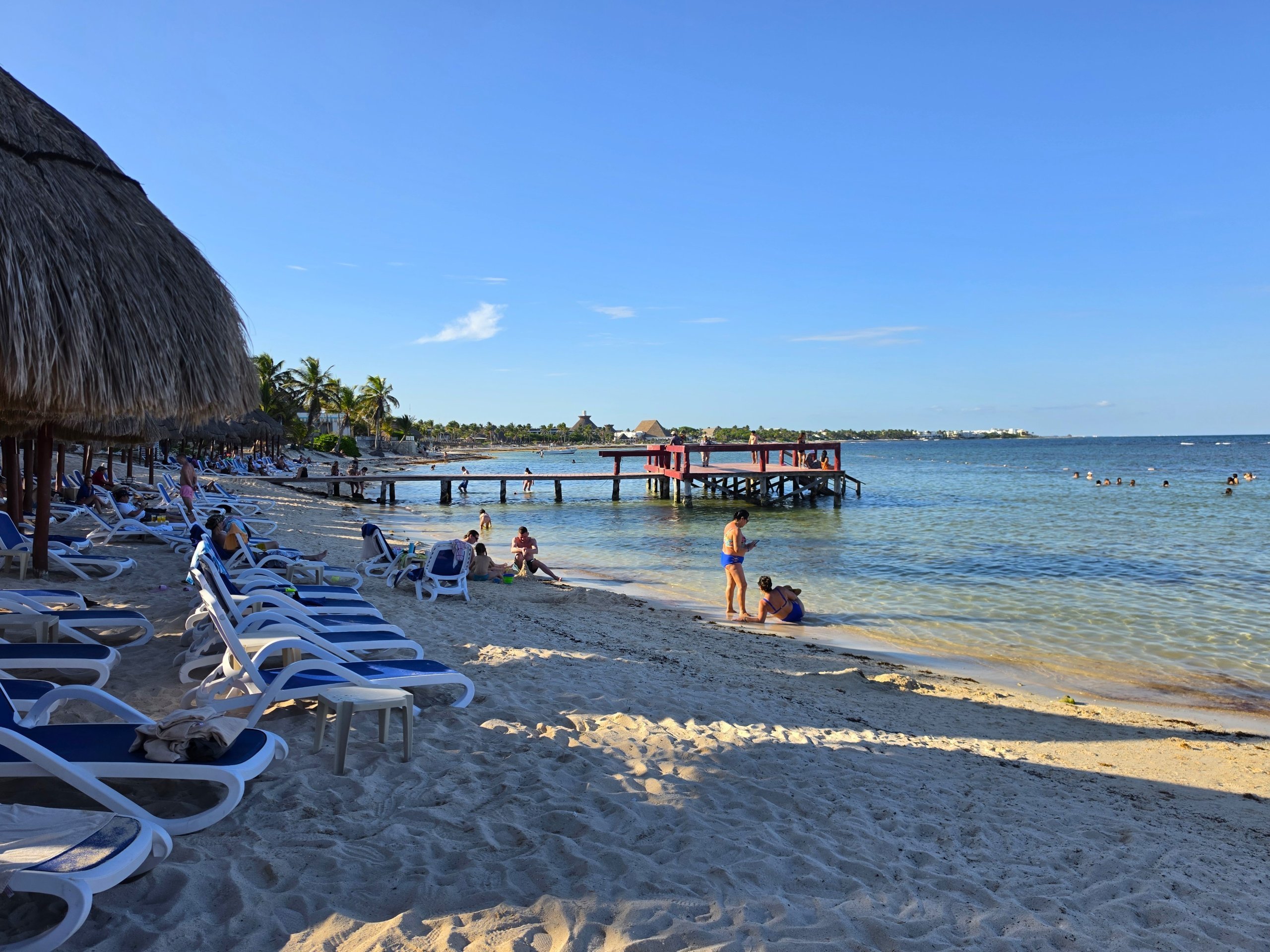
We have either paid a brief visit to the following hotels or have verified from several sources that their beaches remain clean even during the sargassum season.
You should only choose these hotels if you don’t mind having less space for swimming. A sheltered cove is not the same as a long Caribbean beach.
We compare other areas and hotels in our guide to where to stay on the Riviera Maya.
The hotel zone in Cancún is shaped like the number 7. The difference between its short northern side and its long eastern side is crucial when it comes to sargassum blooms.
Beaches on the short side facing Bahía de Mujeres tend to have a lower risk:
The sea here is also calmer and shallower. However, do expect piers, boat traffic and a more urban setting. Not all areas have water as distinctly turquoise as the open beaches to the east.
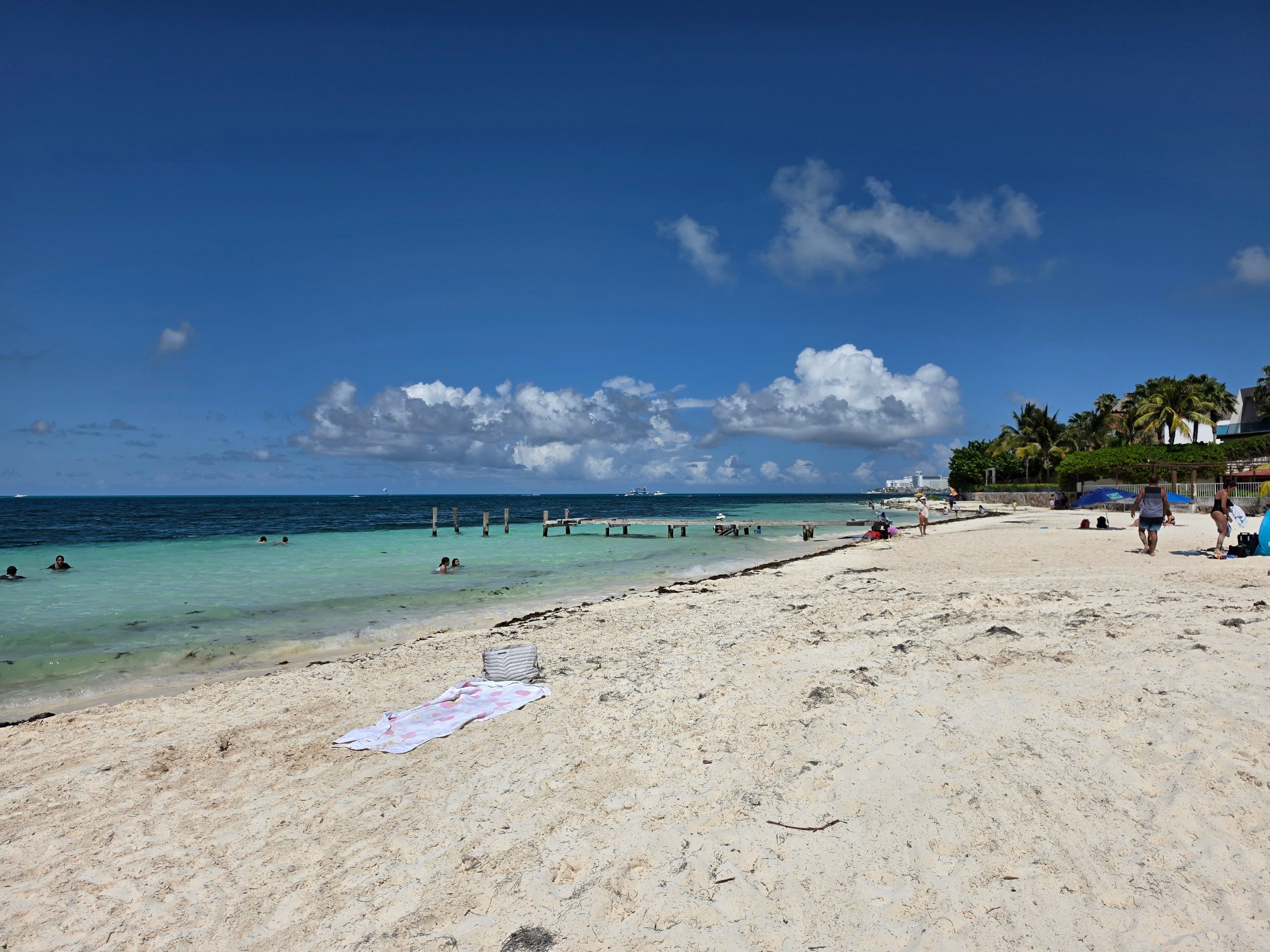
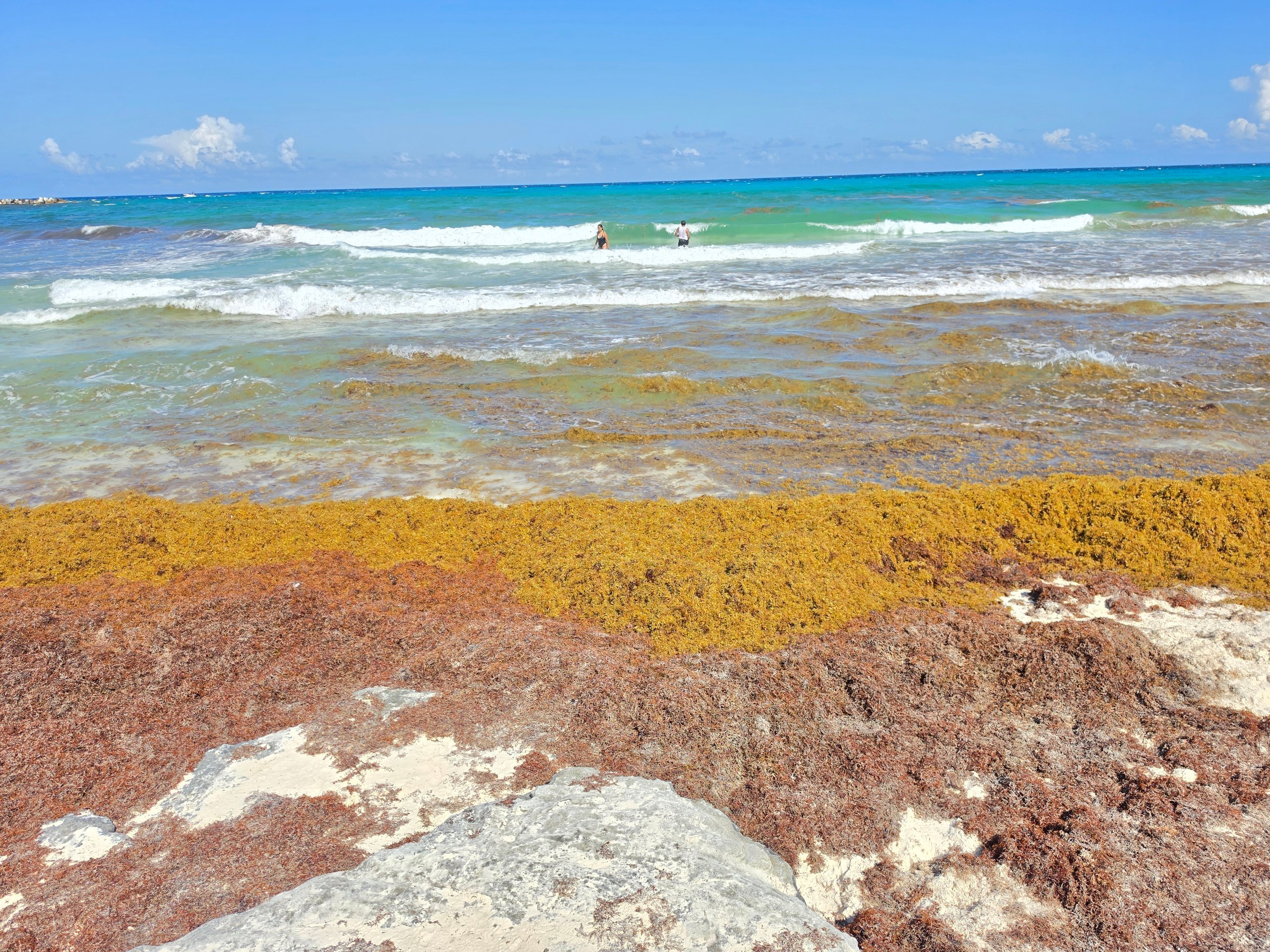
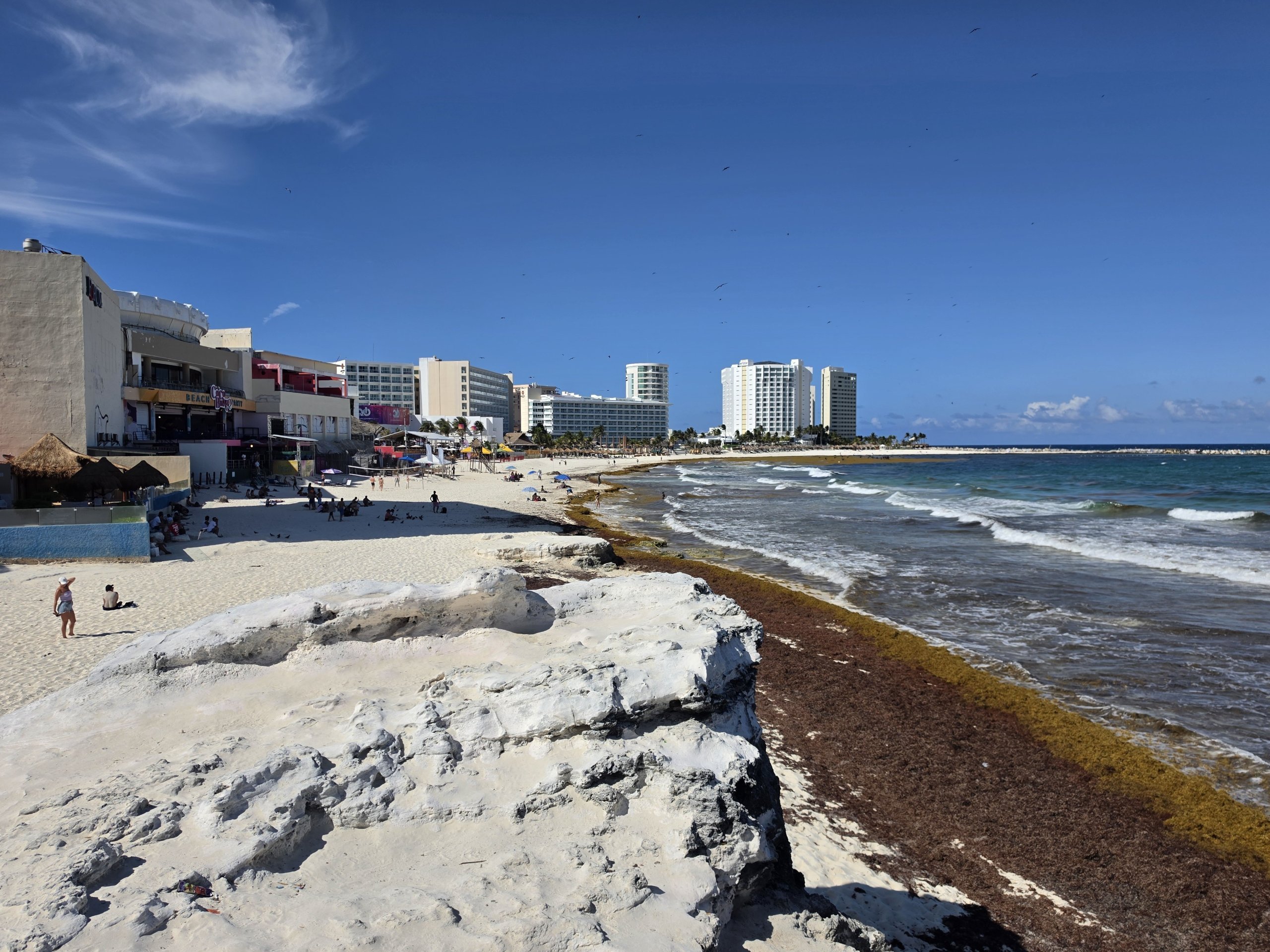
In contrast, Playa Chac Mool, Playa Marlin, Playa Ballenas and Playa Delfines face directly out onto the open Caribbean.
They are more photogenic and have bigger waves, but during the sargassum season they pose a significantly greater risk – in fact, the greatest in the entire Mexican Caribbean region:
We describe specific beaches, transport and hotels in our guide to Cancún.
Costa Mujeres is often described as an area sheltered by the island of Isla Mujeres. This is only partly true.
The best location is the southernmost stretch around Punta Sam / Playa Mujeres, which lies directly opposite Isla Mujeres and faces more towards the bay than the open sea.
If we were to pick a single spot in this area with consistently better conditions, it would be Punta Sam.
However, it is not the prettiest beach on the Costa Mujeres. There are ferry piers and harbours in the vicinity, and the coastline does not have quite the holiday feel of the resorts further north.
Towards Playa Mujeres, Costa Mujeres and, in particular, Playa Blanca and Isla Blanca, the protective effect diminishes. Seaweed can appear in large quantities here.
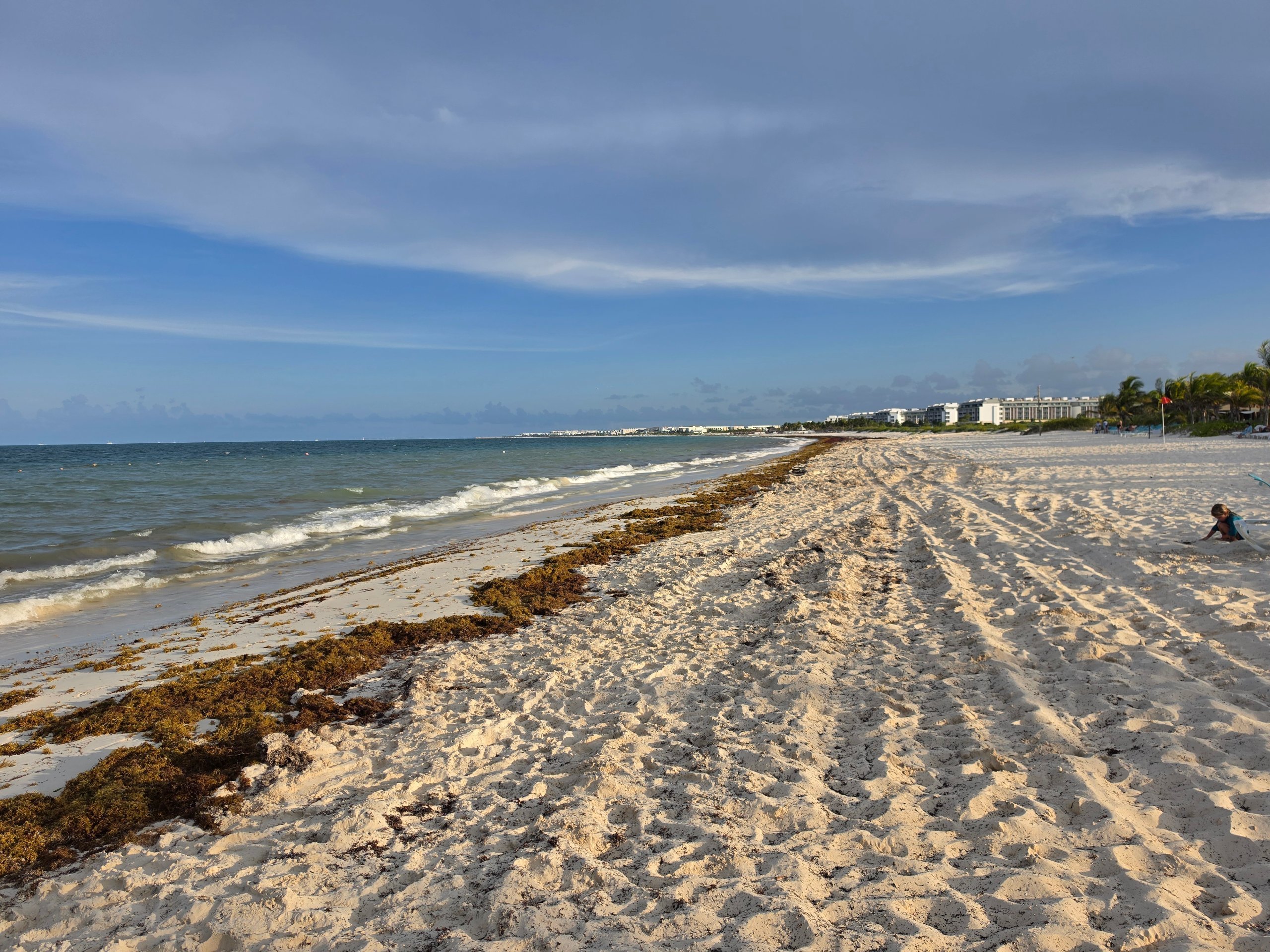
We stayed in Costa Mujeres and also visited Playa Blanca. Although it is often cited as a lower-risk area, during our visit we saw virtually not a single metre of coastline free of sargassum – not even around Punta Sam!
We would therefore recommend Costa Mujeres for its modern all-inclusive resorts, the space it offers, and the trips to Isla Mujeres or Isla Contoy. However, we wouldn’t choose it as a safe haven from sargassum.
Both Holbox and the northern coast of Yucatán lie outside the main east-facing stretch of the Riviera Maya.
There is generally far less Sargassum here – traces of seaweed do appear, but compared to the Caribbean side, the amount is negligible.
On Holbox, Punta Mosquito, the town beach and Punta Cocos tend to be particularly good spots. However, following a change in wind direction or a storm, seaweed may appear here too, and conditions can change significantly within a few days.
Furthermore, don’t choose Holbox based solely on the sargassum. The sea is exceptionally shallow, sometimes murkier and a different colour to that at Playa Norte or western Cozumel.
We wouldn’t make the long journey here just for a day’s swim. It makes sense to stay on the island for at least a few days.
During our visit, the beach at Las Coloradas was free of sargassum. However, this is a very remote and wild stretch of coastline with no standard tourist facilities; it is not a beach resort.
Include Las Coloradas in your road trip for its pink salt lagoons and natural beauty. It’s not worth driving several hours from Cancún or Tulum just for a swim.
Bacalar Lagoon is the best choice for anyone whose main priority is swimming in crystal-clear water and who doesn’t mind that it’s not by the sea.
There is no sargassum here, as it is an inland freshwater lagoon. You can expect calm waters, jetties, kayaks and boat trips, rather than long sandy beaches and ocean waves.
Bacalar lies far to the south, and it doesn’t make sense to visit it as a last-minute day trip from Cancún or Tulum. We’d recommend including it in a road trip lasting at least two nights.
If you’re already staying in Playa del Carmen or Tulum and the beaches are covered in seaweed, a simpler alternative would be the nearby cenotes or a day trip to the west coast of Cozumel.
The greatest risk is posed by beaches facing directly east or south-east towards the open Caribbean.
During the season, we wouldn’t rely on the sea being clear, particularly in these areas:
This does not mean that these beaches are bad all year round. In winter or when the wind is favourable, they tend to be perfectly clean.
It’s just that during the peak sargassum season, there is a significantly higher risk there than on the western sides of the islands.
Conditions can change within a single day depending on the wind, waves and sea currents. The weather forecast alone is not enough.
A few days before your visit, we combine three sources:
Do not trust photographs that are several months old.
Similarly, an email from the hotel stating that the beach is ‘cleaned regularly’ is not enough. Cleaning removes the seaweed from the sand, but it does not clean the water, into which more seaweed continues to drift.
If you’re travelling between May and September and a clean sea is one of your top priorities, we wouldn’t base your entire stay on a single open beach.
We’d choose one of these options:
The biggest mistake is to book an expensive resort based solely on a catalogue photo of the beach and assume that daily cleaning will sort out the algae in the water.
Compare accommodation on the Riviera Maya
There is no beach where cleanliness can be guaranteed every day.
In the long term, the best chances are on the northern and western beaches of Isla Mujeres, the west coast of Cozumel and physically sheltered hotel bays.
For a short stay and a classic sandy beach, we’d choose Isla Mujeres.
Cozumel offers a longer coastline, a wider choice of places to stay and better conditions for snorkelling and diving. We’ve only been to Isla Mujeres ourselves.
Only partially. The best location is southern Punta Sam. Further north towards Playa Mujeres, Costa Mujeres and Playa Blanca, the protection diminishes and there can be just as much seaweed as elsewhere along the coast.
Large resorts often clear the sand every morning, and some use barriers out at sea.
However, even thorough cleaning cannot guarantee clean water.
When the tide is strong, seaweed can reach the shore between the barriers faster than the staff can remove it.
Floating sargassum is a natural part of the ocean and provides shelter for marine life.
The problem arises when large quantities accumulate near the shore.
Decomposing seaweed gives off an unpleasant odour and releases gases that can irritate the eyes and respiratory tract. We would not linger for long near large, foul-smelling patches, particularly if we were with small children or if we had asthma.
If you have any questions or comments about the article...