
Getting around Malaga


The centre of Málaga is compact, and you can easily explore most of the sights on foot.
You’ll mainly use public transport when travelling to the airport, Gibralfaro Castle, the eastern beaches or the resorts on the Costa del Sol.
You don’t need a car for a typical stay in Málaga. Hiring one is particularly worthwhile for trips into the Andalusian hinterland, to the white villages or to nature reserves.
How to get around Málaga
| Where are you travelling to? | Best mode of transport |
|---|---|
| The historic centre, the harbour and Muelle Uno | On foot |
| La Malagueta Beach | On foot or by bus |
| Gibralfaro Castle | Bus number 35 |
| Pedregalejo and El Palo | Buses 3 or 11 |
| Málaga Airport | Train C1 |
| Torremolinos, Benalmádena and Fuengirola | Train C1 |
| Central Station and the western part of the city | Metro |
| Caminito del Rey, Ronda or the white villages | Hired car / bus |
If you’re still choosing a hotel, you’ll have the least to worry about in terms of transport if you stay in the Centro or Soho districts. From there, you can usually walk to the sights, the harbour and Málaga–Centro Alameda station.
You can find more tips in our guide to where to stay in Málaga.
Find a hotel in the centre of Málaga
Public transport tickets and fares in Málaga
In Málaga, there isn’t a single ticket that’s best for everyone.
EMT city buses, the metro and Cercanías trains have their own fares, and alongside these, the physical Consorcio Málaga travel card is also available.
For most tourists, the following advice applies:
| How you’ll be travelling | The best way to pay | Price |
|---|---|---|
| Several bus journeys | Your own payment card | 1,40 eur per journey |
| At least 5 journeys on city buses | EMT card with 10 journeys | 5 eur + refundable deposit 1,90 eur |
| Metro only | Payment card at the turnstile | 1,35 eur |
| C1 train only | Payment card at the turnstile | 1,80 eur – 3,60 eur depending on the route |
| Buses, metro and C1 train | Consorcio Málaga card | Card price 1,50 eur + minimum top-up 5 eur |
Airport bus route A has its own fare 4 eur and standard city tickets are not valid on it.
Consorcio Málaga – yes, tourists can use the card too
Consorcio Málaga is an anonymous rechargeable card; you do not need Spanish identification or permanent residence to purchase it. Tourists can therefore use it without any problems.
The physical card is valid on:
- EMT Málaga city buses,
- suburban and intercity buses participating in the scheme,
- the Málaga metro,
- Cercanías trains C1 and C2.
The card costs 1,50 eur and must be topped up with at least 5 eur. Up to 15 passengers travelling together can share a single card.
You can only buy it at official Consorcio sales points, which include selected newsagents, kiosks and information offices. Not every newsagent automatically sells it.
The card is not yet available for purchase at Málaga Airport. You can simply pay for your first journey on the C1 train using your own payment card and, if necessary, buy the Consorcio card later in the city centre.
You can find the current prices for the Consorcio card on the website ctmam.es/tarifas.
Fares when using the Consorcio card are lower than those for individual tickets:
- 1 journey by city bus 0,83 eur
- 1 metro journey 0,49 eur
- Cercanías trains from 1,04 eur depending on the number of zones travelled through.
When is the Consorcio Málaga card worth it?
If you’re travelling by bus, metro and train all at the same time.
It’s therefore particularly good value for journeys from Málaga to the Costa del Sol, where the C1 trains run and where the savings are more significant for more distant destinations.
Be aware of the Consorcio mobile app
The Consorcio Málaga mobile app is not yet a universal public transport ticket.
Its ‘ Virtual Wallet ’ feature is still in pilot operation and can only be used on selected Avanza buses and on the Rinconbús network. It is not valid on EMT Málaga buses, the metro or on the C1 and C2 trains.
Furthermore, the virtual wallet only works on Android phones with NFC, not on iPhones. For a standard tourist stay, we therefore recommend a payment card or a physical Consorcio card.
City buses only: 10 journeys for 5 eur
If you’re only travelling on EMT city buses, the anonymous EMT card with a 10-journey pack is cheaper than the Consorcio card 5 eur.
You pay a refundable deposit for the card itself 1,90 eur and it can be shared by multiple passengers. When changing between different EMT routes, further journeys within one hour are free of charge.
Neither the card nor the 10-journey pack is valid on airport route A.
So which ticket should you buy?
- For a stay of 1 to 3 days with just a few journeys, don’t buy anything – just pay with your own card.
- For multiple journeys on city buses only, buy an EMT card with 10 journeys.
- If you’re combining buses, the metro and C1 trains, a physical Consorcio card is worth it.
- The average tourist will find the Consorcio mobile wallet of little practical use.
Walking around Málaga
Málaga’s historic centre is largely pedestrianised, and the individual sights are close together. You can easily walk the route between the cathedral, the Alcazaba fortress, Muelle Uno harbour and La Malagueta beach.
The exception is Gibralfaro Castle, which is reached via a steep climb. It’s practical to take bus number 35 up and walk back to the centre via the viewpoints.
City buses
City buses are operated by EMT Málaga. A standard single ticket costs 1,40 eur and can be purchased directly on the bus.
You can pay:
- your own contactless card
- by mobile phone or smartwatch
- cash, although the driver does not accept banknotes larger than 5 eur
- a QR ticket via the EMT Málaga app
A single-journey ticket does not allow for transfers. You can make free transfers between different EMT routes within one hour with an EMT 10-journey card or a physical Consorcio card.
Tourists most commonly use the following routes:
- 35 – city centre and Gibralfaro Castle,
- 3 and 11 – city centre, Pedregalejo and El Palo,
- A – city centre and Málaga Airport.
Most daytime routes run from around 6.00 am until midnight. At night, routes marked with the letter N operate, but at longer intervals.
C1 train – the airport and the Costa del Sol
The C1 commuter train is the fastest link between Málaga city centre and the airport and resorts on the western coast of the Costa del Sol.
Trains run from around 6.00 am until midnight, approximately every 20 minutes for most of the day.
The C1 line connects:
- Málaga–Centro Alameda – historic centre
- Málaga–María Zambrano – main railway and coach station
- Málaga Airport
- Torremolinos
- Benalmádena
- Fuengirola
The Málaga–Centro Alameda terminus is situated approximately 300 metres from the edge of the historic centre.
A single journey costs between1,80 eur and 3,60 eur, depending on the number of zones. You can buy a ticket from a ticket machine, but the easiest way is to pay directly at the turnstile using your own contactless card.
You must tap your card when entering and exiting the station. Always use the same physical card, mobile phone or smartwatch.
A single card can be used to pay for several people travelling on the same route. When entering, tap the card once for each passenger, and repeat this number of times when exiting. For repeated journeys using the same card, Renfe offers an automatic discount from the fifth journey onwards in a single calendar month.
The physical Consorcio Málaga card is also valid on trains, but the Consorcio mobile wallet is not.
Line C2 runs via Cártama and Pizarra to the town of Álora. For most tourists, it is less convenient than the coastal Line C1.
Málaga Metro
The metro has two lines and is mainly used for travelling between the city centre, the main railway station and the western parts of Málaga.
- Line 1 – Atarazanas, El Perchel, the university campus and Andalucía Tech.
- Line 2 – Guadalmedina, El Perchel and Palacio de los Deportes.
- You can change between lines at Guadalmedina station.
- El Perchel station serves both Málaga–María Zambrano main railway station and the coach station.
A single journey costs 1,35 eur. The easiest way is to tap your own contactless card or mobile phone directly at the turnstile.
If you buy a standard ticket, you’ll also pay 0,30 eur for the rechargeable card itself. With a physical Consorcio card, a single metro journey costs 0,49 eur.
Taxis, Uber, Bolt and Cabify
There are traditional taxis operating in Málaga, and the Uber, Bolt and Cabify apps are also available.
You’ll mainly use them at night, when travelling with large luggage or in a group, when the fare can be shared between several people.
For journeys booked via an app, you’ll see the price or an estimate before confirming your booking. For individuals, public transport is almost always cheaper during the day.
In my experience, Bolt has always been the cheapest, but it’s definitely worth comparing prices across all the apps.
Day trips from Málaga without a car
The C1 train is quicker and cheaper than a hire car for getting to the resorts of Torremolinos, Benalmádena and Fuengirola. In the towns, you don’t have to worry about parking, and trains run frequently throughout the day.
For other destinations, it depends on your specific destination:
| Destination | Most practical transport |
|---|---|
| Torremolinos, Benalmádena, Fuengirola | C1 train |
| Nerja | Direct bus from the main coach station |
| Nerja and Frigiliana in a single day | Car or organised tour |
| Caminito del Rey | Train to El Chorro and booking an entry ticket; an organised tour is more convenient |
| Ronda | Direct bus or train |
| Ronda and Setenil in a single day | Car or organised tour |
| Gibraltar | Bus to La Línea and walk across the border, or a direct trip |
| Granada and the Alhambra | Train or bus; for a one-day visit, an organised tour is easier |
Organised transport makes the most sense for places with a limited number of tickets or when combining several destinations that are poorly connected:
- Caminito del Rey with transport from Málaga
- Ronda and Setenil in a single day
- A trip from Málaga to Gibraltar
- Granada and the Alhambra from Málaga
Choose a trip from Málaga without a car
Car hire
If you’re spending your entire stay in Málaga, don’t hire a car. The city centre is walkable, parking is tricky, and the C1 train runs to the airport and the western part of the Costa del Sol.
Hiring a car is particularly worthwhile if you’re planning at least two trips into the Andalusian countryside or want to visit smaller villages and natural areas.
You’ll find a car useful, for example, for trips to:
- the white villages around Ronda
- Setenil de las Bodegas
- the El Torcal nature reserve
- Antequera
- the Sierra de las Nieves mountain range
- the smaller beaches east of Nerja
If you’d like to spend a few days in Málaga first, it’s best to hire a car only when you’re leaving the city.
If, on the other hand, you’re travelling straight from the airport to the surrounding area, it’s most practical to collect your car at Málaga Airport, where there’s the widest choice of car hire companies.
Prices vary significantly depending on the time of year. Outside the peak season, a small car can be hired from around 186 eur per week; in summer, expect prices to start from 331 eur upwards.
Compare car hire prices at Málaga Airport
When comparing car hire companies, don’t just look at the final price. Also check:
- the amount of the security deposit and the type of payment card required
- the scope of insurance cover and excess
- the fuel policy – ideally full-to-full
- mileage limits
- whether the counter is located directly in the terminal or requires a shuttle bus ride
If you’re hiring a car for the first time, read our article ‘How to hire a car abroad for the first time’.
Parking in Málaga
The colour of the road markings usually indicates the parking rules:
- white lines – generally free parking, unless traffic signs indicate otherwise,
- blue lines – paid short-term parking,
- green lines – regulated parking intended primarily for residents.
In the historic centre, Soho, the harbour area and La Malagueta, finding a free space is difficult.
Public underground car parks are often more convenient. Their locations and current availability are shown on the SMASSA website.
A Low Emission Zone (ZBE) is in operation in the wider centre of Málaga.
The rules are gradually being tightened, so, particularly if you’re travelling in your own car or a foreign vehicle, check the current conditions and the ZBE map in advance. You won’t usually have any problems with a standard modern hire car, but do check with your specific car hire company to be sure.
Frequently asked questions
Do I need a car in Málaga?
Not for visiting the city. You can walk through the historic centre, and the C1 train runs to the airport and the coastal resorts. A car is only really useful for travelling around the Andalusian hinterland.
Can tourists use the Consorcio card?
Yes. The physical, anonymous card is available without registration, Spanish ID or permanent residence. One card can be shared by several people travelling together.
Can you pay by card on buses?
Yes. On EMT buses, you can pay a single fare using a contactless bank card, your mobile phone or cash.
What’s the quickest way to get from the airport to the city centre?
The fastest option is usually the C1 commuter train. It stops at Málaga–María Zambrano main station and at Málaga–Centro Alameda station, near the historic centre. You can find more details in the section on transport from Málaga Airport.
Any questions left?
If you have any questions or comments about the article...
9 comments
Current experience in Malaga (May 2026):
Suburban Rail (Cercanías):
If you are a credit card holder (not a debit card), then present the card at the turnstile at the entrance to the pay area and again at the turnstile at your destination when you exit. The system will automatically deduct the corresponding amount. A lot of passengers probably don't know this, and especially at Malaga airport there are long queues at the ticket machines... The procedure described here is similar to that in London, for example. Just be patient, the reader is sometimes slow to load and it takes patience.
Disadvantage of the suburban rail: especially at peak times the connections are crowded. Unfortunately, probably the only solution for the future will be to shorten the intervals (now 20 minutes) - if technically feasible(?). Platforms are often only one unit in length, so double trains (as we often know from the Czech Republic) can be forgotten.
Bus service:
If you go from the bus terminal in Malaga (Málaga Centro) in the direction of Torremolinos, then you have to buy the ticket at the ticket office at the terminal (the driver will not sell you the ticket and will refer you to the ticket office). You can pay by card.
If you get on at any of the stops, then you pay at the driver, but only in cash.
You don't have to go far for timetables. Just use the Google Maps app.

Hello, I came back today and just want to add that the charge card works in all means of transport even on commuter trains, I highly recommend to purchase, and we could use two............thank you

Hello. I followed your advice and that was the biggest mistake. The app for public transport in Malaga Consorcio de Transporte Metropolitano is totally useless, useless and I just spent 5€. The app is in pilot phase and only applies to selected suburban buses, no way to city buses or airport services. At the same time the app is ineffective if you set it to English, it only works in Spanish on the bus. In sum, it's "I don't want a free discount" and completely unhelpful, misleading and false information. Thank you for that.
The app looks universal at first glance, but then this message pops up in the virtual wallet.
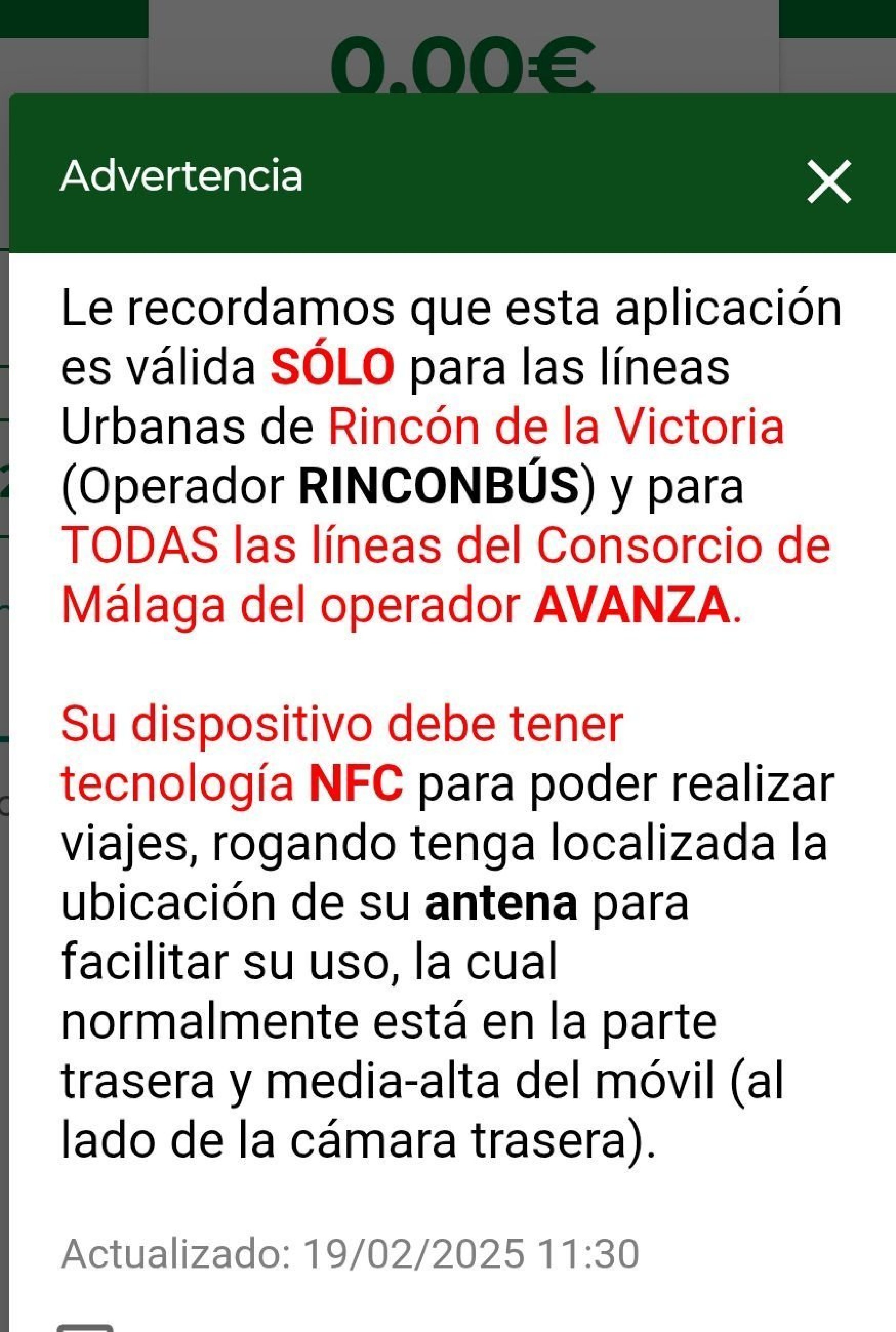
Yes, but no one will tell you that these carriers only operate on three routes, so it de facto applies almost nowhere. Otherwise, instead of €1.80 for a train ticket from the airport, we were charged €3.60. But I'm not surprised anymore. It's an incredible orient from the Rhine, where nothing works as it should. Outside of Madrid and Barcelona, that is.

a giant day,
do any of you have experience with the Consorcio Málaga app? I was wondering if it's possible for multiple people to use it from one mobile, or if everyone has to have their own app on their phone. Thank you for the answer.
Has anyone used the Consorcio Málaga mobile app for public transport. According to their very simple instructions, you just install the app, open it and there is supposed to be a Digital single ticket option. But I don't have anything like that.
I haven't even figured out how to search for connections. I just have the routes and timetables, that's all.

I don't see that option there either. Only the option of topping up a virtual wallet and paying through it.
For getting around Malaga, the "Consorcio de Transporte Metropolitano del Área de Málaga" chip card can be useful, it's also called the Green Card on tripadvisor - website https://ctmam.es/en/transport-ti...avel-card/
The card costs 1,5E + a minimum credit of 5E to top up (probably all Tabacos newsagents sell the card, you can top up the credit there too, there is a map of the points of sale on the website). You can use it to get around Malaga on buses, metro, trains. Outside Malaga intercity buses, C1 (Fuengirola) and C2 trains. Fares are excellent, better than using a credit card or buying single tickets. I have one card for 4 people (each person is "activated" on the card when entering through the turnstile or by attaching the card to the card reader where there is no turnstile, same when exiting by attaching the card to the turnstile, if there is no turnstile then you have to find the card reader at the exit where you "end the journey" - this takes into account the resulting ticket price for each person).
How do I find out how much has been charged on the card and what the balance is?
josefkra: Great, thanks for the useful info. I will edit the text!
Láďa _1: on the C1 train, the turnstile or reader on the platform showed the credit balance on the card on a small display after each card loading/ticket activation, the card balance is supposed to be shown by the ticket vending machine, but what it showed was bizarre, I couldn't make out the displayed table at all, it was for the previous day. On intercity buses there are printed tickets from the driver where you can find out everything about credit and spending. It's strange that they don't sell this card directly at the airport by the trains there is information, yet just next door at Arroyo de la Miel station they sell it at the information window by the turnstiles (it's not listed on the association's website as a point of sale).
That they don't sell it at the airport is more embarrassing than weird. Here are the instructions, a bit complicated and less understandable for my taste, I didn't understand the "whoops" and nobody asked about them in the newsagent anyway. https://ctmam.es/en/transport-ti...avel-card/
Current experience. Getting a card is all about chance. In Málaga, out of three attempts, zero success. In Torremolinos only after two days they had it (only in one Tobacco). Its website says it temporarily doesn't work at the turnstile by the train. But that's not true, normally the turnstile will let you on the card. No problem using one for multiple people, you just hand it to yourself. On the bus you tell the number of tickets. I didn't get the "jumps" either, no one really asked about them when buying the card. The saving is really very good, in simple terms you save about a euro on each ticket.
I don't see any message on that page about the train not working, just some talk about only being able to buy such and such tickets in the machine and not being able to top up the Renfe y Tú card with it. We travelled normally on the train and there was no problem with the card.
In Málaga we bought the card without any problem in a newsagent's near the train terminus: https://maps.app.goo.gl/8MW4RU6PoSFuH2We7
Mostly, though, I wonder if there really isn't a place to buy the card at the airport.
Can I pay for my bus ticket by credit card?
Yes, tickets can be paid by card.
Ďakujem pekne za info.
You don't have to buy any ticket. Just tap your card (credit or debit) at the turnstile or with the driver - see my post below.
Ďakujem,
Kde nájdem ten Váš príspevok?
A few posts down:
I don't know since when, but currently (5/2024) there is no need to buy any tickets or cards in Malaga - you can pay the fare by "beeping" your contactless payment card (mobile, watch,...) at the turnstile at the entrance to the metro or train and a second time at the turnstile at the exit. On buses, you then just beep at the driver and take the ticket that comes out of the machine.
Ďakujem pekne.
Can I pay with a debit card loaded on my phone?
The Firefly rental company requires a physical card to pay for the deposit, the one loaded on your phone is not enough - my own experience. Otherwise, I guess it depends on what you want to pay for.
Yes, you can also pay on public transport with your mobile phone (card in it).

Guys, it’s urgent… On 9 October I’ll be landing in Málaga…I’ll arrive at 01:10 am and my ticket to Nerja has already been booked. So I urgently need your help… The only way to get from the airport to the city centre at that time is by Bolt, as I’ve read that it’s cheaper than Uber and taxis? Has the train service stopped running at those times? So there aren’t any buses either? Finally, I’d like to ask what travel card I need, given that I’ll be staying in Málaga for 9 days but will actually only be spending three days there? For the rest of the time, I’ve booked day trips – some by bus, others by train, and some organised tours, and I’ll only need the metro or bus to get to and from the station…
Information on transport from the airport can be found here: https://www.cestee.gr/aerodromio.../metaphora
The train has stopped running; the last bus from the airport to the city centre leaves at 1.15 am. I’d probably go for Bolt – or at least I’d definitely compare Bolt and Uber. Yes, Bolt is usually cheaper, but not always.
And what sort of travel pass do you need? That depends on how much you’ll be travelling around Málaga. Personally, I usually walk around the city centre and only take the bus occasionally, so I don’t bother with travel passes at all. I just pay for individual journeys using my own contactless card on the bus.
If you’ll be travelling more, a 10-journey card might be worth it.