Riga from Prague with airBaltic on a wide range of dates until August 2027
99 €



Modica is a Baroque town in south-eastern Sicily, spread out across the floor of a deep valley and the surrounding slopes. Most travellers come here for the Church of San Giorgio, the panoramic views and Modica’s traditional chocolate.
Selected monuments in Modica form part of the ‘Late Baroque Towns of the Val di Noto’, a UNESCO World Heritage Site. The town acquired its present appearance mainly during the reconstruction following the devastating earthquake of 1693.
Modica lies just 13 km from Ragusa, so it is easy to visit both towns in a single day. However, you should set aside at least 3 to 5 hours for Modica itself.
In my opinion, yes, but Modica offers a different experience to the refined Noto or the dramatic Ragusa.
It isn’t a town with a single compact historic square. The most interesting spots are spread across different levels and are linked by stairways, steep alleyways and viewpoints. The Baroque monuments are complemented by chocolate shops, restaurants and everyday town life.
If you’re choosing just one place, Noto is the easiest to explore, Ragusa offers the most impressive city panorama, and Modica is the best combination of Baroque architecture, views and gastronomy.
The historic centre is divided into two main parts:
For a first visit, I recommend starting in Modica Bassa and gradually making your way up to Modica Alta. If you don’t want to walk the entire way up, take the city bus to the upper part and walk down.
The best walking route is about 3 to 4 km long. Be prepared for a significant climb and a large number of steps.
Corso Umberto I is the main street in Modica Bassa. It is lined with Baroque palaces, cafés, restaurants and chocolate shops.
The main landmark of the lower town is the Chiesa Madre di San Pietro. A wide staircase, flanked by statues of the twelve apostles, leads up to the church. Entry to the church is free.
The Palazzo della Cultura on Corso Umberto I is home to the small Museo del Cioccolato di Modica. The exhibition showcases the history of cocoa, traditional chocolate-making and chocolate sculptures.
Admission costs 3 eur and the tour takes about 20 to 30 minutes. Opening hours vary throughout the year, so please check the website of the Modica Chocolate Producers’ Consortium before your visit.
Personally, I find the tastings at several different chocolate shops more interesting. If you only have a few hours in Modica, the museum isn’t essential.
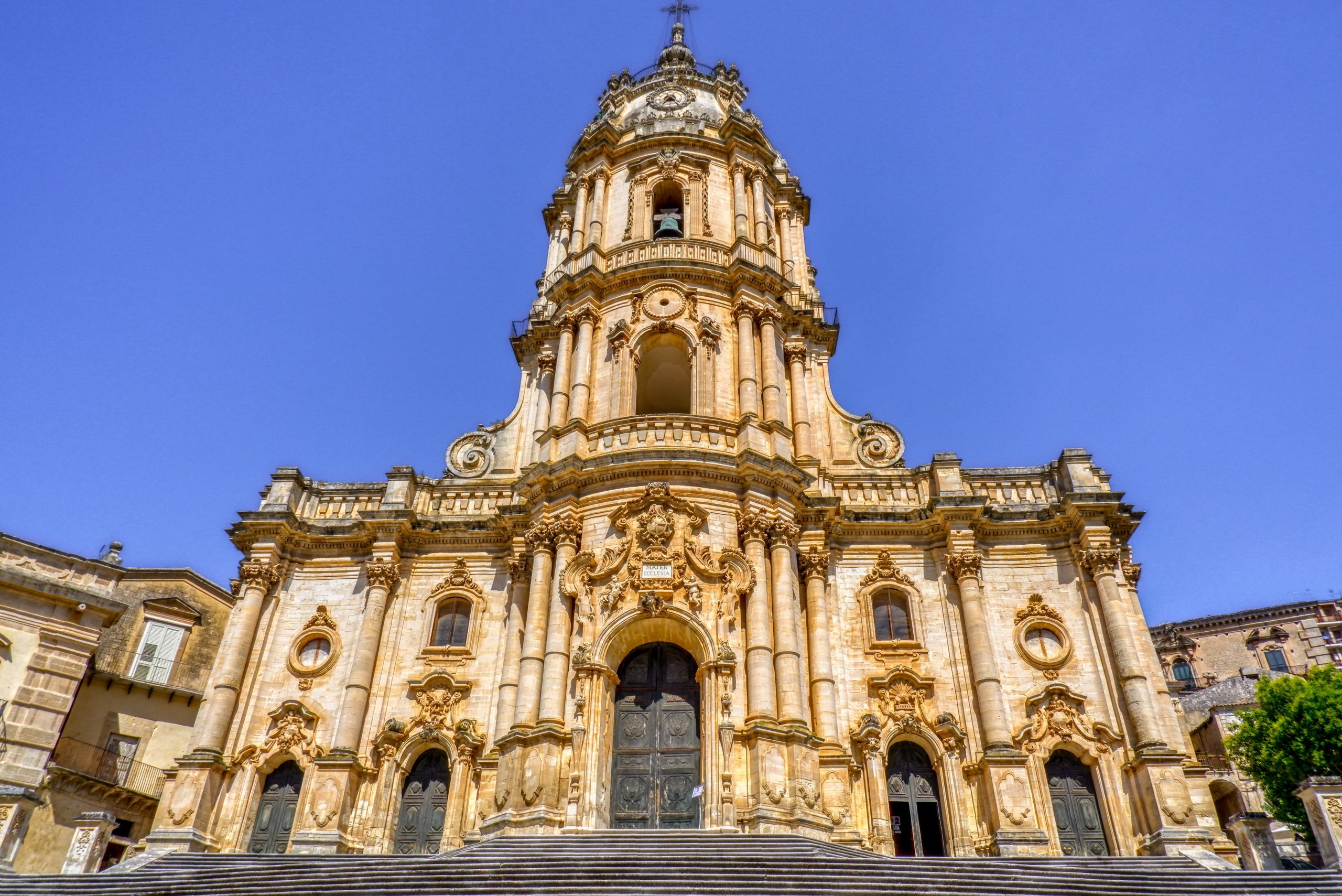
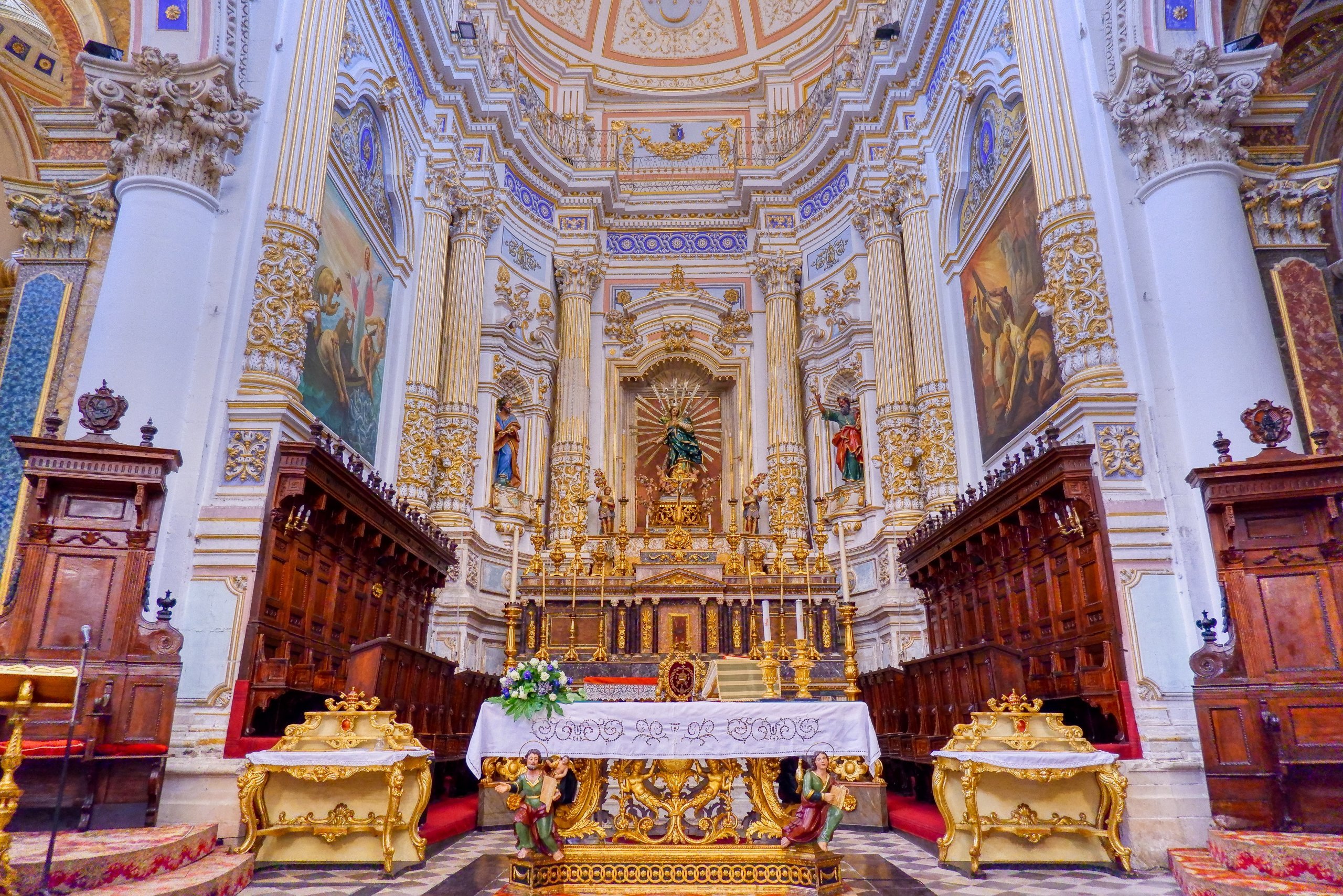
Modica’s most significant landmark is the Duomo di San Giorgio, which stands high above the lower part of the town. A long, monumental staircase leads up to the cathedral, and from the top you can enjoy one of the best views of Modica Bassa.
San Giorgio is commonly referred to as a cathedral. However, as Modica is not a bishop’s seat, it is not, strictly speaking, a cathedral.
Admission is free. The church may be closed during services or at midday.
The medieval Castello dei Conti complex is situated above the historic centre. Its most striking feature is the Torre dell’Orologio clock tower, built on a rocky promontory.
Opening hours for the interiors vary. Even without going inside, however, it is worth visiting for the views and continuing on to Modica Alta.
The Belvedere Pizzo viewpoint in the upper part of the town offers the best panoramic view of Modica. From here, you can see San Giorgio, the lower part of the valley and the houses built on the opposite hillside.
Nearby stands the church of San Giovanni Evangelista. From the viewpoint, you can return to Modica Bassa on foot through the narrow streets or by city bus.
If you have more time, you should also visit the birthplace of the poet Salvatore Quasimodo, the rock-cut church of San Nicolò Inferiore, or the church of Santa Maria del Gesù, which survived the earthquake.
Chocolate from Modica has a Protected Geographical Indication (PGI ) and differs from ordinary bar chocolate. The cocoa is processed at a low temperature and the lengthy refining process is omitted. As a result, the sugar crystals remain inside, giving the chocolate a grainy, slightly crunchy texture.
Documented chocolate production in Modica dates back to at least 1746. Details are provided by the official Cioccolato di Modica IGP consortium.
The most common flavours are cinnamon, vanilla, orange, coffee and chilli. A bar usually costs between 4 and 8 eur.
Well-known producers include the historic Antica Dolceria Bonajuto and the more modern Sabadì. I recommend trying the chocolate in at least two shops, as the texture and intensity of the cocoa vary.
Some chocolate makers also organise guided tastings and production workshops lasting around three hours. Prices for these experiences start at around 80 eur per person.
Modica is a good base for trips to Ragusa, Scicli, Noto and the south-east coast. In the evening, the town centre is quieter than during the day, and restaurants and chocolate shops are within walking distance.
For your first stay, I recommend Modica Bassa. It’s more practical without a car, as it’s close to restaurants and you don’t have to tackle a steep climb every time you return.
Modica Alta is ideal for travellers who prefer views and peace and quiet. Before booking, check accessibility by car, parking options and the number of steps leading up to your accommodation.
Smaller guesthouses and flats usually cost between 60 and 120 eur per night for two people. Well-reviewed hotels in the historic centre typically range from 90 to 150 eur.
Hotels and accommodation in Modica
Interesting accommodation options include:
You can find other recommended areas in the chapter on Accommodation in Sicily.
A car is the best option if you want to combine a visit to Modica with trips to Ragusa, Scicli, Noto or the beaches. The journey takes about 1 hour and 40 minutes from Catania, approximately one hour from Syracuse and about 20 minutes from Ragusa.
It’s best not to drive into the narrow streets of Modica Alta. Park in the lower part of the town and continue on foot or by city bus.
On Corso Umberto I, Piazza Principe di Napoli and Via Marchesa Tedeschi, parking in the blue zones 1 eur costs per hour. Free 15-minute parking is also permitted, provided you display a parking disc visibly behind the windscreen.
You’ll find spaces marked in white, for example, around Viale Medaglie d’Oro. However, some may be reserved for local residents.
You can find details on driving in the chapter ‘Hiring a car in Sicily’.
Modica railway station is situated in the lower part of the town, about a 15- to 20-minute walk from Corso Umberto I. Direct regional trains are operated by Trenitalia.
It is not necessary to buy a ticket for regional trains well in advance. The price does not increase as the departure time approaches.
The bus is the best form of public transport from Catania. Direct services operated by AST also run from Catania Airport.
To search for routes, use the AST and SAIS Autolinee websites directly. Google Maps does not show all Sicilian bus routes.
For further information, see the section on Transport in Sicily.
SAIS city buses are particularly useful for travelling between Modica Bassa and Modica Alta.
You can find tickets, a route planner and the current location of buses on the official Modica public transport website.
At certain times of the year, the Trenino Barocco tourist train also runs from Corso Umberto I to Modica Alta.
Discover all the places to see in Sicily.
If you have any questions or comments about the article...