Mauritius from Prague at a TOP price, with checked-in luggage included
468 €


I’ve been collecting air miles specifically for about 3.5 years. Before that, I’d flown with a different airline on practically every flight, so it didn’t make sense to me.
During that time, I’ve redeemed themfor eight bonus one-way business-class tickets withEmirates, Turkish Airlines, Lufthansa and Air France.
I earn miles from my flights and also make use of points from Revolut. I mainly use three loyalty programmes, to which I have flights from many different airlines credited.
How does it work, how many miles can I accumulate, and what does the ticket itself cost apart from the miles? I’ll show you using my own travels as an example.
Miles are loyalty points. You earn them, for example, on flights, and can later use them towards another ticket. A ticket booked using miles is called a bonus ticket.
You don’t have to collect them with the airline you’re currently flying with. Many airlines collaborate and allow you to credit miles to a partner programme. And not just for flights, but also, for example, for hotel stays, car hire and many other things.
For example, when I book a suitable flight with Lufthansa, I have the miles credited to the Greek Aegean programme. I can then use them later for an available flight with one of its partners.
To get started, you just need to know four things:
One more quick clarification: miles for tickets and points towards status are two different things.
Status can, for example, grant you access to a lounge or an extra piece of luggage. In this article, I’ll be focusing mainly on miles that can be spent on tickets.
I have lots of accounts with practically every airline I’ve ever flown with. Just in case.
But mainly, I collect miles through three programmes.
I originally chose Miles+Bonus because it was relatively easy to achieve Gold status at the time. For me, it was mainly valuable because of access to airport lounges.
Since I’ve been paying for Revolut Ultra, this benefit has become less essential for me. That’s because I also use lounges through Revolut, even though the range of lounges and the terms of access aren’t exactly the same.
I explain this in more detail in this article.
However, Aegean still suits me:
Some business class tickets offer a favourable mileage rate. However, finding suitable seats requires some searching and flexibility; in this respect, Miles+Bonus is inferior to other Star Alliance programmes (such as Air Canada or, at times, Lufthansa).
The Alaska Airlines programme is now called Atmos Rewards. Previous miles have been converted into points at a 1:1 ratio. For simplicity’s sake, I’ll continue to refer to them as miles.
For many of my flights, Alaska has offered me an attractive number of miles for travelling. I collect eligible flights operated by oneworld members as well as partners outside this alliance. The airlines that matter most to me are Condor, Icelandair, Aer Lingus, Korean Air and Hainan Airlines.
Points do not expire.
I’m also attracted by certain business class booking options and favourable cash top-ups with selected partners. However, the amount of the top-up always depends on the specific journey.
I haven’t booked any bonus flights from Alaska yet. I’m still collecting points. Unfortunately, RevPoints cannot be transferred here.
Flying Blue currently best suits my use of SkyTeam flights, which include, for example, Air France, KLM, Delta, Vietnam Airlines and SAS.
I can transfer RevPoints to this programme, and I’ve already booked two business-class tickets to Mexico through it.
For a standard adult Explorer member, you need to keep an eye on the expiry of your miles. However, from May 2026, any qualifying activity will extend the entire balance by 24 months.
I’m also considering the Virgin Atlantic Flying Club, where points don’t expire. Should I switch, the mileage accrual and the price of the flights I’d like to book with them will be key factors for me.
In addition, I have, for example, the Qatar Privilege Club and accounts with other airlines.
I use them as and when needed, when the three main programmes aren’t suitable for a particular flight or I can’t earn points with them.
Before buying a ticket, I need to find out how many miles the programme I’m collecting with will credit me for it.
It’s certainly not enough just to know whether I’m flying in economy or business class.
The basic procedure is simple: I find the booking class → check the fare in my programme → calculate the miles for each flight.
A booking class is a ticket category, usually denoted by a single letter, such as K, Q, Z or C.
In the tables for earning miles, you will find it listed as ‘Booking class ’ or ‘Fare class’.
There are several such classes within Economy, Economy Plus, Business and First. They may have different prices, conditions and mileage accrual rates.
To help you navigate this, distinguish between these three pieces of information:
| Item | Example |
|---|---|
| Cabin class | Economy, Business |
| Fare name | Light, Classic, Flex |
| Booking class (the only relevant source for mileage) |
K, Q, Z, C, F |
To calculate based on booking class, you need to look for the letter itself. The words ‘Economy Light’ or ‘Business’ alone are never sufficient to determine the number of miles.
Furthermore, the same letter very often corresponds to a different number of miles across different airlines and loyalty programmes.
Some fare classes even mean “0%” miles in one programme (meaning you’ll receive nothing for that flight), whilst another programme may credit 25%, 50% or even more.
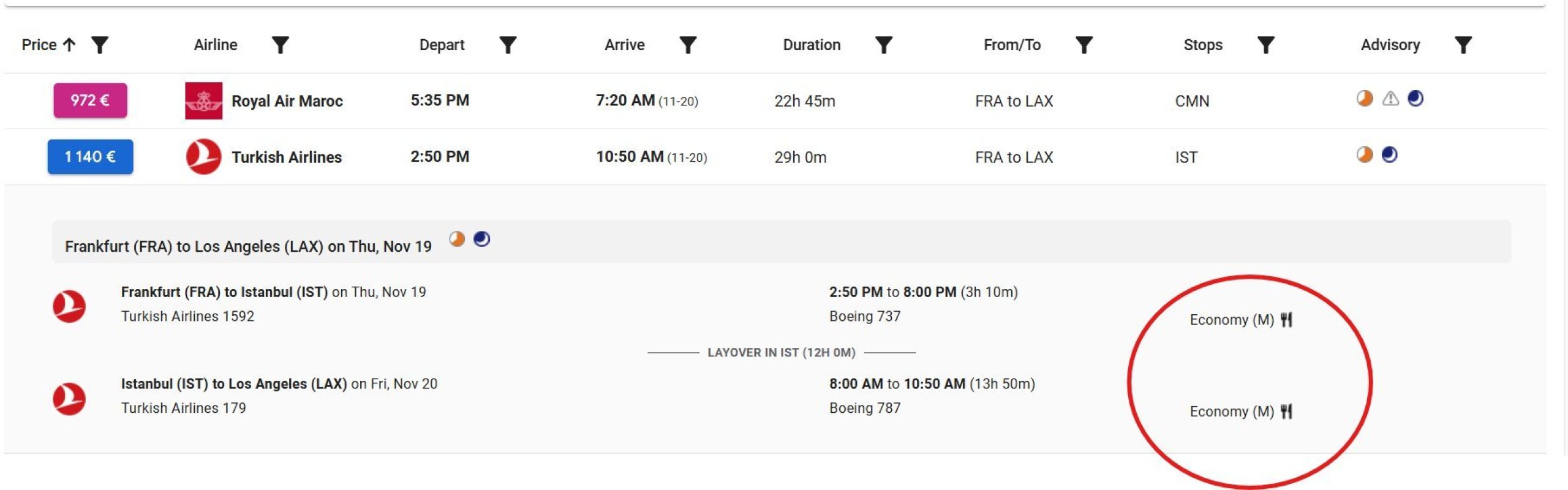
Ideally, before you pay for your ticket. Open the details or fare conditions for your chosen flight. Look for terms such as:
The letter may be listed on its own or, for example, as Economy (Q). In that case, you are looking for Q.
The exact location varies depending on the airline and the seller.
For a ticket you have already purchased, open your e-ticket, confirmation or document labelled ‘E-ticket’ or ‘Passenger receipt’. Look for the ‘Class’ or ‘Booking class’ field.
If the retailer does not display this information, the following websites may help.
ITA Matrix allows you to search for a route and view details of its fare and booking classes. To check a specific offer, follow these steps:
The result serves as a guide to the offer you are purchasing. Another seller may be selling the same flights at a different fare.
Identical flights and similar prices will help with the comparison, but do not in themselves guarantee the same booking class. You should therefore treat any differences in the Matrix as a rough estimate only.
You cannot purchase a ticket directly in Matrix. To complete your purchase, you will need to return to the airline’s website or your travel agent’s site.
ExpertFlyer offers two useful features:
However, the class available on a flight does not necessarily determine the class of a specific offer in your basket. ExpertFlyer is therefore a tool to help you find your way around; for an initial search, I would start with Matrix.
Check each flight separately. The connecting flight to the transit airport, the long-haul flight and the return journey may all be in different classes.
You now have the airline and the letter. You’ll need the programme’s mileage table for the programme you wish to credit your miles to.
For example, if you’re flying with Lufthansa and collecting miles with Aegean, look for Aegean’s rules for Lufthansa flights.
For a quick comparison, you can use ‘Where to Credit’:
Please verify the results directly with the programme before purchasing, as the rules and data provided by comparison sites may change. In my case, I mainly check the following programmes:
Please also read the notes: sometimes it depends on the flight route, date, fare or who you bought the ticket from.
For flights marked ‘Operated by’, please also note the airline actually operating the flight.
If this differs from the airline listed in the flight number, check the rules for this combination. The mere fact that airlines belong to the same alliance does not guarantee that miles will be credited.
If the table specifies a percentage of the distance, the calculation works as follows:
Flight distance in miles × rate from the table = loyalty miles earned.
A purely hypothetical example: a flight is 5,000 miles long and your specific class of travel earns 50 per cent. This flight would earn you 2,500 loyalty miles. At a rate of 100 per cent, it would be 5,000 miles.
For connecting flights, calculate each flight separately and add the results together. You can also use the Where to Credit calculator for an approximate calculation of the entire route.
In the table, you may also come across a fixed number of miles, a minimum allocation or classes that do not qualify for miles.
An exception is the calculation based on fare. For example, for flights sold under an Air France or KLM code, Flying Blue bases the calculation on the eligible fare and your status. In such cases, the distance alone or the flight code is not sufficient for the calculation.
When making a booking or managing your booking, select the programme and enter your membership number. After your flight, check that the miles have been credited.
If they are missing, use the credit request form on the programme’s website. Until then, keep your e-ticket and boarding passes. Credit processing times vary.
RevPoints are points I earn, for example, when making payments with my Revolut personal card. I can then convert them into air miles.
On my Ultra plan, I earn 1 RevPoint for every 1 eur spent at the standard rate. On the free Standard plan, it’s one point for every 10 eur.
They are usually credited to loyalty programmes at a 1:1 ratio. A transfer to Aegean, for example, works as follows:
Before transferring, it is important to find an available flight, check the number of miles required and the cash top-up.
Thetransfer is non-refundable.
I describe this in more detail in the article‘RevPoints in practice: from everyday payments to flights for miles’.
In the tables, I list the specific route, travel class, ticket price and miles earned.
For return tickets, the price is for both legs; for other tickets, it is for the one-way journey specified. Connecting flights are included in the mileage total.
For comparison, I’ve included an approximate value for the miles earned: for Aegean and Alaska, I’ve calculated 0 eur per mile; for Flying Blue, 0 eur. I explain these working estimates below. The value of the miles represents a potential benefit for future bookings; no one is refunding me any money.
Aegean Miles+Bonus
| Flight | Class | Ticket price | Miles | Mileage value |
|---|---|---|---|---|
| Air India: Milan–Melbourne and return | Business | 1884 eur | 47,756 | 684 eur |
| Lufthansa: Cairo–Tokyo and return | First | 5120 eur | 39,200 | 561 eur |
| ANA: Budapest–Tokyo and return | Business | 2663 eur | 25,300 | 365 eur |
| Air Canada: Frankfurt–Antigua / Barbados–Frankfurt | Business | 1352 eur | 19,300 | 279 eur |
| Ethiopian: Jakarta–Manchester | Economy | 442 eur | 9,400 | 135 eur |
| Air China: Frankfurt–Hong Kong and return | Economy | 451 eur | 8,500 | 123 eur |
| TAP: Prague–Azores and return | Business | 643 eur | 5,700 | 82 eur |
| Shenzhen: Doha–Singapore | Economy | 205 eur | 3,900 | 57 eur |
How does the value compare? Air India offered miles with an approximate value of 684 eur against a ticket price of 1884 eur , which is around 36 per cent of the price paid.
Ethiopian provided a value of 135 eur for a ticket costing 442 eur – roughly a third of the price. With the expensive Lufthansa First Class, the value is 561 eur from 5120 eur , which is around 11 per cent.
Such a comparison illustrates the value of miles relative to the cost. The quality of the flight and its price must be assessed separately.
For example, Air India’s business class had some significant shortcomings, whilst with Lufthansa I was able to experience both the old First Class on the Boeing 747 and the new Allegris First Class.
I flew with Ethiopian via Bangkok and Addis Ababa. You can find a practical guide to securing a free transit hotel in the overview of transfers at Addis Ababa Airport.
Alaska / Atmos Rewards
| Flight | Class | Ticket price | Miles | Miles value |
|---|---|---|---|---|
| Condor: Johannesburg–Prague | Business | 1434 eur | 8,500 | 123 eur |
| Hainan: Prague–Bangkok | Business | 1147 eur | 8,400 | 119 eur |
| SriLankan: Paris–Maldives | Business | 778 eur | 7,200 | 102 eur |
| Oman Air: Frankfurt–Zanzibar | Economy | 365 eur | 2,800 | 41 eur |
| Finnair: Prague–Iceland | Economy | 204 eur | 2,300 | 33 eur |
The price covers the entire journey as stated, not just the section described in the linked review.
Even the budget economy class offers good value for money. Finnair provided a value of around 33 eur at a price of 204 eur , which is around 16 per cent.
For SriLankan, the figure is around 13 per cent , and for Condor around 9 per cent. Earning more miles does not, in itself, mean better value for money.
I describe the product itself in my reviews of the Condor Prime Seat from Johannesburg, the connecting European business class flight with Condor, and the Hainan flight from Prague to Beijing.
Flying Blue
| Flight | Class | Ticket price | Miles | Miles value |
|---|---|---|---|---|
| Etihad: Singapore–Abu Dhabi, Abu Dhabi–Paris | First | 2785 eur | 20,000 | 246 eur |
| Air France/KLM: Prague–Saint Martin–Trinidad–Prague | Economy | 1045 eur | 4,100 | 49 eur |
| Kenya Airways: Dar es Salaam–Paris | Economy | 324 eur | 2,300 | 29 eur |
As you can see, Flying Blue has the worst figures so far, and the ratio of miles earned to money spent is the worst here.
That’s one of the reasons why I try to use airlines in the SkyTeam alliance (where I can collect miles through Flying Blue) as little as possible.
In total, I’ve earnedaround 460,000 miles over 3.5 years of frequent flying.
My biggest source of miles at the moment comes from a combination of earning miles on flights and RevPoints from Revolut payments. For example, if I were to combine the estimated 41,600 miles from the aforementioned trip with Air India and 24,000 points per year from payments on Ultra, that would come to 65,600 miles.
That figure is equivalent to one of my previous one-way business class tickets with Emirates.
So far, I’ve used my miles for long-haul business class tickets. Simply because, with many airlines, I can’t afford business class at the standard fare, so I use my miles to buy not just the journey but the experience as well.
If I’d used my miles purely to get from A to B in economy class, I could have taken roughly twice as many flights.
I booked each of the following trips for two people.
The table shows the price per person for a single one-way ticket, including a stopover.
| Journey | Airline | Miles | Surcharge |
|---|---|---|---|
| Cancún–Prague | Turkish | 55,000 | 373 eur |
| Tokyo–Prague | Emirates | 65,000 | 743 eur |
| Prague–New York | Lufthansa | 55,000 | 430 eur |
| Prague–Mexico City | Air France | 55,000 | 403 eur |
I booked the first three flights using Aegean miles, and the Air France flight using Flying Blue miles. I haven’t used any Alaska miles yet.
These are the prices of my previous bookings. Today’s price in miles and availability may differ.
When issuing a bonus ticket , I pay taxes, airline surcharges and any other applicable fees. The total of these is shown in the ‘Additional Charge’ column.
My wider budget also includes the Ultra subscription and any purchases of miles or RevPoints. The paid tickets from which I earned miles also had a cost. However, in return for that cost, I was able to make the journey in question.
That is why it is useful to keep track separately of how much I paid extra for the bonus ticket and how I earned the miles I am using for it.
Miles do not have a fixed exchange rate. Their value depends on the type of ticket you book with them and how much extra you pay towards it.
To get a rough idea, you can use these conservative estimates, which are generally agreed upon by the wider community of aviation enthusiasts, and with which I broadly agree.
| Programme | 1 mile / point | 10,000 miles / points |
|---|---|---|
| Aegean | 0 eur | 143 eur |
| Alaska | 0 eur | 143 eur |
| Flying Blue | 0 eur | 123 eur |
| Virgin Atlantic | 0 eur | 102 eur |
| Qatar Avios | 0 eur | 123 eur |
I regard these as a guide only, not as a guaranteed value or the amount the programme will pay out to me. The actual amount for a specific booking may vary significantly.
Imagine a purely hypothetical situation:
Dividing 901 eur by 55,000 miles gives a figure of just over 0 eur per mile.
For the purposes of comparison, it is necessary to include a reasonably affordable paid alternative for the same journey. An overpriced one-way fare can significantly inflate the face value of the miles.
If I hadn’t paid for business class at all and had otherwise flown economy, part of this benefit for me is the greater comfort. The entire price difference does not automatically equate to money saved.
I’d start with a free account and add the flights I’ve already planned.
If you fly once or twice a year on holiday, I wouldn’t count on a quick route to long-haul business class. Even so, you can start collecting points without any extra expense.
For travel similar to mine, I’d start like this:
For a specific ticket, please check the booking class and your entitlement to miles using the instructions above.
I would only add another account once I have an actual flight or a specific use for it. This way, the miles won’t be needlessly spread across lots of small balances.
Example: a more expensive fare costs an extra 61 eur and yields only 2,000 additional miles. Based on the valuation used here, these miles are worth around 29 eur. I wouldn’t buy the more expensive fare just for those miles.
If you also need a piece of luggage or the option to make changes for an extra charge, factor these services in as well.
In the scenario described, you’ll earn points worth between 295 eur and 344 eur a year, whilst my annual subscription costs 594 eur. The points alone won’t cover this cost.
Under these conditions, I’d only consider the Ultra if you also make use of other services. For me, that’s mainly airport lounges.
If you already have Ultra for these reasons, RevPoints can be a good complement to the miles you earn from flying.
Search for an available flight for all passengers, check the fare difference and only then transfer the necessary points. It helps to have two or three possible dates ready.
For example, if you have 40,000 miles with Aegean and the selected available flight costs 55,000 miles, with a 1:1 conversion ratio you will need to top up with 15,000 RevPoints. You can keep the remaining points for other uses.
If you have any questions or comments about the article...